With 2F Game Warden for FedRAMP, deliver your cloud service to federal civilian agencies faster—accelerating authorization and opening federal market access.
Whether delivering software to the public sector for the first time or needing a hand navigating the complex accreditation process, 2F is your one-stop shop.
See how Second Front helped Integrate fast-track IL6 accreditation and deploy to a classified environment in under 12 months—paving the way for a $25M Phase III SBIR award.
7 common (and costly) mistakes to avoid in your DoD ATO process
Achieving software authorization in regulated environments doesn’t have to be slow or costly—avoid common pitfalls and use modern DevSecOps to turn compliance into a competitive advantage.
2F Team
11.05.2025 / 11 months ago
10 minute read
Share
TLDR: Navigating the DoD’s ATO gauntlet—without getting lost
Achieving software authorization in government or regulated environments is one of the biggest hurdles for commercial technology companies. The process is expensive, slow, and often misunderstood, but it doesn’t have to be.
By understanding the most common mistakes and embracing modern DevSecOps practices, you can turn compliance from a blocker into a business advantage.
In short:
Treat security as part of development, not a final checklist.
Plan for continuous monitoring—Day 2 is where many fail.
Define your authorization boundary precisely.
Don’t reinvent the wheel—inherit controls where possible.
Replace manual evidence collection with automation.
Test early and correctly to avoid rejection.
Align with the DoD’s new CSRMC model, not legacy RMF.
Companies that embrace platforms like Second Front’s Game Warden can drastically cut timelines, reduce costs, and deliver secure capabilities faster.
Introduction: Demystifying the DoD’s path to “Authority to Operate”
For any software company aiming to serve the Department of Defense (DoD) – one of the largest buyers of technology in the world – one three-letter acronym stands as the gatekeeper: ATO.
Securing a DoD Authority to Operate (ATO) is a critical, formidable, and often-misunderstood milestone. An ATO is not merely a technical certification or a checklist to be completed. It is a formal declaration by a senior DoD official—the Authorizing Official (AO)—who personally attests that a system’s benefit to the mission outweighs the inherent security risk it presents.
This formal risk acceptance is the indispensable green light for a system to “go live.” It’s what allows your software to operate on DoD networks, access sensitive data, and ultimately support the warfighter. Without it, your product remains stranded in a commercial environment, unable to make an impact or secure the large-scale production contracts that represent billions in opportunities. You may have the best technology in the world, but without an ATO, it’s a demo for defense buyers.
The path to achieving this authorization, however, is a notorious gauntlet of immense cost, complexity, and delay. The average ATO process can exceed $3 million and take 18 to 24 months—a timeline that stifles innovation and prevents critical capabilities from reaching the field when they are most needed. This process has long been described as a “procedural obstacle course” and “notoriously burdensome,” characterized by manual, paper-based workflows that are prone to human error.
Recognizing this critical friction, the DoD is in the midst of a massive pivot. It is aggressively moving away from the legacy Risk Management Framework (RMF) with its static, point-in-time audits and championing a new paradigm: the Cybersecurity Risk Management and Compliance (CSRMC) model. This new framework reframes authorization not as a one-time event, but as a continuous, data-driven process built on automation, DevSecOps, and continuous monitoring.
For companies navigating this shift, understanding the old pitfalls is key to leveraging this bigger, more urgent opportunity. Leveraging a fully accredited DevSecOps platform, such as Second Front’s Game Warden, is specifically designed to transform the ATO process from a bureaucratic barrier into a strategic accelerator.
For a detailed explanation of all things ATO, read our DoD ATO explainedarticle.
Here are the seven most common—and costly—mistakes we see companies make on their journey to an ATO.
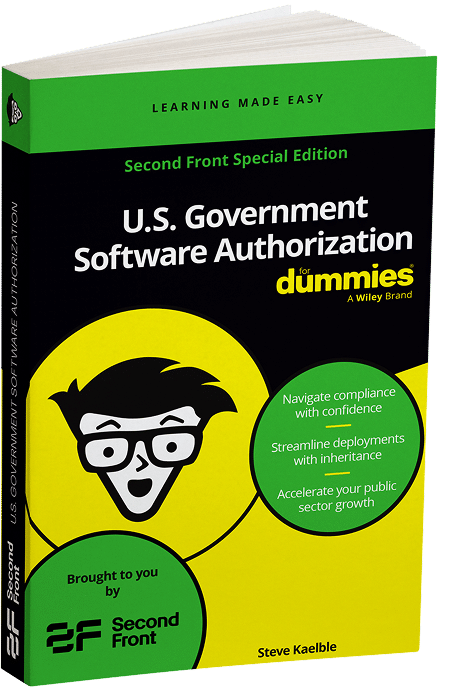
Dummies eBook
U.S. Government Software Authorization for Dummies
Government authorization doesn’t have to be a black box. Learn how it actually works.
Mistake 1: Treating security as a final, static compliance gate
A common and damaging anti-pattern is treating security as a final hurdle to be cleared after a system has been developed.
Why it happens: This approach is a direct legacy of the old RMF and “waterfall” development mindsets. Teams build their capability, get it working, and then “throw it over the wall” to a separate security team to “go get the ATO.” This fosters a focus on creating paper artifacts, such as the System Security Plan (SSP), that satisfy assessors but may not accurately reflect the system’s operational security posture. The goal becomes passing a test, not building a secure system.
The costly consequence: When security is not integrated from the beginning, critical architectural flaws are often discovered late in the formal assessment phase. Imagine spending a year and a million dollars on development, only to have a Security Control Assessor (SCA) find that your data logging architecture doesn’t meet DoD standards. This forces expensive, time-consuming redesigns and creates a debilitating cycle of rework, finger-pointing, and delays. It creates a perverse incentive structure where the goal becomes producing a perfect set of documents rather than engineering a genuinely resilient system.
The solution: A ‘Secure by Design’ philosophy
Organizations must adopt a “Secure by Design” philosophy, often called “shifting left.” Regardless of whether a company ever intends to serve the DoD, integrating security from the first line of code is the most efficient way to build resilient systems.
But many companies aren’t there yet. They may not have the in-house expertise or infrastructure to build secure-by-design environments on their own, but still want to get their software into the hands of mission owners.
That’s where Second Front can help. Our suite of products provides a pre-accredited DevSecOps environment that integrates security from the first line of code. With shared continuous integration /continuous delivery (CI/CD) pipelines, security-hardened base images, and integrated common vulnerabilities and exposures (CVE) remediation, your software is optimized for regulated networks from day one. This shifts security from a final, manual gate to an automated, continuous process. Security isn’t an add-on at the end; it’s the foundation you build upon.
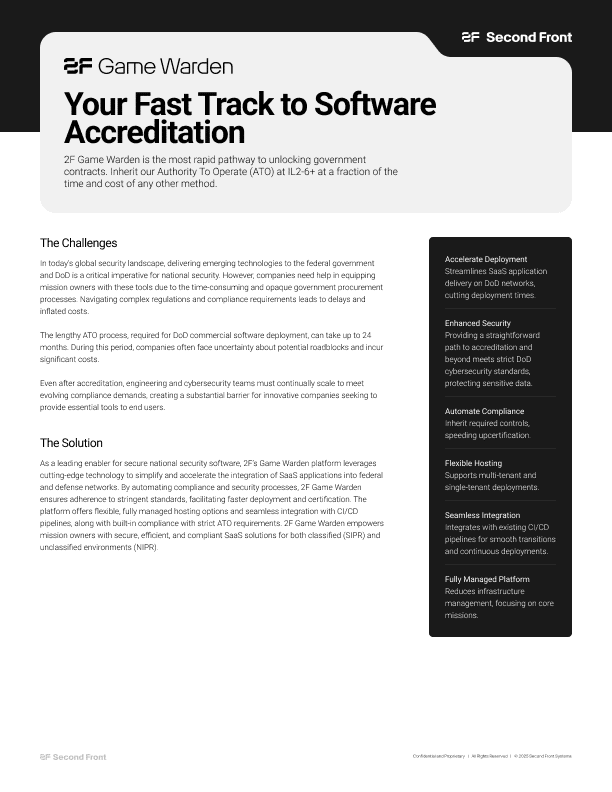
Fast-track your software authorization
Get the 2F Game Warden product overview to see how you can rapidly onboard, host and deploy applications to government networks.
Mistake 2: Failing to plan for ‘Day 2’ operations and continuous monitoring
Many companies focus so intensely on the monumental task of achieving the initial ATO that they fail to adequately plan for what comes next: the continuous monitoring (ConMon) and maintenance required to keep it. This is a critical oversight, as ConMon is one of the ten core tenets of the new CSRMC model.
Why it happens: Teams are exhausted from the ATO marathon. They treat the ATO as the finish line, not the starting line. They staff up for the initial accreditation but don’t budget or plan for the 24/7/365 vigilance required for “Day 2” operations.
The costly consequence: An ATO is not a “fire-and-forget” event; it marks the beginning of an ongoing compliance lifecycle. The CSRMC model mandates that systems are continuously monitored, vulnerabilities are managed, and documentation is kept in a “live” state.
Neglecting this phase means relying on manual, periodic scans and a reactive security approach. This is inefficient, risky, and can jeopardize your ATO status. A system that was compliant on Monday can become non-compliant by Tuesday due to a newly discovered “zero-day” vulnerability. Without automated monitoring, no one knows. This “compliance drift” breaks the AO’s trust and can lead to your ATO being revoked, shutting down your system and your revenue. Furthermore, this ongoing requirement for continuous monitoring significantly increases the Total Cost of Ownership (TCO), as companies must hire and maintain dedicated staff and complex systems to keep their application compliant.
The solution: Architecting for Continuous Monitoring (ConMon)
You must deploy onto an end-to-end software delivery platform that has Day 2 operations and continuous monitoring built into its core.
You have two paths: you can build and manage your own ConMon infrastructure — maintaining 24/7 monitoring, alerting, logging, and compliance reporting internally — or leverage a platform built to handle this heavy lift for you.
A managed platform like Game Warden is purpose-built from the ground up for “Day 2” operations. It provides the necessary infrastructure for real-time logging, monitoring, and alerting, abstracting this immense operational burden from your team. This ensures long-term stability and compliance while dramatically reducing overhead. The result: your engineers stay focused on innovation and feature delivery, not manual compliance upkeep.
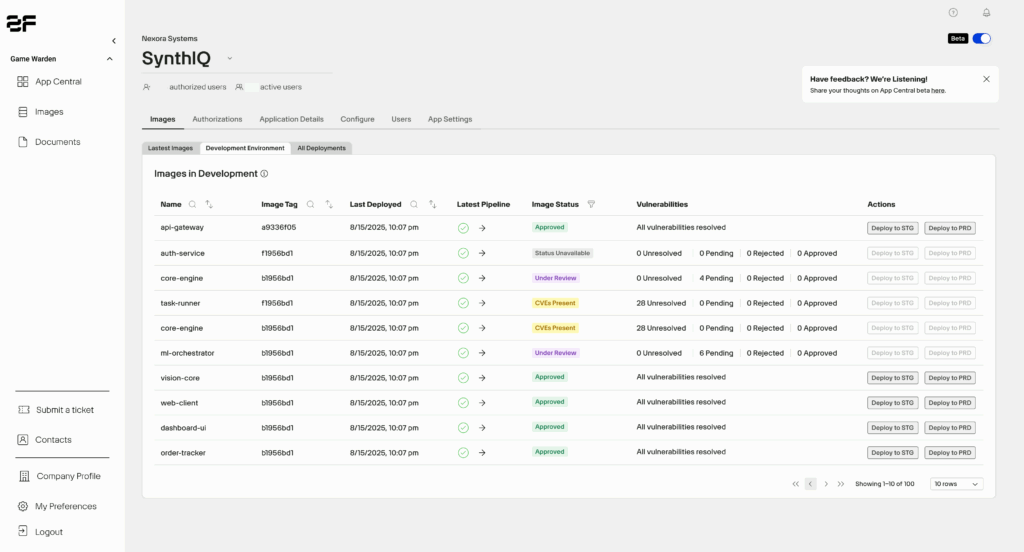
Check out our recent blog on the new App Central beta, delivering next-gen transparency, control, and insight into mission deployments.
Mistake 3: Defining an ambiguous or improperly scoped authorization boundary
A failure to precisely and rigorously define the “authorization boundary” during the system design phase is one of the most consequential early-stage mistakes.
Why it happens: This boundary defines which components, data flows, and interconnections are subject to the ATO assessment. Errors often happen due to simple ignorance of a system’s full dependencies. A developer might use a third-party API for maps, a commercial logging tool, or an open-source library that “phones home” for updates, without realizing they’ve just extended the system’s boundary to include a service that isn’t DoD-approved.
The costly consequence: This is a classic “showstopper.” When this is discovered late in the process, the company must often restart the entire ATO process from the beginning, a setback that causes many to lose their initial government contract. Even if the contract is salvaged, this forces a major, costly re-architecture to rip and replace the non-compliant service. You’ve included a non-compliant component within your boundary, and the AO cannot sign the ATO.
The solution: A tightly scoped, inheritance-driven boundary
The key is to define a clear and narrow authorization boundary from the start—one that includes only what’s essential and leverages inherited controls wherever possible. This minimizes assessment scope, reduces risk, and accelerates your path to authorization.
Game Warden is designed around this principle. When you deploy onto the platform, you operate within a pre-defined, accredited boundary that already accounts for inherited infrastructure and platform controls. Every component and data flow is known and validated, ensuring compliance without limiting flexibility. The result is a faster, more predictable, and scalable path to ATO.
Mistake 4: Neglecting control inheritance
A prevalent and needlessly wasteful mistake is “reinventing the wheel” by attempting to address all 1,000+ NIST 800-53 security controls and enhancements from scratch.
Why it happens: This often occurs when companies fail to leverage the powerful concept of control inheritance. They don’t realize that while the ATOs of Cloud Service Providers (CSPs) like AWS or Azure are not transferable, their FedRAMP-authorized infrastructure satisfies many of the security controls, which the company can then inherit. This failure to build on an accredited foundation, whether it’s an Infrastructure as a Service (IaaS) from a CSP or a Platform as a Service (PaaS) from a FedRAMP High Authorized partner like Second Front, means they are starting from scratch.
The costly consequence: The cost is a massive and unnecessary duplication of effort, time, and money. You are literally spending millions of dollars to solve problems that your providers have already solved and received accreditation. Strategically building on a DoD-accredited cloud platform can immediately reduce the number of applicable security controls by more than half.
The solution: Standing on the shoulders of giants
This is the single biggest accelerator available. You must build on a platform that provides a massive set of inherited security controls. A fully accredited PaaS, like Game Warden, is built on a fully accredited IaaS. It inherits hundreds of controls from the IaaS layer and then satisfies hundreds more at the platform layer. This dramatically reduces your team’s scope of work, allowing you to focus only on the controls relevant to your specific application.
Mistake 5: Relying on manual evidence collection and static documentation
The traditional RMF process is infamous for its reliance on massive, static documents. We’re talking about SSPs that run to hundreds of pages, spreadsheets for tracking Plans of Action & Milestones (POA&Ms), and folders full of manually collected screenshots used as “evidence.”
Why it happens: This is simply “the way it’s always been done.” The legacy RMF process was born in an era of static documentation and waterfall development, not modern, agile software delivery. Many organizations have not updated their processes to comply with 2020s-era cloud technology. This mismatch is where the friction occurs. From a technical perspective, modern tools like APIs alone do not accelerate workflows; it’s only when they are combined with automation and orchestration processes—capabilities that platforms like Game Warden provide—that the evidence collection process can be significantly sped up.
The costly consequence: The direct cost is the significant financial drain of diverting expensive, highly skilled cybersecurity and software engineers to perform clerical work—taking screenshots and copying and pasting log files. The indirect —and arguably greater —cost is the dangerous disconnect that emerges between the compliance documentation and the reality of the running system. That 500-page SSP is obsolete the moment a new line of code is deployed. This breeds a culture of “document-based security” rather than “data-driven security.”
The solution: From static artifacts to a ‘live’ dashboard
This is where modern DevSecOps platforms shine. You must replace these manual processes with automated evidence collection and real-time observability. Game Warden is designed to automate the generation of a compliant Body of Evidence (BOE) package. It translates the real-time state of your running system, your container scans, and your log files into the specific evidence an AO and SCA need to see. The real-time dashboard gives AOs the ongoing confidence they need to authorize your system.
Check out our recent blog on the new App Central beta, delivering next-gen transparency, control, and insight into mission deployments.
The Game Warden App Central Beta image displays simulated data and is for illustrative purposes only.
Mistake 6: Executing inadequate or non-compliant security testing
A critical and frustrating error is misunderstanding the rigor and specificity of DoD security testing requirements.
Why it happens: Teams often confuse commercial best practices with hardened DoD requirements. It’s common for them to perform generic, unauthenticated vulnerability scans, which are insufficient and will be rejected. Both FedRAMP and the DoD mandate that authenticated scans with all plugins enabled be performed on every host, database, and container image within the authorization boundary. Teams may also fail to properly remediate CVEs and fix high-severity findings before submitting their package.
The costly consequence: This is like failing at mile 25 of the marathon. Submitting an ATO package with evidence from improper scans will result in immediate rejection by the assessment team. You will be forced to conduct a complete and correct re-scan of the entire environment, wasting months (or years) of time, effort, and momentum. It’s demoralizing and completely avoidable.
The solution: Integrate compliant testing from Day One
Best practice involves integrating world-class, DoD-compliant security testing directly into the development and deployment lifecycle. Game Warden integrates this into its managed service. We provide continuous, compliant application scanning, and 24/7 incident response as part of the platform. This support comes not only from the Game Warden platform but also from our security experts who guide customers throughout the entire process, helping them identify and fix vulnerabilities before submission. You don’t have to become a cybersecurity expert overnight; you inherit that expertise from the platform, ensuring your system is ready for assessor review from day one.
Mistake 7: Architecting for RMF in a CSRMC world
The ultimate strategic mistake is to default to the legacy RMF paradigm simply because it is familiar, at a time when the DoD actively works to dismantle it. The lack of a transparent, modern compliance process is often what makes the ATO journey so difficult, but aligning with an obsolete model to solve that challenge is a critical error.
Why it happens: This is often not a failure of vision, but a failure of execution. Most teams know they should be building for a continuous, software-defined conflict (the new CSRMC model). The challenge lies in the immense expertise and effort required to achieve it. They focus on periodic, multi-year authorizations and static documentation because that is the only process they have the tools to manage, even as DoD’s senior leadership is pushing relentlessly for continuous authorization and real-time risk management.
The costly consequence: You will be outpaced. Your authorization processes will be demonstrably slower and more expensive than those of your competitors who have embraced platforms built to automate and accelerate this process. While you spend 18 months in meetings to get a static ATO, your competitor will already be deployed, iterating with their end-user, and capturing market share. You will win the compliance battle but lose the business war. While no platform can streamline the entire process overnight, this is the exact challenge Second Front Game Warden is built to solve.
The solution: Aligning with the future, not the past
To remain competitive, organizations must align with the DoD’s modern vision. This is the entire reason Game Warden exists. It is an end-to-end software delivery platform built for DevSecOps and designed for the new paradigm of continuous authorization. It inherently enables companies to deliver capabilities at the speed the mission demands.
The paradigm shift: From legacy RMF to modern CSRMC
The DoD’s vision is clear. The future is not about static, periodic audits; it’s about live, data-driven risk management.
Attribute
Legacy RMF approach
Modern CSRMC approach
Assessment cadence
Periodic: Authorization typically lasts 1-3 years.
Continuous/Real-Time: A “constant ATO posture” is maintained.
Documentation
Static: Hundreds of pages in Word documents and PDFs.
Automated: API calls to live systems and security tools.
Risk posture
Point-in-Time: Reflects the system’s state on the day of the audit.
Constant/Ongoing: Reflects the live, operational risk posture.
Key enabler
Manual Audits: Relies on teams of human assessors.
DevSecOps Pipeline: Relies on an automated software factory.
Core mindset
Compliance-Driven: “Are we compliant with the checklist?”
Resilience-Driven: “Is our system secure right now?”
Read our recent article detailing the CSRMC and how 2F is fully aligned with it.
Conclusion: From a painful obligation to a strategic advantage
The DoD ATO process is transforming—from a slow, paper-driven obligation into a continuous, data-driven model built for modern conflict.
Avoiding these seven pitfalls isn’t just about saving time and money—it’s about aligning with the future. By integrating security into development, automating evidence collection, and architecting for continuous monitoring, organizations can turn compliance into a competitive advantage.Game Warden provides the accredited bridge from commercial innovation to mission impact.
Whether delivering software to the public sector for the first time or needing a hand navigating the complex accreditation process, 2F is your one-stop shop.