TLDR
- The Shift: Federal procurement has moved from “black box” trust to verifiable transparency. OMB Memorandum M-26-05 (Jan 2026) rescinded rigid attestation forms, empowering agencies to demand raw Software Bill of Materials (SBOM) data “upon request.”
- The Risk: Without a machine-readable SBOM, your product represents an unquantifiable risk to agency heads, who now bear organizational liability for security decisions. Egregious security breaches can lead to disqualification from future contracts.
- The Standard: Modern compliance requires automated, deep visibility into software components (provenance, pedigree, integrity) using standards such as CycloneDX and SPDX. Manual spreadsheets are no longer sufficient.
- The Solution: Accredited platforms like Game Warden automate SBOM generation and continuous monitoring, transforming a complex operational burden into a strategic asset that accelerates authorization.
The federal procurement landscape has undergone a seismic transformation between 2021 and 2026, fundamentally altering the calculus for Product Managers (PMs) and Growth leaders seeking government revenue. The definition of a “market-ready” product in the federal sector has expanded far beyond traditional feature sets, pricing models, or even basic security attestations. Today, the price of admission to the Department of Defense (DoD), one of the largest buyers of technology in the world, and civilian agency markets is deep, verifiable, and machine-readable software supply chain transparency.
At the epicenter of this shift is the Software Bill of Materials (SBOM), which is a dynamic, nested inventory of software components that has evolved from a niche technical artifact into a central pillar of national security strategy and federal contracting policy.
As of late January 2026, the regulatory environment governing these requirements has pivoted dramatically. The Office of Management and Budget (OMB), through Memorandum M-26-05, has rescinded the rigid, compliance-heavy attestation forms mandated by the previous administration. While superficial analysis might suggest a relaxation of standards, a rigorous examination of the new “risk-based approach” reveals a more complex and potentially more demanding reality. By eliminating the standardized “check-the-box” forms, the White House has empowered federal agencies to demand raw SBOM data and conduct independent, granular risk assessments.
The burden of proof has shifted from a static signature on a PDF to the continuous provision of real-time supply chain data. This represents a failure of execution for many vendors who lack the infrastructure to support it, but a strategic opportunity for those who do.
This report provides an expert-level analysis of the SBOM ecosystem, specifically tailored for commercial vendors navigating the complexities of winning and maintaining federal business in this volatile era.
Dummies eBook
U.S. Government Software Authorization for Dummies
Government authorization doesn’t have to be a black box. Learn how it actually works.
The Strategic Imperative of Software Transparency
The Evolution of Software Visibility
To understand the criticality of SBOMs in 2026, one must first recognize the fundamental shift in how government buyers view software. For decades, software was purchased as a “black box”, essentially a finished product evaluated on its output and functionality. The internal composition of that software (the proprietary code, third-party libraries, open-source frameworks, and firmware) was invisible to the buyer.
This opacity was accepted as a standard industry practice until the catastrophic supply chain attacks of the early 2020s, most notably the SolarWinds breach and the Log4j vulnerability crisis. These incidents exposed a fatal flaw in the “black box” procurement model: agencies could not defend what they could not see. When a vulnerability was discovered in a ubiquitous component like Log4j, Chief Information Security Officers (CISOs) across the federal government were forced to spend weeks manually discovering affected systems and emailing thousands of vendors to ask, “Are we affected?”
In the modern context, the SBOM is the mechanism of transparency that solves this problem. It transforms software from an opaque product into a transparent asset with a known “ingredients list.” It provides the government with the data necessary to answer critical questions about provenance (origin), pedigree (authorship and version history), and integrity (freedom from tampering).
Defining the Modern SBOM
An SBOM is not merely a static document; it is a formal, machine-readable inventory of software components and their dependencies, along with information about those components and their hierarchical relationships. In the context of high-stakes government contracting, specifically under the 2025 CISA Minimum Elements guidelines, a compliant SBOM must detail the “DNA” of the application.
The “depth” of an SBOM is a critical differentiator. Early SBOMs often listed only top-level dependencies, such as the direct libraries a developer knowingly added. However, modern federal standards require visibility into “transitive dependencies,” i.e., the libraries those libraries rely on. This can result in dependency graphs that go many layers deep. For a Product Manager, this means that “knowing your code” is no longer sufficient; you must know the code that your code consumes.
The “Black Box” Risk in Federal Acquisition
The transition to SBOM mandates is driven by the need for machine-speed visibility. In a contested cyber environment, the U.S. government demands the ability to query its entire software asset inventory for a specific bad hash or vulnerable library instantly.
Agencies are increasingly utilizing automated ingestion tools that consume SBOMs from all vendors and cross-reference them against threat intelligence feeds. If a vendor’s product remains a “black box” because they cannot provide a machine-readable SBOM, that product represents an unquantifiable risk. Under the new risk-based approach of M-26-05, unquantifiable risks are grounds for disqualification.
Strategic Implication: The ability to generate an SBOM is no longer a “back-office” compliance task; it is a front-line sales enabler. It signals to the Contracting Officer and the Authorizing Official (AO) that the vendor is a mature, low-risk partner capable of supporting the agency’s emerging Cybersecurity Risk Management and Compliance (CSRMC) requirements.
The Regulatory Landscape (2021–2026)
The regulatory environment for software supply chain security has been volatile, shifting between rigid mandates and flexible frameworks. Understanding this history is essential for ISVs to counter objections and accurately position their compliance posture.
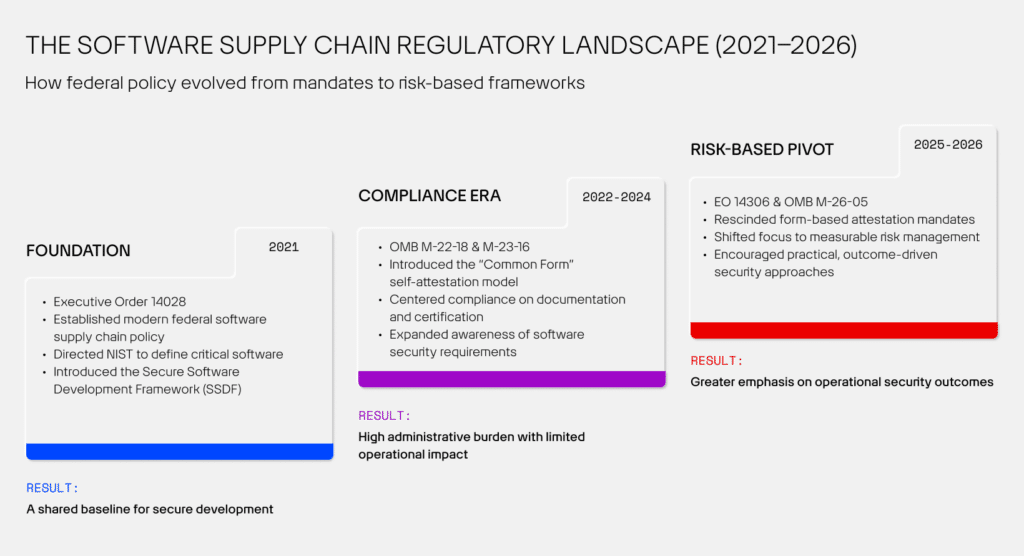
Phase 1: The Foundation (2021)
- Executive Order 14028: Issued in May 2021, this EO was the genesis of modern federal supply chain policy. It directed NIST to define “critical software” and established the initial requirement for SBOMs. Key outputs included NIST SP 800-218 Secure Software Development Framework (SSDF), which became the benchmark for secure development.
Phase 2: The Compliance Era (2022–2024)
- OMB Memoranda M-22-18 and M-23-16: These memos created the “Common Form” era, where compliance meant signing a PDF attesting to conformity with NIST SP 800-218. While it raised awareness, it created a bureaucratic burden without necessarily improving technical defense.
Phase 3: The “Risk-Based” Pivot (2025–2026)
- Executive Order 14306 and OMB Memorandum M-26-05: The regulatory landscape shifted again with the issuance of EO 14306 in June 2025, culminating on January 23, 2026, with OMB Memorandum M-26-05. This memorandum explicitly rescinded the previous “form-based” mandates, declaring them “unproven and burdensome.”
Critical Analysis for Government Contractors:
It is a dangerous misconception to view M-26-05 as a removal of security requirements. The rescission of the form creates a vacuum that is filled by data.
- Liability Shift: Each agency head is now “ultimately responsible” for software security based on a “comprehensive risk assessment.” This places immense pressure on Agency CISOs to be personally convinced of a vendor’s security without the “air cover” of a government-wide form.
- The SBOM Clause: Crucially, the memo empowers agencies to adopt contractual terms requiring a software producer to provide a current SBOM “upon request.”
This creates a fragmented, higher-stakes market. Instead of a single form, vendors may now face disparate, rigorous data requests from every agency they target.
The Department of Defense Divergence
While OMB sets civilian policy, the DoD operates under its own authorities and has pursued aggressive transparency.
- U.S. Army Mandate (Feb 2025): The Army Assistant Secretary for Acquisition, Logistics, and Technology (ASA(ALT)) issued a policy requiring SBOMs for new software contracts. Vendors must provide a new or updated SBOM with each release.
- DoD “Software Fast Track” (SWFT): This evolving initiative accelerates the acquisition of secure software, explicitly prioritizing suppliers that offer usable SBOMs and continuous risk assessments.
Technical Deep Dive for Product Managers
For Product Managers, the SBOM is a technical artifact that must be integrated into the roadmap. Understanding the standards and mechanisms for generating SBOMs is critical to meeting the 2026 “machine-readable” requirements.
Data Standards: The Language of Transparency
The federal government requires SBOMs to be machine-readable to facilitate automated ingestion. Two primary standards have emerged:
- CycloneDX (OWASP): Security-focused, lightweight, and designed for CI/CD generation. It natively supports vulnerability mapping and is increasingly preferred for automated security scanning.
- SPDX (Linux Foundation): Comprehensive and ISO-standardized, often preferred for legal and licensing compliance.
Technical Insight: While both are accepted, CycloneDX has gained significant traction in the DevSecOps community because it was built specifically for the high-velocity use cases of modern software delivery, enabling real-time vulnerability identification and dependency graph management.
The Anatomy of a Compliant SBOM
Under the 2025 CISA Minimum Elements, a compliant SBOM must contain specific data fields for every component:
- Supplier Name: The entity that created the component.
- Component Name & Version: Precise technical identifiers (e.g., log4j-core, 2.14.1).
- Component Hash: A cryptographic hash (SHA-256) to verify integrity.
- Unique Identifier: CPE (Common Platform Enumeration) or PURL (Package URL).
- Relationship: How the component fits into the software hierarchy.
The “Automation” Requirement:
Crucially, CISA guidance explicitly rejects manual SBOM creation. The sheer volume of transitive dependencies makes manual tracking impossible. An SBOM must be generated automatically at build time to be considered accurate.
The “Day 2” Problem and Continuous Monitoring
An SBOM is a snapshot of a specific build at a specific moment. However, the threat landscape is dynamic. A library that is secure today may have a critical vulnerability discovered tomorrow. This is the “Day 2” problem.
The DoD’s shift toward CSRMC requires that SBOMs be treated as living data streams. It is not enough to have an SBOM; that SBOM must be continuously monitored against the National Vulnerability Database (NVD). Failing to plan for this continuous requirement significantly increases the Total Cost of Ownership (TCO), as it demands dedicated staff to manually track and patch emerging threats.
VEX: Solving the “False Positive” Crisis
A major operational challenge is the problem of “false positives.” A scanner might flag a library as vulnerable, but the application might not use the vulnerable function.
- The Solution: VEX (Vulnerability Exploitability eXchange) is a machine-readable “negative security advisory.” It allows a vendor to communicate: “Yes, we contain Component X, but we are NOT AFFECTED by Vulnerability Y because the code path is not reachable.”
Providing VEX documents alongside SBOMs prevents products from being flagged as “high risk” during automated agency scans, maintaining authorization status.
The Business Case for Growth
For companies looking to scale within the U.S. government, the SBOM requirement is often viewed as technical overhead. However, in the post-M-26-05 landscape, it is a strategic asset. The ability to provide deep transparency is a competitive differentiator that can help win business.
Deconstructing the RFP: Where SBOMs Live
To monetize transparency, companies must identify SBOM requirements embedded in Request for Proposals (RFPs).
- Section C (Statement of Work): Look for “Supply Chain Risk Management (SCRM)” or “Vulnerability Management.” Strategy: Influence Section C during the RFI phase to suggest that “automated, machine-readable SBOM delivery” be mandatory, effectively ghosting competitors who rely on manual processes.
- Section L (Instructions): Submit your SBOM generation methodology as part of the technical volume. Explicitly stating, “We generate CycloneDX SBOMs for every build via an accredited DevSecOps pipeline” demonstrates maturity.
- Section M (Evaluation): DoD source selections often include a “Technical Risk” rating. A vendor with opaque supply chains represents High Risk. A vendor with automated SBOMs represents Low Risk.
Go/No-Go Criteria
Supply chain security is increasingly a binary “Go/No-Go” gate. If a solicitation references DoD Instruction 5000.87 (Software Acquisition Pathway) and a vendor cannot demonstrate the ability to provide an SBOM “upon request,” they may be deemed “non-responsible” and excluded from competition.
The ROI of Automation
Manual compliance is a margin killer. Engineers spending hours cataloging libraries for every release creates operational drag and accuracy risk.
- Manual Cost: High engineering hours, high error rate, slow sales velocity (“We’ll get back to you in 2 weeks”).
- Automated Platform: Near-zero marginal cost per SBOM, high accuracy, instant sales velocity (“Here is our live security dashboard”).
The Solution Architecture – Game Warden & Modern DevSecOps
The complexity of the 2026 regulatory environment, managing SBOM standards, VEX, continuous monitoring, and DoD authorization, is often beyond the core competency of commercial software companies. This is where Second Front’s Game Warden serves as a critical enabler.
Accredited PaaS for Government
Game Warden is a fully accredited DevSecOps Platform-as-a-Service (PaaS) specifically engineered to bridge the gap between commercial software and government compliance. Operating across all major cloud providers, it provides a pre-configured hosting environment that meets strict federal security controls.
The primary value proposition is inheritance. Applications deployed on Game Warden inherit the authorization of the underlying platform for a vast majority of controls (physical security, network monitoring, access control), drastically reducing the vendor’s burden.
Automated SBOM Generation
Game Warden automates the SBOM lifecycle, directly addressing the Army and M-26-05 mandates. The platform integrates best-in-class tools like Syft (for generation) and Grype (for scanning) directly into the CI/CD pipeline.
- Process: When a vendor pushes code, Game Warden automatically builds the container, generates a CycloneDX SBOM, scans it for risks, and hardens the container.
- Result: The vendor does not need to buy separate scanners or hire compliance engineers. It is a native feature of the platform.
Continuous Monitoring: Solving the “Day 2” Problem
Game Warden provides the continuous monitoring required for the CSRMC model favored by the DoD. Even if application code doesn’t change, Game Warden re-scans existing SBOMs daily. If a new vulnerability (like a Zero Day) is announced, the platform identifies it instantly across the fleet.
Crucially, CVE remediation is a common failure point for many teams. Game Warden includes support from security experts who guide customers in identifying and fixing vulnerabilities before submission, ensuring that the evidence packages generated by the platform lead to a successful authorization.
Accelerating Time-to-Revenue
The impact of this automation is measurable.
- Case Study: Integrate faced a potential 18-24 month timeline for traditional authorization. By leveraging Game Warden’s automated inheritance and SBOM capabilities, they achieved IL6 authorization (SECRET-level data) in a fraction of the time, saving hundreds of thousands of dollars and paving the way for a $25M Phase III SBIR contract.
- Note on Edge Cases: For critical software that must run disconnected from the cloud or at the tactical edge, 2F offers Frontier, an extension of Game Warden that enables secure deployment while adhering to DoD standards in austere, air-gapped, or on-premise environments.
Strategic Alignment with M-26-05
The rescission of the common attestation form creates a trust gap. Agencies are skeptical. When a vendor states, “We are deployed on Game Warden,” they leverage the DoD’s existing trust in the platform. Game Warden’s DISA Provisional Authorization (PA) acts as a high-trust credential, signaling to the Agency AO that the SBOMs are accurate and the infrastructure is secure. This facilitates reciprocity; while not automatic, the platform’s clear, consistent data significantly speeds up approval.
Conclusion
The federal government has recognized that paper compliance is not security. A signed form does not stop a nation-state actor; deep, data-driven visibility does.
The difficulty of adopting this new model is a failure of execution, not a failure of vision, due to the immense expertise and effort required to achieve it. No platform can streamline the entire process overnight, but Second Front is building Game Warden to solve this exact challenge.
By automating the heavy lifting of compliance, SBOM generation, and continuous monitoring, Game Warden allows commercial vendors to focus on their core mission: building world-class software. In the race to win federal business, it turns the heavy burden of compliance into a strategic advantage.
Ready to automate your software transparency?
Speak with our team about how Game Warden can automate your SBOM generation and accelerate your path to authorization.