With 2F Game Warden for FedRAMP, deliver your cloud service to federal civilian agencies faster—accelerating authorization and opening federal market access.
Whether delivering software to the public sector for the first time or needing a hand navigating the complex accreditation process, 2F is your one-stop shop.
See how Second Front helped Integrate fast-track IL6 accreditation and deploy to a classified environment in under 12 months—paving the way for a $25M Phase III SBIR award.
Top 5 things your Authorizing Official (AO) looks for in an authorization package
2F Team
03.11.2026 / 6 months ago
6 minute read
Share
For commercial software vendors, the Department of War represents one of the largest buyers of technology in the world. However, reaching those end users requires navigating a notoriously complex labyrinth of cybersecurity regulations to achieve an authority to operate (ATO). At the end of this grueling journey sits a single individual who holds the keys to your deployment: the Authorizing Official (AO).
Securing an ATO is not just about checking boxes. It is a formal risk-acceptance decision in which an AO determines whether the system’s mission value outweighs the security risk it introduces. To get a “yes,” you must provide the AO with an unimpeachable case that your software can protect mission data commensurate with its sensitivity.
But what does an AO look for when evaluating an ATO package?
The core difficulty of the modern ATO journey isn’t a lack of controls or requirements, but the challenge of applying the Risk Management Framework (RMF) to rapid, cloud-native development. While RMF remains the de facto standard, many teams struggle with ‘legacy’ execution—relying on manual, static documentation that can’t keep pace with continuous delivery. The goal is not to abandon RMF, but to evolve our execution toward modern, automated compliance standards that satisfy an AO’s need for real-time risk insight.
In this comprehensive guide, we will unpack exactly what goes into an AO decision, the critical elements of a successful ATO decision brief, and the top five things your Authorizing Official needs to see before signing off on your authorization package.
What is an Authorizing Official (AO)?
Before diving into the components of an ATO package, it is critical to understand the mindset of the Authorizing Official. An AO is typically a senior DoD civilian or military officer who is entrusted with the responsibility to accept risk on behalf of the U.S. government.
Because risk can never be entirely eliminated from an information system, the AO’s role is to weigh the operational utility of a software application against its potential residual risks. When an AO signs an ATO, they are personally attesting that the system is secure enough to operate within a specific environment and that the mission needs justify the remaining risks.
To make this determination, the AO relies on an ATO package, a massive body of evidence comprising security documentation, architectural diagrams, and assessment reports. The process often culminates in an ATO decision brief, where the system owner presents the system architecture, risk posture, and remediation plan directly to the AO and supporting security staff.
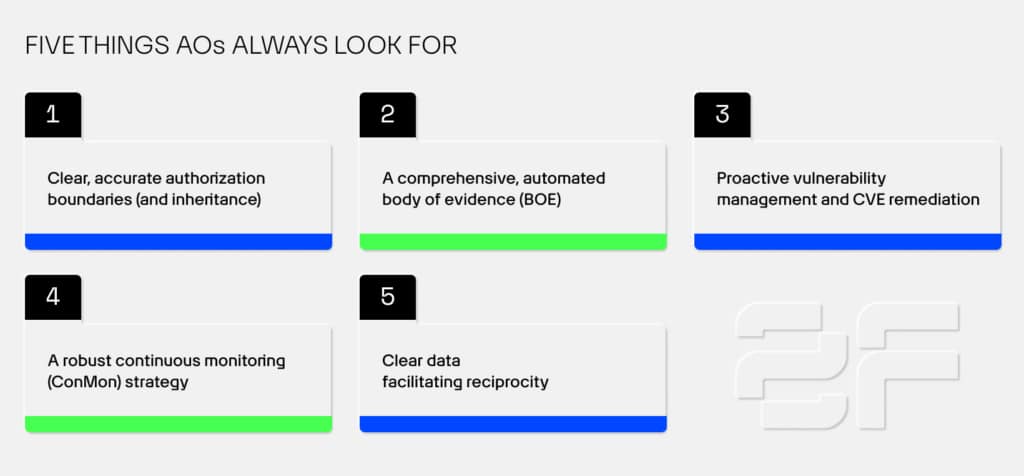
If your ATO package is disorganized, incomplete, or relies on outdated compliance, the AO decision will inevitably be a “no.” In practice, most ATO decision briefs succeed or fail on a small number of issues. Here are five things Authorizing Officials consistently look for when evaluating an authorization package.
1. Clear, accurate authorization boundaries (and inheritance)
The very first thing an AO will look at is your authorization boundary. This boundary explicitly defines which components, services, and data flows are “in scope” for the authorization process and which fall outside it.
In modern cloud-native, microservice-based architectures, drawing a clean boundary is incredibly difficult. Does your application rely on third-party APIs? Does it pull data from an external database? Are you using shared infrastructure? Have those external components been assessed and authorized? The AO needs to know exactly where your responsibility ends and where another entity’s responsibility begins.
If you get this wrong, the rest of your authorization becomes much harder. If an AO determines your boundary is improperly defined, it can trigger major rework of the authorization package and delay your ATO timeline. In some cases, teams must revisit documentation or parts of their architecture, putting contracts and deployment schedules at risk.
The solution: inherited controls
The smartest way to present a clean boundary to an AO is to build on top of a pre-accredited environment. It is important to note that ATOs are not transferable between systems; however, you can inherit the security controls of an accredited solution provider
Second Front is an authorized partner across both the Department of War and the federal civilian market, with authorization pathways that support deployments up to FedRAMP High and DoW environments spanning IL2 through IL6+. By deploying within that established framework, your team can operate inside a pre-authorized boundary designed for regulated government environments, rather than building every control from scratch. That significantly reduces the scope of what your AO needs to evaluate for your specific application and helps streamline the path to authorization.
2. A comprehensive, automated body of evidence (BOE)
An AO decision is only as good as the data supporting it. The ATO package is essentially your system’s resume, and it must contain a complete, hyper-accurate Body of Evidence (BOE).
Historically, building the BOE required thousands of pages of manual documentation, Excel spreadsheets, and static Word documents. AOs despise reviewing manual documentation because it is prone to human error and is usually out-of-date the moment it is printed.
Today, AOs look for evidence that your compliance documentation is generated dynamically and accurately. However, it is a common misconception that simply plugging into a few tools solves this problem. APIs alone do not accelerate workflows. It is the automation and orchestration processes, such as those Game Warden provides, that use APIs to speed up evidence collection and generate a machine-readable, always-accurate BOE.
When your ATO decision brief is backed by an automated BOE, the AO has much greater confidence that the security posture you present matches the actual security posture of the code in production.
Dummies eBook
U.S. Government Software Authorization for Dummies
Government authorization doesn’t have to be a black box. Learn how it actually works.
3. Proactive vulnerability management and CVE remediation
No software is perfectly secure. Authorizing Officials know this. What they want to see is not the absence of vulnerabilities, but a mature, systematic process for identifying, tracking, and fixing them to manage compliance drift
During the ATO decision brief, the AO will closely scrutinize your Plan of Action and Milestones (POA&M). This document tracks your known vulnerabilities and your timeline for resolving them. If your POA&M is overflowing with high-severity Common Vulnerabilities and Exposures (CVEs) with no clear remediation plan, risk acceptance becomes impossible.
In fact, poor CVE remediation is a common failure point for companies attempting to cross the ATO finish line. AOs look for teams that don’t just scan for vulnerabilities, but actively harden their containers and applications before pushing to production.
To overcome this, your ATO package must demonstrate a proactive security posture. This is why 2F partners with Chainguard to provide minimal, secure-by-default container images. By leveraging Chainguard’s minimal, secure-by-default container images, teams can eliminate up to 97% of base vulnerabilities before a scan even occurs. By presenting an AO with a clean, hardened application and a drastically reduced, highly managed POA&M, you make it easy for them to confidently grant ATO approval.
4. A robust continuous monitoring (ConMon) strategy
The traditional view of an ATO is that it is a finish line, a point-in-time audit that you pass once every three years. Modern AOs, however, know that the threat landscape changes daily. They are no longer satisfied with static approvals; they demand to know what happens on “Day 2.”
Across the DoW, there is growing emphasis on continuous monitoring and ongoing risk management. Concepts such as Cybersecurity Risk Management and Compliance (CSRMC) reflect this shift toward greater visibility into a system’s security posture over time, though implementation guidance is still evolving.
Regardless of the framework used, AOs want to see that your team can maintain security after authorization. Continuous monitoring typically includes automated vulnerability scanning, logging, and reporting to ensure the system remains secure long after the initial ATO is granted.
Many commercial companies underestimate the operational burden of this requirement. Without a clear plan for continuous monitoring, the Total Cost of Ownership (TCO) for a government deployment can rise quickly due to the personnel and systems required to maintain 24/7, ongoing compliance.
When reviewing an authorization package, AOs look for evidence that a system can sustain this ongoing security posture. Leveraging a fully managed platform that handles continuous monitoring can demonstrate that the system will remain secure without overwhelming internal engineering teams.
5. Clear data facilitating reciprocity
Finally, Authorizing Officials look for pedigree and precedent. If your software has already been assessed and authorized by another federal agency, an AO can leverage that previous work to accelerate their own ATO decision.
However, it is crucial to understand that reciprocity is not automatic. Just because you have a FedRAMP authorization or a DoD ATO from the Air Force does not mean the Navy will instantly grant you an ATO. Rather, the principle is that one organization should accept another’s due diligence to significantly speed up its own approval process.
To achieve this, the AO must be able to easily review previous assessment data and map it to their mission’s specific risk tolerances, which, for cloud deployments, are strictly governed by the DISA Cloud Computing Security Requirements Guide (CC SRG). Facilitating reciprocity requires clear, consistent data and standardized formats. When your ATO package leverages standardized controls and is hosted on a pre-accredited platform—such as Game Warden, which holds a DISA Provisional Authorization (PA) at Impact Level 5 (IL5)—you give the AO an established baseline they can trust. This empowers them to confidently accept their peers’ due diligence, dramatically shortening your deployment timeline.
How 2F Game Warden helps you win the AO decision
Navigating the expectations of an Authorizing Official is a significant challenge. Modern ATO processes increasingly demand automated evidence, continuous monitoring, and mature DevSecOps practices that many commercial teams were never built to support.
Second Front helps bridge that gap.
Our platform, 2F Game Warden, provides a secure DevSecOps environment designed for government software deployments. By deploying on Game Warden, teams operate within an established authorization framework, inherit robust security controls, and automate the collection of the body of evidence required for an ATO decision.
The result is simple: less time spent navigating compliance mechanics and more time delivering mission software to government users.
If you’re preparing for an ATO decision brief and want to accelerate your path to deployment, we can help.
Whether delivering software to the public sector for the first time or needing a hand navigating the complex accreditation process, 2F is your one-stop shop.