When a mission crosses a border, the technology behind it has to clear more than one set of rules. Data standards, release permissions, export controls, and host-country requirements all change with the partner on the other side.
At the same time, the spending is following. In 2025, NATO allies committed to investing 5% of GDP annually on core defense and defense- and security-related spending by 2035, with up to 1.5% earmarked for areas including protecting critical infrastructure, defending networks, and innovation. Sovereignty is driving commercial spending too: Gartner forecasts worldwide sovereign cloud spending will reach $80 billion in 2026, up 35.6% from 2025. That raises a practical question for any company eyeing allied missions: what does it take to be ready?
At Second Front’s Inside the ATO webinar, four leaders from Sovereign Tech and Allied Scale talked through what it takes to support allied and coalition missions. Cody Barrow, General Manager, EMEA at Second Front, moderated the conversation with:
- COL Arnel David, U.S. Army, Director of Task Force Maven at NATO’s Supreme Headquarters Allied Powers Europe (SHAPE)
- Tony Schwarz, Executive Director, Federal Strategy at Armada, a sovereign edge computing infrastructure company
- Steve Clement, Field CIO at Onebrief, which builds collaborative operational planning tools
- Rob Turner, Senior Vice President, Government at Strider Technologies, a strategic intelligence company
Four lessons stood out. Each is below, or you can watch the full webinar on demand.
1. Sovereignty means control, and the edge is wherever the mission operates
Schwarz defined sovereignty in practical terms: where the data resides, who can access it, and who operates the infrastructure. He pointed to the South China Sea scenario, where cloud access would likely be degraded or denied for extended periods, and asked what a fighting force does when the cloud goes down. That assumption has support in the policy community: a May 2026 CNAS report warns that China could try to cut off Taiwan’s communications and says U.S. and Taiwanese forces must prepare to operate where spectrum-dependent capabilities are severely degraded, if not outright denied.
Clement made the same case from the planning side:
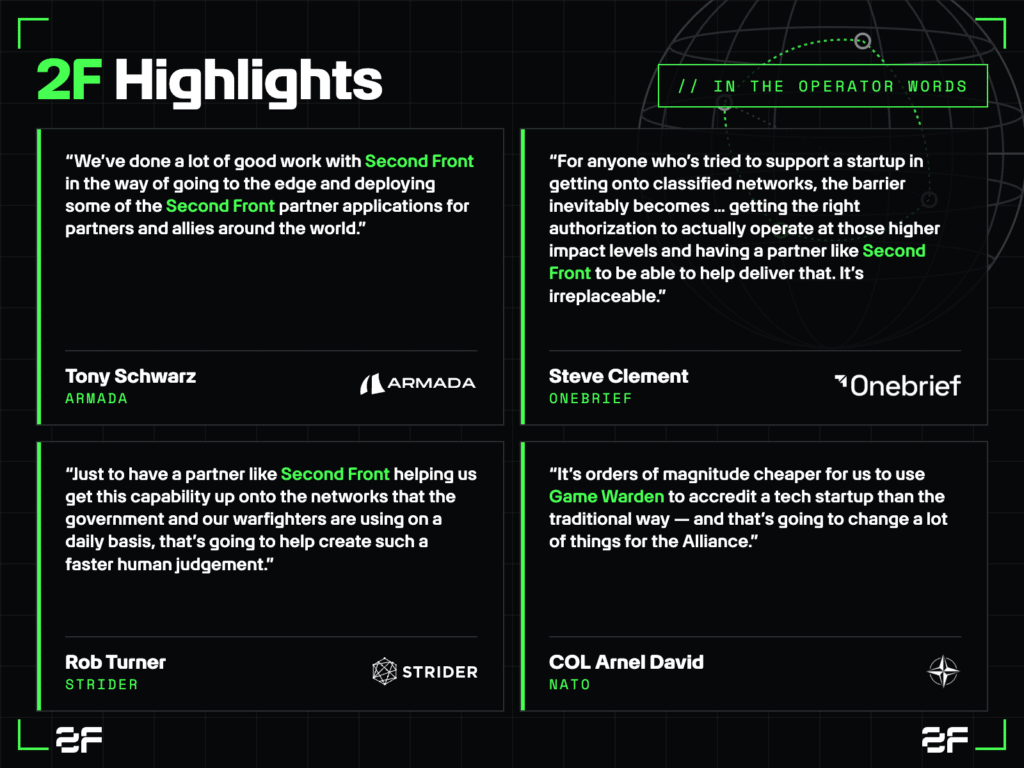
“In large-scale combat operations, we know the adversary is going to try to sever connectivity to cloud-based resources to be able to dominate a tactical edge. And the requirement for collaboration and detailed operational planning does not decrease at all at that tactical edge.”
Steve Clement, Onebrief
NATO’s COL Arnel David pushed back on how loosely the word gets used. For him, it comes down to the ability to defend yourself.
“I think you want … to have battle-winning capability and … your ability to maintain your sovereignty is because you can defend yourself.”
COL Arnel David, Task Force Maven, NATO SHAPE
2. Interoperability starts with policy and data, not just compute
Schwarz said the mission owner or partner decides what runs on the infrastructure and what can be shared. When deploying alongside coalition forces, he said, the approach is to put forward a basic design and then work with each partner to understand their rules and red lines.
“Compute alone does not create interoperability. Nations still need to have compatible data standards, trusted models. We need clear rules governing what can and should be shared and when … Sovereignty and interoperability actually reinforce each other. In my view, a nation can retain control of its raw data and share an authorized alert or an analytical result with a partner when the policy and architecture permit.”
Tony Schwarz, Armada
Turner tied it to the supply chain.
“Sovereignty is actually interoperability, but it’s knowing who owns your supply chain … It’s not about holding it all in. It’s just about having the understanding of who owns everything.”
Rob Turner, Strider Technologies
On nation-state risk, Turner said it comes down to knowing where supply chain, research, and partner risk sits, and whether an adversary has a hidden stake somewhere. On the government side, that means looking at who is recruiting engineers and who is buying into suppliers.
Turner also noted that intelligence built on open-source data carries no classification level, which makes it easy to share with a partner in places where classified material blocks sharing.
AI adds its own friction.
Clement noted that frontier model providers have valid concerns about intellectual property control once models move into air-gapped networks, which is part of what teams are working through to bring AI to the edge. He also said large language models could help with foreign disclosure, imagining an agent trained on security classification guides that moves data much faster than today’s human-centric processes.
3. Build the authorization foundation before the mission needs it
Onebrief and Strider both described authorization as the barrier to getting onto the networks that matter. Turner described what he did when he joined Strider: shop around for the quickest way to get moving on compliance. He described the catch-22 of asking a government customer to be your ATO. Clement framed the same barrier from the startup side.
“For anyone who’s tried to support a startup in getting onto classified networks, the barrier inevitably becomes … getting the right authorization to actually operate at those higher impact levels and having a partner like Second Front to be able to help deliver that. It’s irreplaceable.”
Steve Clement, Onebrief
Turner put the goal in terms of the mission.
“You’ve got to get your stuff where the mission happens … Though all of our information is open source and unclass, we still have to move it to a classified level … we’re up where the warfighter is.”
Rob Turner, Strider Technologies
Wondering how long authorization takes? In a December 2025 survey of 200 Department of War decision makers involved in ATO decisions, respondents said real-world ATO timelines typically run 12 to 18+ months. None said ATOs take under six months, including the 66% who said they use reciprocity. That timeline is the case for starting early.
4. Scaling internationally means repeatable deployments and local partners
Schwarz said scaling at speed means making successful deployments repeatable: reliable production availability, proven configurations, and credible local partners outside the U.S. who can install and sustain the systems, so a small deployment team can pursue every country. Clement said going beyond U.S. borders means approaching each country’s compliance regime on its own terms, often through partners on the ground.
“If anyone’s looking for advice on how to do that scaling internationally: identify the funded problem. Understand who buys and who approves. Think about export requirements early in the game. And obviously negotiate IP and support obligations very carefully when you go overseas to do business with our partners.”
Tony Schwarz, Armada
COL David closed with a warning about the standards themselves.
“You’ve got to think about interoperability from the start … especially if you’re trying to work with NATO … It’s hard. If you look at the standards, it’s like thousands of pages … this is where Second Front is really helpful.”
COL Arnel David, Task Force Maven, NATO SHAPE
Watch the full conversation
The common thread across all four conversations was timing. Start compliance as soon as you can, think about interoperability from the start, and consider export requirements early. Watch the full webinar on demand, request a topic for the next webinar, or talk to Second Front.