TLDR
- The baseline: The Defense Information Systems Agency (DISA) governs cloud security for the Department of Defense through the DoD CC SRG, a framework that layers defense-specific controls on top of civilian FedRAMP baselines.
- The distinction: IL4 protects Controlled Unclassified Information (CUI) using logical separation within commercial cloud environments. IL5 escalates to physically isolated federal community clouds and supports unclassified National Security Systems (NSS).
- The escalation: The transition to NIST 800-53 Rev 5 has added roughly 170 net new controls to the IL5 NSS baseline, a 40% increase in compliance scope.
- The accelerator: Pre-accredited platforms like Game Warden allow commercial vendors to inherit the vast majority of these controls, compressing ATO timelines from years to months.
The strategic context
The Department of Defense is one of the largest buyers of technology in the world. Its accelerating adoption of commercial cloud infrastructure, driven by the need for AI, advanced analytics, and software-defined warfare, has created enormous opportunities for commercial vendors. But opportunity and complexity scale in lockstep.
Integrating commercial software into defense networks expands the attack surface. To govern that risk, DISA established the Cloud Computing Security Requirements Guide (DoD CC SRG), the definitive security architecture for commercial cloud services operating within the Department of Defense Information Network (DoDIN). For any commercial technology company seeking to deliver innovation to the defense market, the DoD CC SRG is both the mandatory gateway and the most formidable compliance challenge they will face.
At the heart of the CC SRG is a tiered system of DISA impact levels (IL2, IL4, IL5, and IL6) that escalate requirements as data sensitivity increases. For vendors dealing with sensitive but unclassified defense data, the critical threshold lies in the distinction between IL4 and IL5. Understanding that distinction requires a clear grasp of FedRAMP, the precise categorization of Controlled Unclassified Information, and the rapidly evolving baselines of NIST.
The foundation: FIPS 199 and FedRAMP
The DoD does not build its cloud security requirements from scratch. It builds on top of civilian federal frameworks.
Federal Information Processing Standard (FIPS) 199 establishes the universal method for categorizing information systems across three security objectives: Confidentiality, Integrity, and Availability. Systems are rated Low, Moderate, or High based on the potential impact of a breach of the data processed on the system. This categorization determines which security controls apply.
FedRAMP operationalizes those standards for commercial cloud computing. It provides a standardized approach to security assessment, authorization, and continuous monitoring for cloud products used by civilian agencies. FedRAMP Moderate covers the majority of civilian deployments. FedRAMP High is reserved for the government’s most sensitive unclassified data, such as critical infrastructure, law enforcement, or healthcare, where a breach could have severe or catastrophic consequences.
Crucially, a 2014 DoD CIO memorandum established FedRAMP as the absolute minimum security baseline for all DoD cloud services. The CC SRG uses FedRAMP Moderate and FedRAMP High as the structural foundation, then layers defense-specific controls on top.
The Architecture of the DoD CC SRG
While FedRAMP provides the necessary foundation for civilian government, the DoD operates in a threat landscape populated by sophisticated, well-funded nation-state actors. Civilian standards alone are insufficient to protect advanced weapon systems logistics, global troop deployments, and defense intelligence operations. The Defense Information Systems Agency addresses this gap through the DoD CC SRG, which applies to both DoD-provided cloud services and those offered by commercial CSPs or defense contractors operating on behalf of the Department.
The current DoD CC SRG evolved from the earlier DoD Cloud Security Model (CSM). The initial iterations of the CSM (Version 1 and Version 2.1) established the initial frameworks for handling public data and early definitions of Controlled Unclassified Information within commercial environments. However, as cloud computing matured from simple infrastructure hosting to complex, software-defined networks and serverless architectures, DISA overhauled the model, completely rescinding the CSM and publishing the comprehensive CC SRG. The CC SRG maps directly to the DoD Risk Management Framework (RMF) and explicitly delineates the specific responsibilities of Cloud Service Providers versus DoD Component Mission Owners.
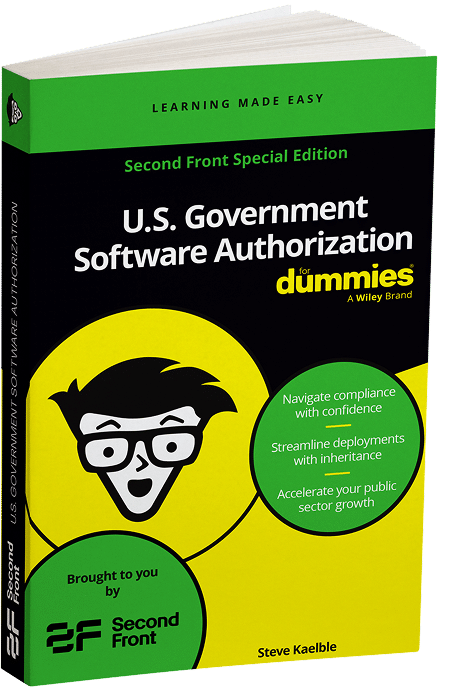
Dummies eBook
U.S. Government Software Authorization for Dummies
Government authorization doesn’t have to be a black box. Learn how it actually works.
Deep dive: Impact Level 4 (IL4)
IL4 is the entry point into sensitive defense operations. It accommodates Controlled Unclassified Information (CUI), non-critical mission data, and export-controlled information. CUI is a broad government-wide designation for information that requires safeguarding but is not formally classified, covering categories from export control and protected health information to law enforcement data and critical infrastructure schematics. CUI replaces the legacy designation “For Official Use Only (FOUO)”.
Baseline and controls
Achieving IL4 requires a FedRAMP Moderate baseline combined with a CUI-specific set of FedRAMP+ controls, though DISA frequently considers the FedRAMP High baseline in practical assessments. The IL4 FedRAMP+ Rev 5 baseline removed 38 outdated controls and added 22 new ones compared to the previous iteration.
Infrastructure
The DoD accepts virtual or logical separation between tenant systems at IL4. A workload can reside on the same physical hypervisor as a civilian workload, provided there is cryptographically provable isolation, dedicated VPCs, precise IAM boundaries, and strong software-defined barriers. The environment is considered a “Limited Public Community.”
Networking
IL4 systems are strictly prohibited from maintaining direct connections to the public internet. All off-premises traffic must route through the DoD’s NIPRNet via a Boundary Cloud Access Point (BCAP), a heavily fortified inspection gateway managed by DISA that provides deep perimeter defense and packet inspection.
Personnel
Access to IL4 environments is restricted to U.S. citizens, U.S. nationals, or U.S. persons. Foreign nationals are unconditionally prohibited from accessing systems processing IL4 data. For global software companies with distributed international teams, this mandate frequently requires creating fully siloed, U.S.-only operational structures.
Deep dive: Impact Level 5 (IL5)
IL5 is the categorization for the DoD’s most sensitive unclassified missions. It supports higher-sensitivity CUI, mission-critical information, and unclassified National Security Systems (NSS). As of late 2025, only roughly 57 organizations held an IL5 PaaS authorization, a measure of the extreme difficulty involved.
The NSS threshold
The critical differentiator between IL4 and IL5 is the inclusion of National Security Systems. An NSS is any information system whose function involves intelligence activities, cryptologic activities, command and control of military forces, or equipment integral to weapons systems. If an information system is officially designated as an NSS by the sponsoring organization, it requires IL5. If it lacks that designation, IL4 remains the authorized level.
Physical separation
This is the requirement that fundamentally breaks standard commercial cloud models. Unlike IL4’s logical isolation, IL5 demands that the underlying physical hypervisors, storage arrays, and network switches be physically severed from non-federal tenants. The environment must operate as a dedicated Federal Government Community Cloud. This forces hyperscale providers to construct entirely separate physical data centers or fenced-off regions within existing facilities.
Personnel and networking
Access at IL5 is restricted strictly to U.S. citizens, eliminating the broader “U.S. persons” allowance at IL4. Personnel must typically hold an ADP-2 clearance with a National Agency Check with Law and Credit (NACLC). All traffic must flow through the NIPRNet via BCAPs. Absolutely no direct internet connectivity is permitted.
The Rev 5 control explosion
The transition to NIST 800-53 Rev 5 has dramatically increased the IL5 compliance burden. For IL5 NSS workloads, DISA removed 47 older controls but added 178 new ones, a roughly 40% net increase. These new controls require sophisticated solutions for phishing-resistant MFA, Zero Trust architectures, behavioral analytics, and granular supply chain provenance tracking. DISA has also removed prior language allowing CSPs to propose equivalent mitigations on a case-by-case basis. The new controls must be implemented precisely.
IL4 vs. IL5: The comparative matrix
| Requirement | IL4 | IL5 |
| Data sensitivity | CUI, non-critical mission data | Higher-sensitivity CUI, unclassified NSS |
| NSS designation | Not supported | Explicitly supported |
| FedRAMP baseline | Moderate (+ IL4 FedRAMP+ controls) | High (+ IL5/NSS FedRAMP+ controls) |
| Infrastructure isolation | Logical/virtual separation | Physical separation required |
| Network routing | NIPRNet via BCAP | NIPRNet via BCAP; no internet connectivity |
| Personnel access | U.S. citizens, nationals, or U.S. persons | U.S. citizens only |
The leap from IL4 to IL5 is not a bureaucratic checkbox. It is a fundamental architectural divergence requiring dedicated hardware, physically walled infrastructure, and the flawless implementation of nearly 200 specialized national security controls.
Commercial friction and the ATO “Valley of Death”
The complexity of the DoD CC SRG creates a massive barrier for commercial vendors. The traditional ATO pathway is characterized by enormous pre-revenue investment, manual documentation processes, and timelines that can stretch 18 to 24 months, all before a single line of production code is deployed on a defense network. (For a breakdown of the most common failure points, read 7 common (and costly) mistakes to avoid in your DoD ATO process.)
This is the cybersecurity “Valley of Death.” The DoD has billions in budget and a desperate need for commercial innovation, but the regulatory friction routinely stalls or bankrupts emerging technology companies before they can deliver value.
The platform approach to accelerating compliance
The solution lies in pre-accredited DevSecOps platforms. By deploying on a specialized Platform as a Service (PaaS), commercial vendors inherit a large share of the required CC SRG controls, shortening the path from code to mission deployment.
Second Front’s Game Warden is built for exactly this challenge. The platform provides a fully managed hosting environment and compliance engine, CI/CD pipelines, database management, continuous monitoring, and real-time observability, engineered specifically to navigate FedRAMP and the DoD CC SRG. By containerizing applications and deploying within Game Warden, vendors avoid building compliant infrastructure from scratch.
The power of IL5 inheritance
Game Warden holds a DISA Provisional Authorization at IL5. When a vendor deploys onto the platform, the application inherits the foundational security controls already validated by DISA, boundary protection, media controls, physical access, continuous monitoring infrastructure, and the expansive NSS FedRAMP+ overlay. The vendor focuses only on the controls specific to their application.
The platform automates the generation of the Body of Evidence (BOE) required by Authorizing Officials, translating the real-time state of running systems into the rigid documentation formats government risk managers expect. The result: ATO timelines compressed from years to months, with operational data showing authorizations achieved in as little as 90 days.
Game Warden was also recognized as the first software platform authorized at IL5 for AWS GovCloud under the Joint Warfighting Cloud Capability (JWCC) contract, providing mission owners with an immediate, pre-authorized procurement pathway.
Conclusion
The regulatory perimeter around defense cloud computing is not softening. The transition to NIST 800-53 Rev 5 and the 40% increase in mandatory controls for National Security Systems signal that barriers to entry are becoming more formidable, not less.
For commercial vendors, attempting to engineer compliance with these baselines independently is a high-risk, low-velocity strategy. The volume of FedRAMP+ controls, combined with the opaque timelines of the traditional ATO process, creates an unsustainable financial burden.
Platforms like Game Warden, armed with DISA Provisional Authorizations at IL5 and integrated into enterprise vehicles like JWCC, provide the bridge over the compliance Valley of Death. By centralizing the compliance burden and allowing commercial software to inherit DoD-approved security controls, they enable technology companies to focus capital and talent on building software, not navigating bureaucracy.
Navigating FedRAMP and the DISA impact levels is no longer merely a legal compliance exercise. It is a strategic engineering challenge that demands platform-driven solutions.
Ready to accelerate your authorization? Speak with our team to learn how Game Warden can compress your path to IL4 or IL5.