With 2F Game Warden for FedRAMP, deliver your cloud service to federal civilian agencies faster—accelerating authorization and opening federal market access.
Whether delivering software to the public sector for the first time or needing a hand navigating the complex accreditation process, 2F is your one-stop shop.
See how Second Front helped Integrate fast-track IL6 accreditation and deploy to a classified environment in under 12 months—paving the way for a $25M Phase III SBIR award.
5 proven strategies to accelerate your FedRAMP timeline
2F Team
12.01.2025 / 10 months ago
9 minute read
Share
TLDR: From “legacy model” bottlenecks to modern marketplace velocity
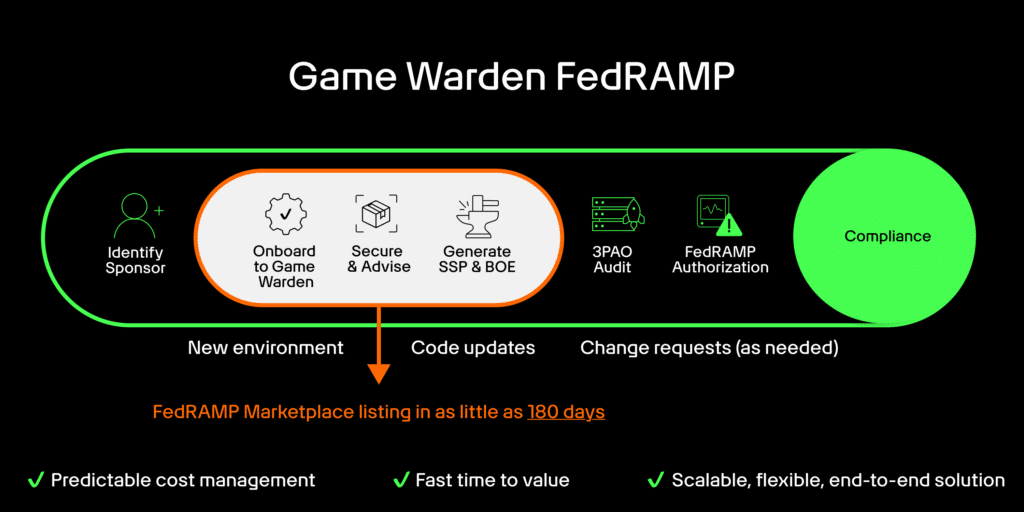
Escape the legacy model: Traditional, manual authorization efforts often take 18–24 months. Modern acceleration strategies can secure a FedRAMP Marketplace listing in as little as 180 days.
Inherit, don’t build: Building a compliant infrastructure from scratch is an anti-pattern. Leveraging a pre-accredited Platform-as-a-Service (PaaS) allows you to inherit controls and focus on your core application.
Marketplace differentiation: Unlike models where the service is embedded within an existing FedRAMP Authorization to Operate (ATO), securing an independent ATO ensures you secure your own listing on the FedRAMP Marketplace, making your solution directly discoverable and allowing you to control the entire sales and security lifecycle.
Know your market: FedCiv and DoD share some baseline security principles, but their authorization paths, sponsorship models, and buying motions are distinct.
Automate evidence: Compliance must be code. Implementing DevSecOps and automated continuous monitoring (ConMon) is the only way to maintain authorization without stalling innovation.
Introduction: The high stakes of federal authorization
For Cloud Service Providers (CSPs), the U.S. federal government represents one of the largest and most stable markets in the world. However, entry into this market is gated by stringent security requirements. For federal civilian agencies, such as the Department of Veterans Affairs (VA) or the Environmental Protection Agency (EPA), the mandatory gateway is the Federal Risk and Authorization Management Program (FedRAMP).
FedRAMP was established in 2011 to standardize security assessment, authorization, and continuous monitoring for cloud products and services. Its core mission is to create a “do once, use many times” framework that fosters trust and consistency across the government.
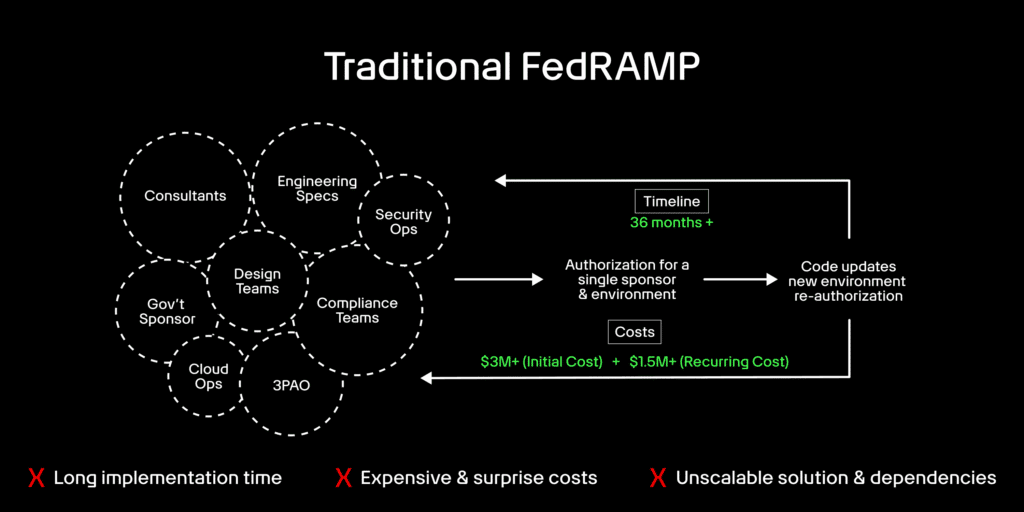
However, under the traditional approach, what we might call the “legacy model” of compliance, the path to FedRAMP Authorization has been a formidable undertaking. Historically, this process has been characterized by manual documentation, static point-in-time audits, and significant resource drain.
The reality for many CSPs operating under this legacy model is that the journey to authorization is a marathon, not a sprint. Industry data suggests that without modern acceleration strategies, the timeline for a successful authorization can range from 12 to 36 months, with costs often scaling into the millions.
STOP: If you need a refresher on the basics, start withFedRAMP® explained — our breakdown of requirements, benefits, and how the process works.
Clarifying the landscape: FedCiv vs. DoD
Before diving into acceleration strategies, it is critical to distinguish between the two primary federal markets, as they operate under different governance structures, terminology, and technical requirements. Conflating these two paths is a common strategic error.
The Federal Civilian Market (FedRAMP): This path applies to civilian agencies. The primary goal here is to obtain FedRAMP authorization and secure a dedicated listing on the FedRAMP Marketplace. This listing acts as a government-wide validation, signaling to agencies that your product meets the rigorous NIST standards for cloud security.
The Department of Defense Market (DoD ATO): This path applies to the military and defense sectors. The goal here is to achieve an Authority to Operate (ATO). The DoD classifies data sensitivity using Impact Levels (IL2, IL4, IL5, IL6).
Both paths rely on controls derived from NIST 800-53, and while there may be overlap between the control baselines, the authorization process and sponsorship requirements are distinct.
Note: This guide focuses primarily on strategies to accelerate the FedRAMP journey for the civilian market. If you’re interested in understanding the DoD process, here are a few helpful links:
Given the high stakes, the ability to accelerate the FedRAMP timeline is more than a matter of convenience; it is a critical business imperative. Every month spent in the “pre-authorization” phase is a month of lost revenue and missed contract opportunities.
The following five strategies constitute a modern playbook designed to move beyond the legacy model. By implementing these proven approaches, a CSP can transform the compliance journey from a daunting hurdle into a manageable, strategic initiative that significantly shortens the time to the FedRAMP Marketplace.
Strategy 1: Front-load the journey with a meticulous pre-authorization phase
The single most significant cause of delay, budget overruns, and stalled progress in the FedRAMP process is insufficient preparation. In the legacy model, organizations often rushed into the formal assessment phase only to discover fundamental architectural gaps, such as the lack of FIPS-validated encryption or improper boundary definitions, that required months of costly re-architecting.
A disproportionate investment of time and resources in the pre-authorization phase yields exponential returns in terms of reduced timeline. This “front-loaded” approach lays a stable foundation for the entire journey.
The strategic value of “FedRAMP Ready”
While some CSPs attempt to go straight for a full authorization, the “FedRAMP Ready” designation is a powerful strategic milestone. Achieving this status requires compliance with a subset of FedRAMP controls and a Readiness Assessment conducted by an accredited Third-Party Assessment Organization (3PAO).
This assessment functions as a formal gap analysis, validating your system’s capability to meet FedRAMP requirements. A successful Readiness Assessment Report (RAR) allows your company to be listed as “FedRAMP Ready” on the official Marketplace.
For a CSP without an existing agency sponsor, this designation is a vital business development tool. It signals to potential agency sponsors that you are a low-risk partner who has already validated your core security architecture. This credibility can drastically shorten the “Partnership Establishment” phase, making it easier to find the agency backing required for full authorization.
A practical readiness framework
To prevent delays, CSPs should conduct a thorough internal review against these key pillars before engaging a 3PAO:
1. Boundary definition
The challenge: One of the most common points of failure is an ill-defined authorization boundary. You must precisely identify where federal data flows, where it is stored, and every external system that connects to it.
The fix: Create detailed data flow diagrams early. Ensure you are not inadvertently pulling non-compliant corporate resources into the rigorous FedRAMP boundary (“scope creep”).
2. Governance & resource allocation
The challenge: Underestimating the effort. FedRAMP is not just an IT project; it requires legal, HR, and operational input.
The fix: Secure executive buy-in for a multi-year program. Assemble a cross-functional team that includes engineering, security, and compliance stakeholders.
3. Technical “showstoppers”
The challenge: Discovering technical non-compliance late in the game.
The fix: Address the “Big Three” immediately:
FIPS 140-2/3 Requirements: Ensure all encryption modules (data in transit and at rest) are FIPS-validated.
Multi-Factor Authentication (MFA): MFA must be enforced for all privileged and non-privileged access within the boundary.
Federal Mandates: Ensure compliance with specific mandates like DNS/DNSSec and IPv6 requirements.
Strategy 2: Build on a compliant foundation by inheriting controls
Attempting to build a FedRAMP-compliant environment from the ground up on bare-metal infrastructure is an increasingly inefficient legacy approach. The fastest, most reliable path to compliance is to inherit controls by building your Cloud Service Offering (CSO) upon a specialized, pre-authorized PaaS foundation.
The mechanics of inheritance
Control inheritance is a core mechanism of the NIST Risk Management Framework. It allows a CSP to leverage the existing authorization of an underlying provider to satisfy a large number of security controls.
When you build on a purpose-built platform like Second Front’s Game Warden, you are effectively “standing on the shoulders” of its existing authorization. Instead of implementing, documenting, and testing hundreds of controls related to physical security, network architecture, and operating system hardening, you inherit them.
Result: You can focus almost exclusively on the “customer responsibility” portion of the controls, specifically those related to your application layer. This massively reduces the documentation burden and engineering effort.
The “dedicated listing” advantage
It is vital to understand how you enter the Marketplace. Some FedRAMP providers suggest “folding” your application into another company’s existing authorization via a Significant Change Request/Notification (SCR/N). While this may seem like a shortcut, it often comes with a significant trade-off: you lose your brand identity on the Marketplace and may be contractually locked into the host’s ecosystem.
The superior strategy is to utilize a platform that supports a dedicated listing.
Your brand: With Game Warden, you obtain your own listing on the FedRAMP Marketplace. You are the vendor of record.
Marketplace velocity: This approach is designed for speed. By leveraging the Game Warden platform, CSPs can achieve an “in process” listing on the FedRAMP Marketplace in as little as 180 days.
In Process status: Gaining “in process” status is a critical revenue milestone. It signals to the federal government that you have a confirmed agency sponsor and a 3PAO engaged, effectively opening the door for procurement while the final authorization steps are completed.
Aligning with market needs: FedRAMP High vs. DoD
When selecting a foundation, ensure it aligns with your target market’s data sensitivity.
FedRAMP High: Game Warden offers a FedRAMP High authorization. This is the standard for civilian agencies, allowing you to handle highly sensitive unclassified data (e.g., law enforcement, healthcare, financial). Inheriting from a high baseline positions you to serve the broadest possible range of civilian customers.
DoD Impact Levels: If you also plan to pursue the Defense market, ensure the platform meets the requirements for the DoD Impact Levels (the sensitivity of the data you’re handling determines the impact level). While distinct from FedRAMP, utilizing a platform like Game Warden that supports both allows you to pursue a DoD ATO and a FedRAMP authorization simultaneously without rebuilding your stack.
Strategy 3: Embed compliance into engineering DNA with DevSecOps
In the legacy model, compliance was often a “bolt-on” activity performed by a separate team at the end of the development cycle. This leads to friction, delays, and “drift” where the actual system diverges from its documentation. To accelerate authorization, compliance must be integrated directly into the software development lifecycle (SDLC) through DevSecOps.
Compliance-as-Code
Modern acceleration relies on “Compliance-as-Code” shifting security definitions from static Word documents into machine-readable code.
Infrastructure as Code (IaC): Tools like Helm allow you to define your cloud environment in code. You can write templates that are compliant by design (e.g., ensuring all storage buckets are encrypted and private). This prevents manual configuration errors.
Policy as Code: You can implement automated guardrails that prevent non-compliant code from ever reaching production. If a developer accidentally tries to open a firewall port to the public internet, the platform automatically blocks the deployment.
Automating evidence collection
One of the most time-consuming aspects of FedRAMP is the need to provide evidence for hundreds of controls. The traditional method involves taking screenshots and manually filling out spreadsheets, a process prone to human error and “assessor fatigue.”
In a DevSecOps model, evidence is an automated byproduct of the engineering process.
Continuous Artifacts: Vulnerability scanners, container security tools, and SIEMs generate logs and reports with every build.
Audit-Ready: When an auditor asks, “How do you manage vulnerabilities?”, you don’t have to scramble for screenshots. You can point to the automated pipeline reports that are generated, timestamped, and stored every time you deploy.
This automation not only speeds up the initial assessment but is absolutely critical for the continuous monitoring phase that follows authorization.
Strategy 4: Streamline the audit through partnership
The FedRAMP process involves a complex ecosystem of stakeholders, most notably the Third-Party Assessment Organization (3PAO). In the past, the relationship between a CSP and their auditor was sometimes viewed as adversarial. A modern acceleration strategy reframes this into a collaborative partnership.
The 3PAO ecosystem
Your 3PAO is an independent, accredited auditor responsible for validating your security posture. You cannot get authorized without them. The key to acceleration is to make their job as efficient as possible.
The “Known-Good” advantage
When you build on a platform like Game Warden, you are presenting the 3PAO with a “known-good” foundation.
Reduced Complexity: Because the underlying platform is already authorized, the 3PAO does not need to spend weeks auditing the base infrastructure, networking, and orchestration layers. They can focus their time and energy on the delta and on your specific application and configuration.
Standardized Artifacts: Experienced 3PAOs appreciate standardized documentation and evidence. When they encounter a platform they recognize, the audit process moves significantly faster because there is less ambiguity.
Collaborative execution
Strategy 4 is about leveraging this ecosystem. By working with Second Front and our 3PAO partners, you create a streamlined workflow. The 3PAO audits the application, Second Front provides the platform evidence, and you focus on your software. This collaborative triad reduces friction, minimizes misinterpretation of controls, and ultimately compresses the timeline between the “Ready,” “In Process,” and “Authorized” milestones.
Strategy 5: Architect for longevity with a proactive continuous monitoring (ConMon) program
A common misconception is that the work ends when the authorization is granted. In reality, continuous monitoring (ConMon) is the operational state of being FedRAMP authorized and mitigates the risk of drift from an authorized baseline. If you do not plan for this phase from day one, you risk losing your authorization or stalling your product roadmap.
Shifting ConMon left
The FedRAMP framework requires that your ConMon strategy be fully defined in your initial System Security Plan (SSP). Agencies need to know how you will maintain security before they grant you authority.
The Requirement: You must provide monthly vulnerability scans, updated Plans of Action and Milestones (POA&M), and annual assessments.
The Strategy: Architect your environment so that these outputs are automatic. If your team has to manually run scans and generate reports every month, they will have no time for feature development.
Accelerating future innovation
The biggest hidden cost of the legacy model is the inability to update software. Once authorized, any “significant change” (e.g., adding a new microservice or changing a database) requires a Significant Change Request (SCR), which must be reviewed and approved by the government. In manual environments, this review can take months, freezing your product in time.
However, when ConMon is automated, you can accelerate this review process.
Data-Driven Trust: Because you have automated scanning and logging (Strategy 3), you can instantly provide the agency with data proving that your new feature is secure.
Rapid SCRs: A proactive ConMon program allows you to submit robust evidence packages along with your change requests, giving Authorizing Officials the confidence to approve updates quickly.
By investing in automated ConMon early, you are not just checking a compliance box; you are buying future agility, ensuring that your federal customers always have access to the latest version of your product.
Conclusion: The new standard for federal market entry
FedRAMP may be more than a decade old, but the playbook for getting authorized is changing. The new standard is built on inheritance, automation, and trusted platforms like Game Warden that eliminate the friction baked into the legacy model.
Follow these five strategies, and you shift from surviving the process to accelerating through it:
Go “FedRAMP Ready” the right way.
Inherit a FedRAMP High foundation with a dedicated Marketplace listing.
Turn compliance into code.
Give 3PAOs a known-good stack to audit.
Automate ConMon so you can keep shipping.
Do this, and the timeline reflects the pace of modern software — with the potential to reach an “In Process” listing in as little as 180 days and grow quickly across the federal civilian market.
Whether delivering software to the public sector for the first time or needing a hand navigating the complex accreditation process, 2F is your one-stop shop.