With 2F Game Warden for FedRAMP, deliver your cloud service to federal civilian agencies faster—accelerating authorization and opening federal market access.
Whether delivering software to the public sector for the first time or needing a hand navigating the complex accreditation process, 2F is your one-stop shop.
See how Second Front helped Integrate fast-track IL6 accreditation and deploy to a classified environment in under 12 months—paving the way for a $25M Phase III SBIR award.
Where DoD ATOs go wrong: key technical pitfalls to watch for
Securing an Authority to Operate (ATO) is the single most critical step for any software company aiming to serve the defense market, but for many engineering teams and CTOs, the process feels like a black box.
2F Team
03.06.2026 / 7 months ago
5 minute read
Share
Navigating the technicalities of Department of Defense compliance
The path to authorization is often blocked not by the quality of the software, but by specific, avoidable technical missteps. An ATO is not just a certification; it is a formal declaration by an Authorizing Official (AO) that the risk of operating your system is acceptable. (For a deep dive into the basics, read our DoD ATO Explained guide.)
However, when technical documentation fails to reflect reality, or when security controls are misunderstood, that risk becomes unacceptable, and the process stalls. To help you navigate this gauntlet, we’ve broken down the technical failures that most often derail ATO timelines and how to fix them.
What causes a DoD ATO failure?
DoD ATOs typically stall due to three technical failures: incomplete System Security Plans (SSP), failure to inherit NIST 800-53 controls, and a lack of automated continuous monitoring. These gaps create “compliance drift,” preventing the AO from accepting the risk required to let the system go live.
The Common Technical Failures Matrix (NIST 800-53)
Understanding the specific mapping between common errors and the NIST controls they violate is the first step toward remediation.
The Pitfall
The NIST Control
The Technical Fix
Static POA&Ms
CA-7 (Continuous Monitoring)
Integrate ticketing systems (e.g., Jira) with OSCAL-native platforms for real-time tracking of vulnerabilities.
The “Frankenstein” SSP
PL-2 (System Security Plan)
Stop writing Word docs. Generate your Body of Evidence (BOE) automatically using “compliance-as-code.”
Undefined Boundary
AC-2 / SC-7 (Boundary Protection)
Consume a pre-defined, accredited boundary (like a PaaS) instead of trying to secure every API and external service yourself.
Aging Vulnerabilities
RA-5 (Vulnerability Scanning)
Implement automated scanning and CVE remediation workflows to fix high-severity findings within mandated timelines.
A Deep Dive: The costliest technical failures
These are the three specific areas where technical debt transforms into financial loss, stalling deployments and draining engineering resources.
Pitfall #1: The “Frankenstein” System Security Plan (SSP)
The System Security Plan (SSP) is the cornerstone of your Body of Evidence (BOE). In the “obsolete model” of compliance, this is often a 500+ page static document cobbled together from various templates, spreadsheets, and manual inputs.
The technical failure here is treating the SSP as a static artifact rather than a living representation of your system. A manual SSP is obsolete the moment a new line of code is deployed. If your documentation says you are encrypting data at rest, but your latest container config drift says otherwise, you have a “dangerous disconnect” between compliance and reality.
The Fix: You need a clear distinction between Inherited Controls (handled by your platform/infrastructure), Shared Controls (managed jointly), and Customer Controls (your responsibility). By leveraging an accredited platform, you can inherit the vast majority of these controls, leaving your SSP focused only on what matters: your application. Game Warden replaces manual screenshotting and document creation with automated evidence collection. The platform continuously gathers data from the runtime environment, container scans, and logs, translating this real-time state into the specific evidence required for a compliant Body of Evidence (BOE). Instead of treating the SSP as a static Word document, Game Warden treats compliance artifacts as code, generating documentation from the actual system configuration to eliminate the “drift” that leads to rejection.
Pitfall #2: Ignoring the POA&M (Plan of Action and Milestones)
A POA&M (Plan of Action and Milestones) is not just a bug tracker; it is a formal, legal commitment to the government. A common technical failure is allowing “aging vulnerabilities” to pile up in the POA&M without a credible remediation path.
When an AO reviews a package, they are looking for “compliance drift.” If your POA&M shows critical vulnerabilities that have been open for 90+ days without action, trust is broken. This failure to plan for the “Day 2” reality of continuous monitoring significantly increases the Total Cost of Ownership (TCO), as you are forced to hire dedicated staff just to manage the spreadsheet churn.
The Fix: ConMon is one of the ten core tenets of the new CSRMC (Cybersecurity Risk Management and Compliance) model. You must automate the population and updating of your POA&M through integrated scanning tools that feed directly into your compliance dashboard. Continuous monitoring is a core feature of the Game Warden platform, not an afterthought. It provides the necessary infrastructure for real-time logging, alerting, and vulnerability scanning as a managed service. The platform’s real-time dashboard gives AOs visibility into the system’s security posture, proving that the system remains secure after the initial authorization. By integrating scanning tools directly into the compliance workflow, Game Warden automates the population and updating of the POA&M, preventing the “aging vulnerabilities” issue where critical findings languish on a spreadsheet.
Teams often confuse commercial best practices with hardened DoD requirements. A frequent point of failure is submitting a package full of unmitigated Common Vulnerabilities and Exposures (CVEs).
Best practice involves integrating world-class, DoD-compliant security testing directly into the development lifecycle. However, simply running a scan isn’t enough. Teams must perform CVE remediation and fix high-severity findings before submission.
The Fix: This support comes not only from automated tools but also from security experts who guide customers throughout the entire process, helping them identify and fix vulnerabilities before they become showstoppers. Without a clean scan and a remediation strategy, your ATO application is dead on arrival. Game Warden provides access to pre-hardened, secure container images with near-zero CVEs, allowing developers to build on a secure foundation from the start. The platform integrates compliant security testing into the CI/CD pipeline, giving developers immediate feedback on vulnerabilities so they can fix high-severity findings before submission. Beyond tools, Second Front provides security experts who guide customers through the remediation process, helping interpret scan results and prioritize fixes to ensure the final package is “clean.”
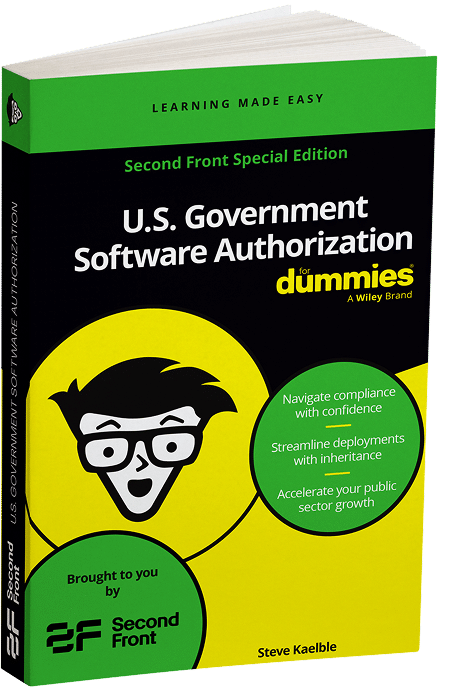
Dummies eBook
U.S. Government Software Authorization for Dummies
Government authorization doesn’t have to be a black box. Learn how it actually works.
The ultimate strategic mistake is attempting to address all 1,000+ NIST 800-53 security controls from scratch, essentially “reinventing the wheel.”
The challenge lies in the “immense expertise and effort required” to achieve the new model of compliance. This is often not a failure of vision, but a “failure of execution.” Building your own platform requires documenting hundreds of controls, managing the authorization boundary, and ensuring 24/7 continuous monitoring.
The smarter path is to stand on the shoulders of giants. ATOs aren’t transferable, but the DoD’s Risk Management Framework allows formal control inheritance when your system is deployed on top of an already authorized environment. Instead of rebuilding and re-documenting controls that have already been assessed, you can inherit them within your system boundary, subject to Authorizing Official approval.
By deploying onto a pre-accredited PaaS like Game Warden, which holds DoD Impact Level authorizations and runs on DoD-authorized IaaS such as AWS GovCloud, customers inherit controls from both the infrastructure and platform layers. That significantly reduces the number of controls the software vendor must implement and defend themselves, while providing a clearly defined authorization boundary that aligns with AO expectations.
This approach avoids the most severe outcome: defining an ambiguous boundary that forces you to restart the entire ATO process, potentially causing you to lose your initial government contract or forcing a costly system re-architecture. By deploying onto Game Warden, customers inherit a pre-defined and accredited authorization boundary, removing the ambiguity of defining it from scratch and ensuring the SSP’s scope aligns with AO expectations.
Conclusion
The lack of a clear, modern compliance process is often what makes the ATO journey so difficult. But by avoiding these technical pitfalls, manual SSPs, neglected POA&Ms, and ignored inheritance, you can turn a compliance burden into a competitive accelerator.
While no platform can streamline the entire process overnight, this is the exact challenge Second Front has built Game Warden to solve. By combining automated evidence collection, massive control inheritance, and built-in continuous monitoring, Game Warden transforms the ATO process from a manual, document-heavy burden into an automated workflow that aligns with the DoD’s modern cybersecurity standards.
Whether delivering software to the public sector for the first time or needing a hand navigating the complex accreditation process, 2F is your one-stop shop.