Bringing commercial software into a government environment is not just a procurement decision—it’s an authorization challenge. The wrong vendor choice can introduce delays, rework, and additional scrutiny that slow or derail your path to an Authority to Operate (ATO).
When evaluating which commercial software providers to bring into your agency’s environment, the stakes are high. Finding the right capability is only the first step. The real test is whether that vendor can successfully navigate the authorization process and get that capability into the hands of mission owners.
Selecting the right FedRAMP authorized vendor or ensuring your commercial software providers are hosted on a pre-accredited Platform-as-a-Service (PaaS) is one of the most strategic decisions an agency can make to reduce deployment friction.
If you’re new to U.S. Government software authorization, it’s important to understand how these frameworks impact your evaluation. This article focuses on FedRAMP—the baseline most civilian government cloud evaluations start from and the foundation for assessing whether a vendor can realistically achieve an ATO in your environment.
If you are evaluating solutions for Department of War (DoW) environments, additional requirements will apply. We recommend reviewing the resources below for a deeper understanding, then returning to this checklist to evaluate vendors through the lens of ATO readiness:
- DoD Authority to Operate (ATO) explained
- FedRAMP® explained: requirements, benefits, and the path to ATO
- Understanding DoD cloud Impact Levels (IL2–IL6): A complete guide
FedRAMP Insights
Ready to ignite your FedRAMP Journey?
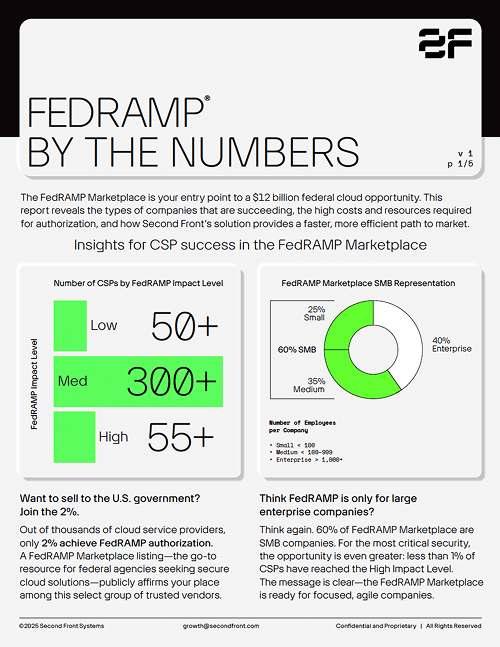
Unlock exclusive access to our FedRAMP By the Numbers Infographic—your front-row pass to a $12 billion federal cloud market opportunity!
The modern compliance challenge: evaluating commercial vendors
As a government buyer, your job is not just to select the best software—it’s to select a vendor that has a proven track record of deploying authorized software to the government.
The difficulty is that the ATO process was not designed for modern, cloud-native software. While the Risk Management Framework (RMF) remains the standard, applying traditional documentation-heavy approaches to dynamic, continuously deployed systems creates friction, delays, and unnecessary complexity.
For commercial vendors, bridging modern DevSecOps practices with federal security requirements is not just a technical challenge—it’s an execution challenge. Many vendors understand the requirements but struggle to operationalize them in a way that meets the expectations of Authorizing Officials (AOs).
As a result, the burden shifts to you as the buyer to evaluate whether a vendor’s architecture, processes, and supporting infrastructure are capable of withstanding that scrutiny.
Use the checklist below to assess whether the vendors you’re considering are positioned to achieve and maintain an ATO in a modern federal environment.
Your evaluation checklist for a FedRAMP CSP
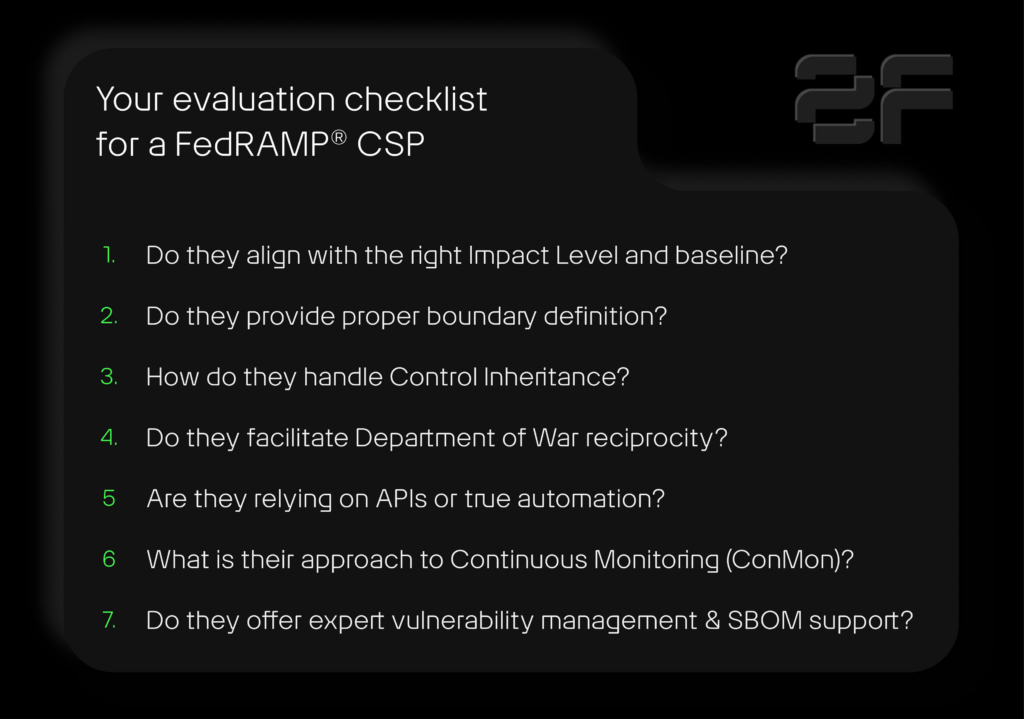
1. Do they align with the right Impact Level and baseline? A vendor claiming to offer “government-grade security” is providing a meaningless marketing platitude; you must definitively verify the explicit authorization baseline the vendor has achieved. Federal information systems are categorized based on the potential impact should data be compromised.
Most commercial SaaS applications handling non-classified federal data require a FedRAMP Moderate CSP. However, for systems handling highly sensitive civilian data, a FedRAMP High authorized vendor is an absolute requirement. Furthermore, if the software will be utilized within the Department of Defense, you must verify that the vendor aligns with the strict categorizations outlined by the Defense Information Systems Agency (DISA).
2. Do they provide proper boundary definition? The authorization boundary is the foundational blueprint of the compliance package; it explicitly defines exactly what components, services, infrastructure, and data flows are “in scope” for the authorization.
If you get this wrong, everything downstream becomes more difficult. An unclear or poorly defined authorization boundary can slow down reviews, create back-and-forth with assessors, and introduce rework across your FedRAMP process. These issues show up early and often translate into lost time, added complexity, and rework that compounds throughout the authorization process. In some cases, teams may need to revisit earlier architectural decisions to align with how the system is ultimately evaluated.
When evaluating vendors, look for those that operate within a pre-defined, accredited environment rather than requiring you to define and defend an authorization boundary from scratch.
3. How do they handle Control Inheritance? In modern, cloud-native environments, drawing a clean boundary and securing every component is an incredibly difficult engineering feat. It is vital to understand that ATOs are not transferable. Context counts. You cannot simply buy a compliance certification that works across all environments and all use cases.
However, organizations can inherit the security controls that have been satisfied by a CSP’s FedRAMP-authorized infrastructure. When evaluating your vendor’s architecture, look for solutions hosted by a FedRAMP High Authorized partner that provides PaaS, such as Second Front and its Game Warden platform. By building on Game Warden, the application inherits the authorization of the underlying platform for the vast majority of physical, environmental, and foundational technical security controls, drastically reducing the compliance workload your agency must audit.
4. Do they facilitate Department of War reciprocity? While FedRAMP is designed for civilian agencies, securing a FedRAMP authorization is frequently used as a strategic bridge to a Department of War ATO. But reciprocity is not automatic. The intention is that one organization should accept another’s due diligence to significantly speed up its own approval.
A mature vendor will excel at facilitating reciprocity by providing clear, consistent data formatted to the rigorous standards of the DISA Cloud Computing Security Requirements Guide (CC SRG) and NIST 800-53. When a vendor’s ATO package leverages standardized controls and is hosted on a pre-accredited platform, they give your Authorizing Official an established baseline they can immediately trust.
5. Are they relying on APIs or true automation? Under modernized federal frameworks, manual compliance is becoming obsolete. Many vendors claim to automate compliance by offering APIs. But APIs alone do not accelerate workflows. It is the automation and orchestration processes, such as those Second Front’s Game Warden provides, that use APIs to speed up evidence collection.
To ensure rapid evaluation by your security team, the vendor should automatically generate and format their Body of Evidence (BOE) into machine-readable files, replacing the archaic, manually crafted System Security Plan (SSP).
6. What is their approach to Continuous Monitoring (ConMon)? The authorization process doesn’t end the day the system goes live. Failing to plan for continuous monitoring significantly increases the Total Cost of Ownership (TCO) due to the need for dedicated staff and complex systems.
You must ensure the vendor has continuous monitoring, including automated vulnerability scanning, centralized audit logging, and real-time incident response, baked into their accredited environment from Day 1.
7. Do they offer expert vulnerability management & SBOM support? Authorizing Officials do not look for the total absence of vulnerabilities; they look for a mature, automated process for identifying and rapidly remediating them.
While many look for a FedRAMP-certified vendor, the correct federal terminology is “Authorized,” and maintaining that authorization requires rigorous Day 2 operations. True platforms offer comprehensive CVE solutions, including support from security experts who guide customers in identifying and fixing vulnerabilities before submission.
Accelerate secure procurement
Navigating the government compliance gauntlet to deliver modern capabilities requires more than just buying software; it demands evaluating the strategic infrastructure on which software is built. The rules of federal cloud acquisition demand dynamic, continuous security enablers capable of operating at the speed of modern commercial innovation.
While no platform can streamline the entire process overnight, Second Front has built Game Warden to solve this exact challenge. By leveraging a pre-accredited PaaS, commercial vendors can provide government buyers with clear, automated evidence, allowing mission owners to focus on deploying mission-critical software while we handle the heavy lifting of government compliance.