For commercial software vendors entering the federal market, the question of whether to pursue FedRAMP, a Department of Defense Impact Level authorization, or some combination of both is one of the most consequential decisions on the product roadmap. It dictates which buyers you can reach, the architecture you have to build toward, and the timeline before any federal revenue lands.
The FedRAMP vs DoD IL decision is too often treated as a purely technical choice when it is really a strategic one. The frameworks are not interchangeable, but they are not entirely separate either. They sit in a layered relationship where civilian authorization sets a baseline and Department of Defense authorization extends that baseline upward. Vendors who understand that relationship can plan a coherent multi-year authorization path. Vendors who delay early architectural commitments lock themselves out of the higher tiers later.
What follows is a strategic breakdown of the relationship between FedRAMP and the DoD Cloud Computing Security Requirements Guide (CC SRG), with particular attention to the mechanics of FedRAMP equivalence, the structural gap between FedRAMP High vs IL5, and the decision logic that should drive your authorization roadmap and GTM strategy.
In this article, we’ll use the long-standing FedRAMP terminology of Low, Moderate and High, while noting that FedRAMP has recently changed the categories. “FedRAMP Authorization” is now called “FedRAMP Certification,” and Impact Levels have been replaced with Classes A-D for package specifications. Beginning in January 2027, “Low”, “Moderate”, and “High” Impact Levels will be removed and full transition to the class structure will take effect.
- Class A (Pilot): Replaces “FedRAMP Ready” and is a new entry point for testing and piloting new cloud services in government environments.
- Class B (Low): Replaces “Li-SaaS” and “Low” impact levels, suitable for low-security-risk services.
- Class C (Moderate): Replaces the “Moderate” impact level, aimed at systems holding Controlled Unclassified Information (CUI).
- Class D (High): Replaces the “High” impact level, required for systems handling highly sensitive data.
The relationship between FedRAMP and the DoD CC SRG
A common framing presents FedRAMP and the DoD CC SRG as parallel, competing tracks. That framing is misleading. The relationship is hierarchical, not parallel.
FedRAMP is a civilian program, established in 2011, that standardizes cloud security authorization across federal agencies. It exists to prevent the same product from being assessed from scratch every time a new agency wants to buy it. FedRAMP categorizes systems as Low, Moderate, or High based on the impact a breach would have on agency operations.
The DoD CC SRG, published by the Defense Information Systems Agency (DISA), takes FedRAMP as its starting point and layers defense-specific controls on top. A 2014 DoD CIO memorandum established FedRAMP as the absolute minimum security baseline for all DoD cloud services. The CC SRG never replaces FedRAMP; it extends it.
That extension is what produces the DISA IL levels. IL2 sits at the bottom and IL6 sits at the top, with IL4 and IL5 in between. As data sensitivity climbs, the CC SRG bolts on additional controls, infrastructure isolation requirements, and personnel restrictions drawn from CNSSI 1253 and Appendix D of the SRG.
The practical implication for vendors is significant. If you already hold a FedRAMP authorization, you are not starting over to pursue a DoD IL deployment. You are extending what you have. Whether that extension is small or substantial depends entirely on which Impact Level you are targeting.
The four active DoD Impact Levels
DISA currently maintains four active Impact Levels: IL2, IL4, IL5, and IL6. Earlier iterations of IL1 and IL3 have been discontinued or merged into other levels.
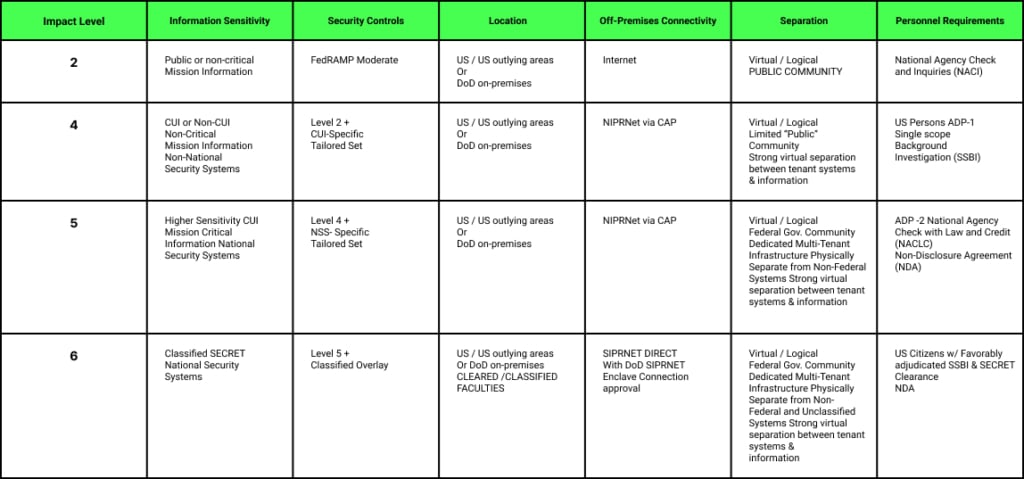
IL2 handles publicly releasable and non-critical mission information. Standard internet connectivity is permitted. Personnel only require a basic National Agency Check. From a security architecture standpoint, IL2 is functionally equivalent to FedRAMP Moderate with the DoD nameplate applied.
IL4 is where Controlled Unclassified Information (CUI) enters the picture. Logical separation between tenants is acceptable, traffic must route through the Non-Secure Internet Protocol Router Network (NIPRNet) via a Boundary Cloud Access Point, and access is restricted to U.S. persons.
IL5 introduces unclassified National Security Systems (NSS). Logical separation is no longer sufficient; physical separation of hypervisors, storage, and networking is mandatory. Personnel access narrows to U.S. citizens only. (For a complete technical breakdown of how IL4 and IL5 differ at the controls and infrastructure level, read our companion article, Achieving DoD CC SRG compliance: navigating FedRAMP and DISA Impact Levels (IL4 vs. IL5).)
IL6 is the highest category covered by the DISA CC SRG. It is reserved for information classified up to SECRET. Infrastructure must be wholly dedicated, physically isolated from every commercial and lower-tier government environment, and connected exclusively via SIPRNet, the DoD’s encrypted classified network. Personnel accessing IL6 data or systems must hold active SECRET clearances. Facilities must hold corresponding physical clearances. IL6 is not an extension of an existing commercial offering; it is a separate operational reality, and the volume of vendors who reach it remains small.
The two tiers that receive less attention in most analyses are IL2 and IL6, and they warrant understanding for opposite reasons. IL2 is easy to underestimate because of how cleanly it slots into existing FedRAMP work. IL6 is easy to misjudge because the leap from IL5 is structural, not incremental.
The mechanics of FedRAMP equivalence
The single most important concept for vendors weighing FedRAMP vs DoD IL is FedRAMP equivalence, which is the formal recognition by DISA that certain civilian FedRAMP authorizations satisfy specific portions of the CC SRG without redundant assessment.
Equivalence is strongest at the bottom of the framework and weakest at the top.
IL2 corresponds directly to FedRAMP Moderate. DISA recognizes full reciprocity between the two. A FedRAMP Moderate Authority to Operate (ATO) positions you for IL2 workloads with no additional DoD-specific controls or secondary assessment. This is the cleanest reciprocity in the framework and one of the strongest reasons FedRAMP Moderate is often the right first authorization to pursue, even for vendors whose long-term target is the defense market.
IL4 builds on FedRAMP Moderate, with caveats. IL4 requires the FedRAMP Moderate baseline plus a CUI-specific set of FedRAMP+ controls. DISA frequently considers FedRAMP High in practical assessments. Vendors entering with FedRAMP High already in hand are a meaningful step closer to IL4, primarily by clearing General Readiness Requirements and security clearance policy reviews. Mission Owners retain the authority to require additional overlays from the Committee for National Security Systems Instruction 1253 based on their specific threat models.
IL5 and IL6 require FedRAMP High as a floor. A FedRAMP Moderate baseline does not get you to IL5. The minimum foundation is FedRAMP High plus the FedRAMP+ overlay specific to that Impact Level. If the system supports a National Security System, which is common at IL5 and built into the definition of IL6, the volume of additional controls expands substantially.
The control deltas tell the story. The IL4 FedRAMP+ Rev 5 baseline added 22 controls and removed 38. IL5 added 21 and removed 47. But IL5 NSS workloads bring in 178 additional controls on top of FedRAMP High, and IL6 NSS environments require 209 additional controls beyond FedRAMP High. These additions touch identity management, personnel security, termination protocols, supply chain provenance, and physical environmental safeguards.
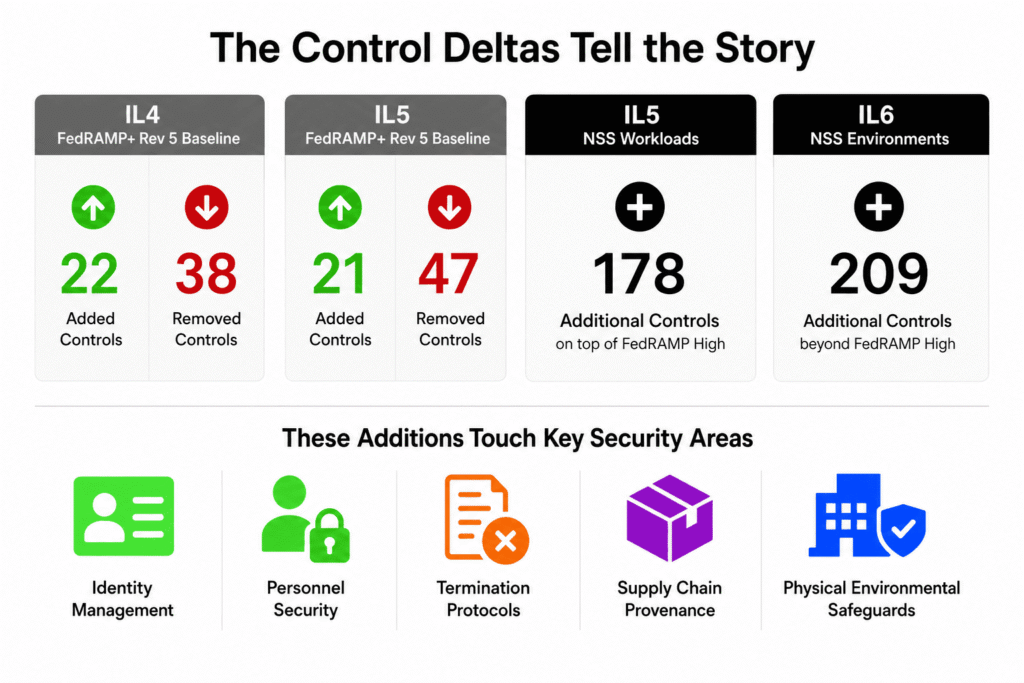
The practical takeaway is that FedRAMP equivalence is genuinely useful at IL2, partially helpful at IL4, and increasingly limited at IL5 and IL6. Reciprocity is a starting line, not a finish line.
FedRAMP High vs IL5: a critical distinction
Vendors frequently treat FedRAMP High and IL5 as roughly equivalent because both occupy the highest tier of their respective frameworks. They are not equivalent, and the gap between them is the single most consequential gap in federal cloud compliance.
FedRAMP High is the strongest civilian baseline. It protects highly sensitive unclassified information across critical infrastructure, financial systems, healthcare, and federal law enforcement. Its threat model is criminal actors, ransomware operators, and opportunistic intruders.
IL5’s threat model is fundamentally different. It assumes sophisticated, well-funded nation-state adversaries actively targeting the system. The data IL5 protects (unclassified NSS, mission-critical operational intelligence, weapons logistics) is exactly the data those adversaries are most motivated to obtain. Three structural differences flow from that distinction.
The Risk Management Framework governs IL5. FedRAMP is a standardized civilian authorization program. IL5 sits inside the DoD Risk Management Framework (RMF), which forces Authorizing Officials to weigh risk in terms of impact on military missions and national security, not just civilian agency operations. This changes which trade-offs are acceptable and which are not.
Personnel access narrows to U.S. citizens. FedRAMP High does not restrict administrator citizenship. IL5 requires that anyone with privileged access to the environment, including system administrators, site reliability engineers, and support staff, be a verified U.S. citizen. For SaaS vendors with distributed international engineering teams, this often means building a separate, U.S.-only operational structure to maintain compliance.
Physical separation replaces logical separation. FedRAMP High permits multi-tenant infrastructure. IL5 mandates that the underlying hypervisors, storage arrays, and network switches be physically severed from non-federal tenants. This forces hyperscalers into separate physical regions and forces SaaS vendors to reckon with which providers can meet that requirement at all.
Dummies eBook
U.S. Government Software Authorization for Dummies
Government authorization doesn’t have to be a black box. Learn how it actually works.
Choosing FedRAMP or DoD: a strategic framework
The strategic question is not which framework is more rigorous. It is which buyers you intend to serve and which data your software is going to process. Two questions narrow the decision quickly.
Who is your target customer? If your buyers are civilian agencies such as Veterans Affairs, GSA, the Department of Energy, or other civilian regulators, FedRAMP Moderate covers most use cases and FedRAMP High covers the rest. You may never need a DoD IL authorization at all. If your buyers sit inside the DoD or the intelligence community, FedRAMP alone is insufficient at every tier above IL2, and you need to plan for a CC SRG path or a classified deployment from the outset.
What data does your software process? A general-purpose enterprise SaaS handling administrative data has fundamentally different requirements than a platform processing logistics for tactical units. The moment CUI enters your system boundary, IL4 becomes the floor. The moment NSS data enters, you are in IL5 territory. Classify your data early, using FIPS 199 and CNSSI 1253, before you architect.
The trap to avoid is architectural myopia: building exclusively for the easiest tier and assuming you can retrofit later. Migrating from a multi-tenant commercial environment to an IL5-compliant GovCloud region is expensive, slow, and disruptive. Vendors who win deals contingent on IL5 capability they do not yet have often spend 18 to 24 months in retrofit purgatory while the contract sits unfilled.
The smarter approach for vendors with dual-use technology is to design a unified baseline capable of satisfying both FedRAMP High and IL5 overlays from the start. That does not mean pursuing both authorizations on day one. It means architecting so that pursuing the DoD path later does not require ripping the foundation out.
Compressing the authorization timeline
Whichever path you choose, the traditional authorization process is slow. Manual FedRAMP and DoD IL authorizations historically run 18 to 24 months and cost millions of dollars before any production traffic flows. This is why pre-accredited DevSecOps platforms have become the dominant accelerator for vendors entering both markets.
Second Front built Game Warden to absorb most of that compliance burden at the platform layer. Game Warden holds authorizations spanning FedRAMP High and DoD Impact Levels 2 through 6, and was the first software platform authorized at IL5 for AWS GovCloud under the Joint Warfighting Cloud Capability (JWCC) contract. Vendors who containerize their applications and deploy onto Game Warden inherit the platform’s underlying controls, including boundary protection, continuous monitoring, physical access, and the NSS FedRAMP+ overlay. They focus their own work on the application-specific controls that actually differentiate their product.
The result is that ATO timelines compress from years to months, and the strategic decision about FedRAMP vs DoD IL becomes a question of business strategy rather than a question of whether you can survive the authorization process at all.
FedRAMP and the DoD Impact Levels are not competing standards. They form a layered system, with FedRAMP setting the civilian baseline and the CC SRG extending that baseline upward into defense and national security territory. Understanding where FedRAMP equivalence applies, where it stops, and where the structural gaps sit between FedRAMP High and IL5 is what separates vendors who plan their authorization roadmap from vendors who get blindsided by it.
The right first move for vendors early in this journey isn’t to pick a single tier and sprint at it. The right first move is to classify your data, identify the highest tier your roadmap will eventually require, and design backward from there. The vendors who do that consistently outpace the ones who do not.
Ready to map your authorization path? Speak with our team to learn how Game Warden can compress your route to FedRAMP.