With 2F Game Warden for FedRAMP, deliver your cloud service to federal civilian agencies faster—accelerating authorization and opening federal market access.
Whether delivering software to the public sector for the first time or needing a hand navigating the complex accreditation process, 2F is your one-stop shop.
See how Second Front helped Integrate fast-track IL6 accreditation and deploy to a classified environment in under 12 months—paving the way for a $25M Phase III SBIR award.
How to Maximize Control Inheritance: A Guide to Reducing Your NIST 800-53 Workload
The essential guide to the standards, steps, and strategies required to secure federal information systems and accelerate authorization.
2F Team
01.08.2026 / 2 months ago
12 minute read
Share
TLDR: Compliance that actually scales
The Problem: The vertical “full stack” approach to NIST compliance is economically unviable, forcing software teams to secure physical infrastructure instead of focusing on their code.
The Solution: Control Inheritance allows System Owners to consume security controls already validated by a Common Control Provider (CCP) or accredited PaaS, drastically reducing the “surface area” of an audit.
The Mechanism: By distinguishing between Common, System-Specific, and Hybrid controls during RMF mapping, organizations can avoid duplicating work.
The Result: Leveraging pre-accredited platforms like Game Warden can reduce the compliance burden by more than 60%, accelerating time-to-market.
The complexity of modern cybersecurity compliance, particularly within the United States federal government and the Department of Defense (aka Department of War), has reached a critical inflection point. As one of the largest buyers of technology in the world, the DoD requires rigorous adherence to security standards that often clash with the rapid pace of modern software development. Organizations tasked with securing information systems are often overwhelmed by the sheer volume of requirements mandated by the National Institute of Standards and Technology (NIST).
Specifically, NIST Special Publication (SP) 800-53, which catalogs security and privacy controls for federal information systems, can present a baseline of hundreds of discrete controls for systems categorized at the Moderate or High impact levels (IL). Managing this workload through a traditional, siloed approach means that every system owner attempts to implement, document, and assess every control individually, and is no longer operationally or economically viable. It is the result of a lack of a clear, modern compliance process, leading teams to default to an obsolete model.
The NIST Risk Management Framework (NIST RMF), codified in NIST 800-37, provides the lifecycle methodology for managing these controls. However, the RMF is frequently misunderstood as a paperwork generation exercise rather than a risk management process. This misunderstanding leads to the “Valley of Death,” where critical software capabilities sit in development hell for 18 to 24 months awaiting an Authority to Operate (ATO), or authorization.
The consequences of failing to navigate this landscape are severe. The most critical risk is not merely a delay; it is that the company must often restart the entire authorization process if the boundary is defined incorrectly, causing many to lose their initial government contract. Secondarily, the financial implications are staggering; obtaining a single ATO can cost upwards of $3 million in labor and tooling, locking up resources that should be directed toward mission innovation.
The solution to this bottleneck lies in a rigorous, strategic application of Control Inheritance. Inheritance is the mechanism by which an Information System Owner (ISO) leverages the security capabilities of a Common Control Provider (CCP). By consuming controls that have already been implemented and authorized by a trusted provider, such as a cloud hyperscaler or a specialized, accredited Platform-as-a-Service (PaaS) like Second Front Systems’ Game Warden, an organization can drastically reduce its NIST 800-53 workload.
The compliance workload crisis
The workload associated with NIST RMF compliance is driven by the granularity of NIST 800-53 controls and enhancements. A single control, such as AC-2 Account Management, is not a singular task. It involves policy definition, procedural documentation, technical implementation across multiple components (databases, operating systems, applications), and rigorous assessment against multiple Control Correlation Identifiers (CCIs). This density of requirements can paralyze a small engineering team that is unprepared for the administrative burden.
In a non-inherited model, a system owner is responsible for the entire “stack.” They must secure the physical facility (gates, guards, guns), the environmental systems (HVAC, power), the networking hardware, the virtualization layer, the operating system, and finally, the application. This vertical integration of responsibility is inefficient and outdated. It forces application developers to become experts in physical security and HVAC maintenance, which are domains irrelevant to their core competency.
Control inheritance breaks this vertical stack. It allows the system owner to “answer once, use many.” If a data center has already proven to the government that its physical security meets NIST standards, every system residing in that data center should inherit that finding. By utilizing an accredited platform, companies can focus on their software, rather than the infrastructure beneath it.
The efficiency gains can be expressed conceptually:
Where the InheritanceFactor represents the percentage of controls provided by the underlying infrastructure. If a CCP supports 500 systems, a single assessment of the common controls saves 500 individual assessments. This mathematical reality is why the DoD and Federal agencies are pushing heavily toward cloud adoption and platform-based authorizations.
Defining the scope: NIST 800-37, 800-53, and 800-53B
To navigate this guide effectively, one must understand the relationship between the framework and the catalog. These documents form the triad of federal compliance, and confusing them often leads to errors in the early stages of the RMF lifecycle.
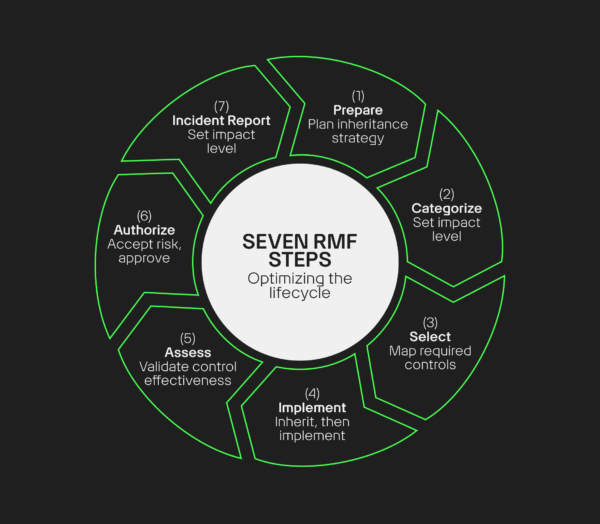
NIST SP 800-37 (The RMF): This is the process. It describes the seven steps of the RMF lifecycle: Prepare, Categorize, Select, Implement, Assess, Authorize, and Monitor. It is the “how” of risk management. It dictates the workflow and the roles required to move a system from concept to authorization.
NIST SP 800-53 (The Catalog): This is the content. It lists the specific security and privacy controls (e.g., AC-1, SI-4) that must be selected and implemented during the RMF steps. It serves as a dictionary of security capabilities.
NIST SP 800-53B (Control Baselines): Often overlooked, this document defines the specific baselines (Low, Moderate, High) for federal information systems. Technical architects must reference 800-53B to ensure they are selecting the correct starting set of controls before inheritance is even applied. This report focuses on optimizing the RMF lifecycle by maximizing the inheritance of NIST 800-53 controls.
The 7 RMF steps: optimizing the lifecycle
The NIST Risk Management Framework is designed to be a holistic, iterative process. While often viewed as a linear progression, it is cyclic, with continuous monitoring feeding back into categorization and selection. Optimizing for inheritance requires specific actions at each of the seven RMF steps.
Step 0: Prepare
The Prepare step is arguably the most critical for inheritance, yet it is often rushed. This step involves activities at the organization level and the system level to establish a context for risk management. If the strategy for inheritance isn’t defined here, the subsequent steps will be exponentially more difficult.
At the Organization Level, the organization must identify and authorize Common Control Providers (CCPs). The organization’s Risk Executive must define the “Common Control Catalog.” At the System Level, the ISO must conduct a feasibility study to identify potential hosting partners. This is where the decision to use a specific Cloud Service Provider (CSP) or PaaS is made.
Strategic Selection is vital here. Choosing a provider is not just a technical decision; it is a compliance strategy. The ISO should request the provider’s Customer Responsibility Matrix (CRM), sometimes referred to as the Shared Responsibility Matrix, during the Prepare phase to estimate the residual workload. If a provider cannot produce a clear CRM or an inheritance guide, the “cost” of compliance will be significantly higher.
Step 1: Categorize
In the Categorize step, the system is assigned a security category based on the potential impact of a loss of Confidentiality, Integrity, or Availability (CIA). This categorization sets the bar for the rest of the process.
The system’s categorization determines the control baseline (Low, Moderate, High). The ISO must ensure the chosen CCP is authorized at a level equal to or higher than the system. This leads to the “Mismatch Trap.” If a system is categorized as High but is hosted on a Moderate infrastructure, inheritance is broken. The ISO cannot inherit a “High” level of protection from a “Moderate” control. This forces the ISO to implement compensating controls or overlay additional security measures, negating the benefits of inheritance.
Step 2: Select
The Select step involves choosing the NIST 800-53 controls that apply to the system and tailoring them. This is the phase where controls are explicitly designated as Common, Hybrid, or System-Specific.
During these RMF steps, specifically the Select phase, precise RMF mapping is required to link system-specific controls to the inherited baseline. The ISO should begin with the provider’s inheritance guide. Instead of asking “What controls do I need?”, the question becomes “What controls are already done?”. The ISO applies the baseline and then systematically marks controls as “Common” based on the provider’s documentation. Utilizing overlays (e.g., Privacy, Classified) can refine the baseline further. Inherited controls often satisfy large swaths of these overlays, particularly in the Physical and Environmental (PE) and Media Protection (MP) families.
Step 3: Implement
The Implement step is where the reduction in workload becomes tangible. Implementation changes from an engineering challenge to an administrative task for a large portion of the control set.
For Inherited Controls, implementation is documentation. The ISO records the inheritance relationship (e.g., “Inherited from AWS GovCloud, Authorization Date MM/DD/YYYY”). For Hybrid Controls, the ISO implements only the customer portion defined in the CRM and captures evidence of compliance to support the assessment. For System-Specific Controls, the ISO bears full responsibility. By maximizing the first two categories, the engineering team can focus entirely on these controls, which usually relate to application logic and unique business rules.
Step 4: Assess
In the Assess step, the Security Control Assessor (SCA) verifies that controls are effective. Inheritance introduces the concept of Assessment Reciprocity.
The SCA does not re-test inherited controls. They rely on the evidence provided by the CCP’s authorization package. However, it is crucial to understand that reciprocity is not automatic. Rather, the goal is that one organization should accept another’s due diligence to significantly speed up its own approval. The solution offered by platforms like Game Warden is to facilitate reciprocity by providing clear, consistent data that Authorizing Officials (AOs) can trust. If a system inherits 70% of its controls, the assessment plan is effectively reduced by 70%
Step 5: Authorize
The Authorizing Official (AO) reviews the package to determine if the risk is acceptable. This is the “Go/No-Go” decision point for the ATO.
An AO is more likely to accept risk if the underlying infrastructure carries a prestigious authorization, such as a DISA Provisional Authorization (PA) or FedRAMP High authorization. The “pedigree” of the inherited controls adds weight to the Body of Evidence (BOE). When a mission owner sees that a system is built on an accredited platform that is already trusted by the DoD or the FedRAMP PMO, the path to authorization becomes smoother.
Step 6: Monitor
Continuous Monitoring (ConMon) is essential for maintaining the authorization. This is one of the ten core tenets of the new CSRMC model.
Inheritance plays a massive role in Monitoring. The ISO monitors the status of the provider rather than the individual controls. If the CCP suffers a breach or loses its authorization, the risk is inherited by the system. Conversely, when the CCP patches a vulnerability in the underlying OS, the system inherits that security improvement instantly. Failing to plan for continuous monitoring significantly increases the Total Cost of Ownership (TCO) due to the need for dedicated staff and complex systems to maintain compliance over the life of the software.
Taxonomy of controls: The mechanics of inheritance
To effectively perform RMF mapping, it is crucial to understand the taxonomy of controls defined in NIST 800-53. The distinction between Common, System-Specific, and Hybrid controls is the technical mechanism that enables workload reduction.
Common Controls are security capabilities provided by an entity other than the system owner that are inheritable by one or more organizational systems. The provider implements the control, assesses it, and maintains the POA&M (Plan of Action and Milestones). The consumer (ISO) simply points to the provider. These controls represent the “infrastructure tax” of IT. They are expensive to implement and maintain but offer little differentiation for the specific mission application. Offloading them is the highest priority.
System-Specific Controls are the unique responsibility of the ISO. The ISO develops, implements, assesses, and monitors these controls. These controls protect the specific data and logic of the mission. Resources saved from common controls should be reinvested here. This is where the unique value of the software lives, and where the security team should spend the majority of their time.
Hybrid Controls are the most complex category. They are implemented in part as a common control and in part as a system-specific control. The control is split; the provider covers the “bottom” (infrastructure/platform) and the consumer covers the “top” (application/configuration). A single NIST control often contains multiple “assessment objectives.” A hybrid control might satisfy objectives 1, 2, and 3 via the provider, while objectives 4 and 5 remain with the customer.
The shared responsibility matrix (SRM)
The Shared Responsibility Matrix (SRM), also known as the Customer Responsibility Matrix (CRM), is the Rosetta Stone of control inheritance. It translates the legal and technical boundaries of the provider’s service into NIST 800-53 compliance terms. Without a robust SRM, RMF mapping is essentially guesswork.
A high-quality SRM lists every control in the baseline and assigns a responsibility status: Provider, Customer, or Shared. For example, regarding Access Control (AC-2), the provider might manage accounts for the underlying OS and hypervisor (Inherited), while the customer must manage accounts for the application users (System-Specific). This granular breakdown prevents “gap” vulnerabilities where both parties assume the other is handling a specific requirement.
Inheritance models: IaaS vs. PaaS
The level of inheritance is directly proportional to the service model. Understanding this hierarchy is essential for calculating the potential Return on Investment (ROI) of a hosting partner.
Infrastructure as a Service (IaaS) (e.g., AWS EC2, Azure VMs) typically offers ~20% inheritance. The burden remains heavy on the ISO, who must manage the OS, patching, middleware, runtime, data, and the application itself. While better than an on-premise data center, IaaS still leaves the “middle” of the stack exposed to the customer.
Platform as a Service (PaaS) (e.g., Game Warden) typically offers 60%+ inheritance. The ISO manages only the Data and the App. Moving from IaaS to PaaS is the single most effective technical decision for reducing NIST 800-53 workload. It offloads the operating system and runtime environment, notorious sources of vulnerabilities and maintenance fatigue, to the provider.
Distinguishing DoD ATOs from FedRAMP
While both require rigorous adherence to NIST RMF standards, the authorization pathways serve different markets. It is critical to understand the distinction between the Defense and Federal Civilian sectors.
DoD (Defense): This market requires an Authority to Operate (ATO) based on Impact Levels (IL2, IL4, IL5, IL6) that determine the sensitivity of the data. This is strictly for defense and military networks. To support the warfighter, software must obtain an ATO.
FedCiv (Federal Civilian): This market (agencies like the VA, EPA, or SSA) requires FedRAMP authorization (Low, Moderate, or High). FedRAMP is an authorization framework built on NIST standards.
For companies targeting the Federal Civilian market, Game Warden offers a distinct advantage. Unlike some partners where you are folded under their authorization, 2F enables you to get your own dedicated listing on the FedRAMP Marketplace. This visibility allows agencies to find your solution directly. Furthermore, partners on Game Warden can achieve “in process” status in as little as 180 days, significantly accelerating market access compared to traditional timelines.
Mapping FedRAMP to DoD (The gap analysis)
When a DoD system inherits from a commercial FedRAMP Authorized cloud, a mapping exercise is required. Even with a FedRAMP High provider, the ISO of a DoD system must verify specific “Plus” controls (such as U.S. citizenship requirements) to ensure compliance with DoD Impact Level 5 (IL5).
Critically, the DoD’s January 2024 Memo on FedRAMP Equivalency clarified that reciprocity is not automatic. It requires a thorough Body of Evidence (BOE) review to ensure the commercial authorization meets DoD standards. This reinforces the “Inheritance Gap” and the value of platforms like Game Warden that are specifically engineered to bridge FedRAMP High and DoD IL5 requirements. By leveraging a platform that understands both standards, companies can avoid the pitfalls of the equivalency review.
Operationalizing inheritance in eMASS
The Enterprise Mission Assurance Support Service (eMASS) is the system of record for managing the RMF lifecycle in the DoD. Understanding how to manipulate eMASS is essential for realizing the benefits of inheritance.
When registering a system in eMASS, the ISO must establish the “hosting” relationship. In the Assets Module, the ISO identifies the hardware or virtual assets. If utilizing a cloud provider, this is where the link is established. eMASS features a specific workflow for inheritance where the ISO searches the database for the CCP, selects the specific controls (or whole families) they wish to inherit, and submits a request.
Once the CCP approves the request, the control status, test results, and artifacts from the provider are automatically propagated to the ISO’s package. For hybrid controls, eMASS allows the ISO to input system-specific test results while retaining the link to the inherited portion. A best practice is to use clear delimiters in the “Implementation Plan” text box (e.g., [COMMON]: Inherited from Provider X vs [SYSTEM]: The application ensures…) to aid the Assessor in distinguishing between what they need to test and what is already covered.
The Future: CSRMC and continuous compliance
The future of NIST RMF compliance is CSRMC (Cybersecurity Risk Management and Compliance), which moves beyond point-in-time assessments to real-time risk management. In a standard ATO process, a system is assessed every 3 years. In CSRMC, the system is assessed continuously via automated sensors.
Inheritance is the foundation of CSRMC. By inheriting the static layers (Physical, Environmental) and the managed layers (OS, Platform), the ISO narrows the scope of continuous monitoring to just the software pipeline. This facilitates the “Software Factory” model, where the pipeline tools themselves generate compliance evidence.
Note on Disconnected Environments: For critical software that must run disconnected from the cloud or at the tactical edge, 2F offers Frontier, which enables secure deployment while adhering to DoD ATO standards in austere environments. This ensures that the benefits of inheritance extend to the tactical edge.
Note: While CSRMC represents the future direction of federal cybersecurity, implementation guidance and timelines continue to evolve and vary across agencies. For now, system owners should expect CSRMC to complement, not replace, existing RMF and ATO requirements.
Conclusion
The path to reducing the NIST 800-53 workload does not lie solely in working harder, but in architecting smarter. By embracing Control Inheritance, organizations shift the paradigm from “compliance creation” to “compliance consumption.” The difficulty of adopting the new model is a failure of execution, not a failure of vision, due to the immense expertise and effort required to achieve it.
It is important to remember that ATOs are not transferable, but that companies can inherit the security controls that have been satisfied by a CSP’s authorized infrastructure. This drastically reduces the “surface area” they must defend and document. While no platform can streamline the entire process overnight, Second Front has built Game Warden to solve this exact challenge. By allowing the infrastructure experts to secure the infrastructure and the platform experts to secure the platform, mission owners are finally free to focus on what matters most: the mission itself.
Ready to accelerate your authorization? Chat with our team of experts to learn more.
Whether delivering software to the public sector for the first time or needing a hand navigating the complex accreditation process, 2F is your one-stop shop.