For decades, leaders have talked about the need to overhaul broken government systems. In 2025, that conversation moved decisively from theory to execution. Pressure mounted to accelerate change, weaknesses were exposed, and the cost of delay became impossible to ignore.
As this shift accelerated, teams across defense and government turned to Second Front to do one thing exceptionally well: prove that modern software can be deployed securely, compliantly, and at the speed the mission demands—without reinventing the process every time. We stayed focused on what matters most—ensuring the nation’s most innovative technologies reach government and defense operators to strengthen the security and resilience of the free world.
Progress has never come from preserving systems that no longer serve the mission. It comes from building new pathways that unlock speed, trust, and scale. That belief continues to guide our work today.
Transforming bureaucracy and legacy infrastructure is brutally hard. From day one, we have stayed focused on helping our customers win and enabling the broader ecosystem to prosper. That focus requires:
- Securing the authorizations and certifications required to operate across the most stringent government and regulated networks.
- Building a best-in-class DevSecOps platform that is robust, flexible, and scalable to meet mission needs.
- Partnering with customers, technology innovators, and policymakers committed to modernizing delivery at scale.
- Inspiring leaders and talent driven by long-term mission impact.
This work is not simple. It requires a team bound by purpose and an ecosystem moving in lockstep. Through that collective effort, here’s what we accomplished in 2025.
“We exist to serve a public mission, not just a balance sheet. Our investors understand that speed, security, and purpose aren’t tradeoffs; they’re force multipliers.”
What We unlocked in 2025
In 2025, Second Front expanded both the reach and the reliability of secure software delivery.
We extended our defense and civilian authorizations, obtaining the DISA Provisional Authorization (PA) for IL5, FedRAMP High, and GovRAMP ATOs, and delivered software across the most demanding secure environments, including IL6 and beyond. These authorizations are not checkboxes—they are the infrastructure that allows modern software to operate where it matters most.
Our impact also went global. We enabled deployments with partners such as the UK Ministry of Defence and NATO, supporting sovereign defense capabilities designed to operate at scale and with confidence. At the same time, we strengthened the Game Warden platform and expanded Frontier’s edge deployment capabilities to meet missions operating far beyond traditional data centers.
Across the ecosystem, we deepened collaborations with leading technology and integration partners including AWS, Google Cloud, Microsoft Azure, Leidos, Cohere, Armada, Epoch Concepts, and EdgeRunner—aligning commercial innovation with government execution.
To support this growth, we welcomed new leaders and advisors, including Drew Hoffman and Nand Mulchandani, who bring deep experience across policy, technology, and national security innovation.
These milestones are not endpoints. They are the foundation for what comes next.
Customer wins and mission impact
Second Front was founded to deliver outsized impact for customers and the mission owners they serve. In 2025, that impact translated into measurable results.
Application deployments grew more than 50 percent year over year. Unique Game Warden users increased by 80 percent. Software updates delivered to mission owners more than tripled, reflecting a fundamental shift from static systems to continuously improving capabilities.
A defining achievement of the year was expansion into classified environments, where every deployment demands uncompromising security and precision. Integrate, a leading space and defense program management provider, successfully deployed at IL6 for the Department of the Air Force—supporting its $25M Phase III SBIR award with the U.S. Space Force. Milllabs extended advanced analytics into the Joint Worldwide Intelligence Communications System (JWICS), operating within Top Secret domains. Second Front also became the first PaaS company to be available on the AWS Marketplace under the Joint Warfighting Cloud Capability (JWCC) contract for U.S. Defense.
From unclassified networks to the highest levels of national security, software innovators and hyperscalers trust Second Front to deliver with speed, confidence, and compliance.
Our momentum is also extending beyond U.S. borders. Since our AWS European Sovereign Cloud (ESC) announcement in September, we have onboarded 10 customers who are ready to deploy into the newly generally available AWS environment. These deployments reflect a growing demand for sovereign-by-design platforms that meet local regulatory and operational requirements—a trend that will only accelerate in 2026.
Platform Progress: Build Once, Deploy Anywhere
In 2025, 2F Game Warden made significant progress toward a new operating model for government software delivery: Build Once, Deploy Anywhere (BODA).
Bespoke, one-off builds are no longer sustainable for modern missions. To move at speed, independent software vendors and mission owners need secure, reusable pathways that allow them to collaborate and deploy across environments without starting from scratch.
This year, we expanded those pathways through new FedRAMP and GovRAMP approvals, opening access to federal civilian, state, and local agencies, alongside our DISA PA—the gold standard for secure applications across the Department of Defense.
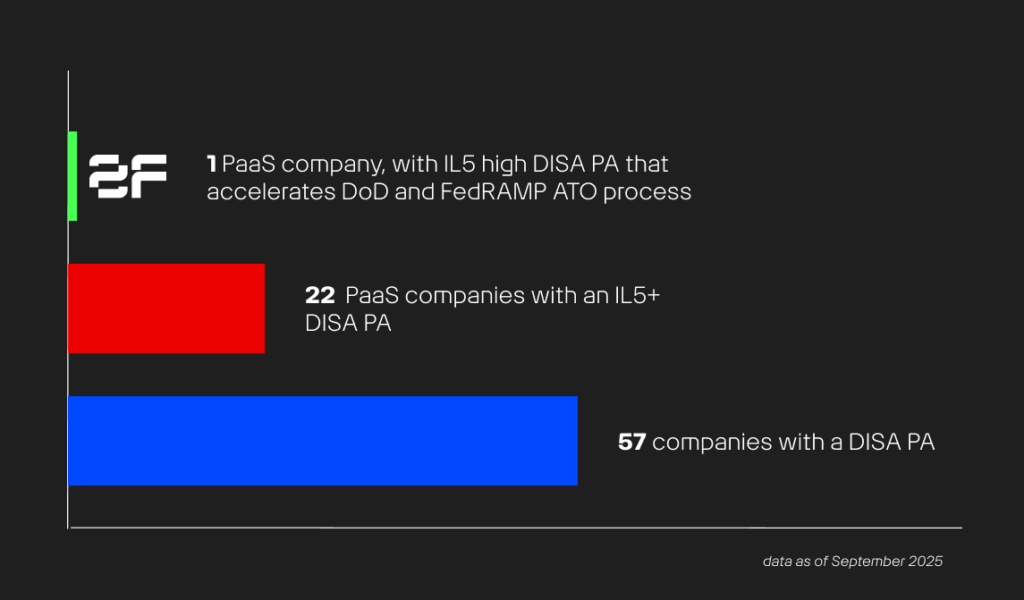
Out of 400+ companies with FedRAMP ATOs and 57+ with a DISA PA, Second Front is the only PaaS provider holding a DISA IL5 PA and FedRAMP High authorization, accelerating secure software delivery into government networks. These authorizations enable teams to move faster without compromising security.
To support true deployment freedom, we expanded Game Warden’s multi-cloud capabilities and global reach:
- Expanded to AWS GovWest to go along with our existing AWS GovEast region for broader U.S. government coverage.
- Enabled deployments on Google Cloud for commercial and public sector workloads.
- Introduced runtime support for Microsoft Azure, powering collaboration with the UK Ministry of Defence and NATO.
With Game Warden, mission owners can deploy software where the mission requires—without being constrained by cloud provider, geography, or classification level.
Managing applications with clarity and control
Secure deployment is only the starting point. In 2025, we delivered new capabilities that help customers manage, monitor, and scale applications throughout their lifecycle.
We enhanced App Central with alerting, cloud cost visibility, and a redesigned interface for clearer performance insights. Developer workflows improved through GitOps Sync, self-service capabilities, and a streamlined form engine. Manual handoffs that previously slowed updates and blocked iteration in regulated environments are a thing of the past.
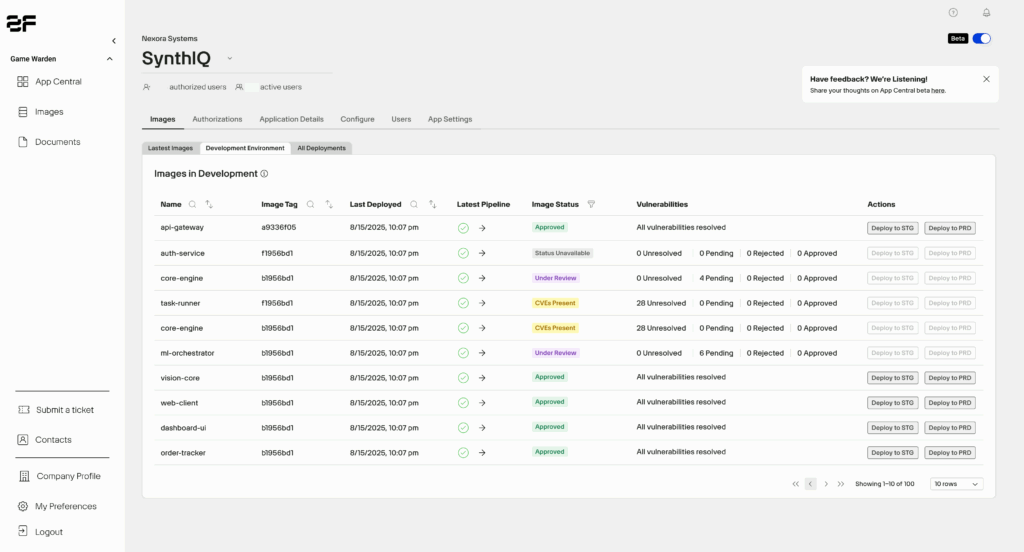
Security and compliance also advanced. New releases such as ScanLab Common Vulnerabilities and Exposures (CVE) management, Keycloak user management, and automated body-of-evidence tooling strengthened the platform’s compliance backbone.
Integrations with generative AI platforms including AWS Bedrock and Cohere extended AI capabilities for government operators, delivering smarter, faster foundational models within secure environments.
Extending secure deployment to the edge with Frontier
As missions increasingly operate in denied, degraded, intermittent, and limited environments, the need for secure edge deployment has become unavoidable. In 2025, Frontier gained strong validation across both defense and commercial markets.
Key collaborations included enabling edge operations with StirlingX for UK drone and data intelligence missions, partnering with EdgeRunner AI to deploy military-grade AI agents at the tactical edge, and working with Epoch Concepts, Armada, and Microsoft to embed DevSecOps capabilities into containerized edge platforms for disconnected operations worldwide.
Together, these efforts bring secure, compliant software deployment to environments where connectivity is limited—but mission impact is not.
Building an ecosystem that drives change
Lasting change does not happen in isolation. In 2025, Second Front deepened partnerships that aligned technology, integration, and policy around a shared standard for how secure software is delivered.
We launched our FedRAMP solution across multiple global cloud providers and expanded listings on the AWS and Google Cloud Marketplaces, making compliant deployment pathways more accessible. Through our partnership with Leidos, we worked alongside system integrators to deploy and operate applications across both classified and unclassified environments.
Our impact also extended into policy and thought leadership. With founding partner AWS, we launched the Offset Institute to foster collaboration across government, industry, and academia. Leaders including Danielle Metz and Sam Gray advanced the conversation on presumptive reciprocity and ATO modernization—work that came together at the annual Offset Symposium, which convened senior leaders from government, industry, and finance.
Beyond traditional service engagement, Josh Stiefel, Vice President of Government Relations, engaged policymakers on the need for a unified U.S. Cyber Force, reflecting a growing recognition that cyber capability requires structural reform, not incremental fixes.
Leadership for the next phase
In 2025, Second Front strengthened its leadership bench to support long-term mission impact.
CEO Tyler Sweatt was appointed Chairman of the Board, guiding the company’s long-term vision and ensuring Second Front remains anchored to its mission as it scales.
Drew Hoffman joined as President and Chief Legal Officer, bringing executive experience across venture funding, operations, and legal strategy. Mamie Cruse was appointed Second Front’s first Chief Mission Officer, continuing to lead execution across partnerships and customer delivery.
We also welcomed Nand Mulchandani, former CTO of the CIA and a successful software entrepreneur, to the Board of Directors—adding deep technical and operational insight as the company grows.
“I see this company as the connective tissue between the tech sector and the missions that defend our values.”
Looking ahead
For the third consecutive year, Second Front was recognized in the Silicon Valley Defense Group’s NATSEC100. More importantly, we enabled multiple other NATSEC100 companies to deploy their technology into government environments—amplifying impact across the ecosystem.
What we accomplished in 2025—expanding authorization pathways, advancing Game Warden and Frontier, and scaling deployment across clouds and Allies—established a new baseline. In 2026, the focus shifts from proving the model works to scaling it globally.
We win when our customers and mission partners win. The opportunity ahead is clear: enable government teams, system integrators, and technology providers of every size to deliver trusted capabilities to defense and civilian missions faster, more securely, and with confidence—at home and across Allied nations.
This moment demands collaboration, urgency, and execution. Together with our partners, customers, and policymakers, we are building the infrastructure that allows innovation to move at the speed of global change.
The momentum is here. The time to deliver is now.
P.S. We just announced Offset Symposium ’26: The Time Is Now. A working forum for the leaders responsible for delivering what comes next. If that’s you, register here.