The traditional “castle-and-moat” model of cybersecurity is officially dead. For decades, federal agencies and commercial software providers relied on a perimeter-based approach: authenticate once, get implicit trust everywhere inside the network. That model has been systematically dismantled by cloud computing, distributed workforces, and a generation of nation-state adversaries who specialize in bypassing outer defenses and moving laterally once inside.
In response, cyber defenders adopted a Zero Trust approach to protecting critical assets and data. Zero Trust isn’t new; the seeds were planted more than 15 years ago and have been growing ever since. Following Executive Order 01428 and other initiatives, the Department of Defense has issued one of the most consequential cybersecurity directives in its history: the DoD Zero Trust mandate. Most importantly, it is no longer a strategic aspiration. It is a fixed-deadline operational requirement that applies to every DoD component, federal agency, and commercial vendor in the Defense Industrial Base (DIB).
The mandate sets two firm milestones. All DoD components and supporting contractors must achieve Target Level Zero Trust by the end of Fiscal Year 2027, followed by a fully optimized Advanced Level by FY 2032. Vendors that fail to align their architecture, software supply chains, and operational practices with these requirements face delays, contract risk, and ultimately exclusion from the federal cloud and software market.
This Zero Trust implementation guide walks through what the mandate actually requires, how the seven pillars of the DoD ZT architecture fit together, what a phased execution roadmap looks like, and how commercial vendors can accelerate compliance rather than build every control from scratch.
What Zero Trust actually means (and what it doesn’t)
A common misconception is that Zero Trust is simply a more sophisticated version of Identity and Access Management (IAM). It isn’t. While identity is foundational, Zero Trust architecture extends far beyond static credentials.
In a legacy perimeter model, an authenticated device carrying a valid certificate is implicitly trusted, even if it is silently compromised by malware. Under a true ZT strategy, trust is never static. An identity, device, or workload is only deemed trusted as long as it behaves exactly as expected, in real time. The model shifts security from protecting network locations to continuously verifying every transaction.
The National Institute of Standards and Technology (NIST) formalized the architecture in Special Publication 800-207, which establishes three immutable tenets that govern every federal ZT implementation:
- Explicit and continuous verification. Every access decision is evaluated dynamically using identity, device health, geolocation, workload context, data sensitivity, and behavioral analytics. Authentication is never a one-time event.
- Strict enforcement of least privilege. Users, applications, and non-person entities (NPEs) like service accounts and API keys receive only the minimum access required, ideally just-in-time and just-enough.
- Assume breach. The architecture is engineered as if the adversary is already inside. All traffic is encrypted regardless of origin, and all activity is logged and analyzed continuously.
Together, these principles eliminate the implicit trust that adversaries have spent two decades exploiting.
Dummies eBook
U.S. Government Software Authorization for Dummies
Government authorization doesn’t have to be a black box. Learn how it actually works.
Where Zero Trust implementations stall
Most DoD Zero Trust programs do not fail because of the technology. They stall because of execution errors that compound over time. Before walking through the seven pillars and the phased roadmap, it is worth flagging the patterns that most consistently derail teams.
- Treating Zero Trust as a product purchase. Vendors will happily sell “Zero Trust solutions” framed as drop-in replacements for legacy tools. ZT is an architecture, not a SKU. No single product satisfies the full set of activities across the seven pillars, and treating any one tool as a complete solution creates dangerous coverage gaps.
- Skipping inventory and discovery. Organizations that deploy microsegmentation or automated policy engines without an accurate inventory of users, devices, applications, and data flows inevitably generate false positives, alert fatigue, and broken access for legitimate workloads. You cannot enforce a policy on what you cannot see.
- Underestimating Day 2 operations. Continuous monitoring, vulnerability lifecycle management, and policy enforcement do not stop at the initial Authority to Operate (ATO). Teams that fail to plan for Day 2 see Total Cost of Ownership (TCO) balloon as they hire dedicated staff to maintain manual compliance posture.
- Documenting a dynamic architecture in static documents. Zero Trust is, by definition, continuously verifying. Trying to represent that posture in 500-page Word documents creates compliance drift the moment code is deployed. Authorizing Officials reject packages where documented architecture and production reality have diverged.
Avoiding these traps is what the phased roadmap below is designed to do.
The seven pillars of DoD Zero Trust architecture
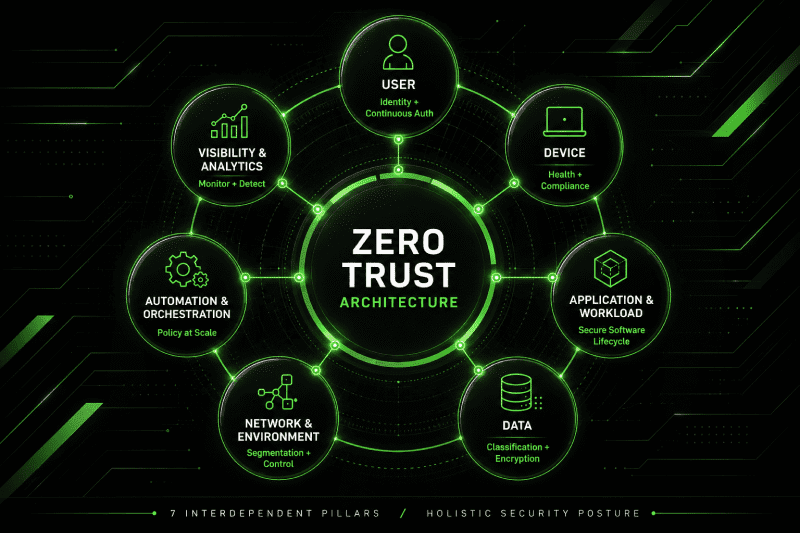
The DoD Zero Trust Strategy and Capability Execution Roadmap organizes implementation into 152 discrete activities mapped across seven interdependent pillars. 91 of those activities make up the Target Level baseline due by FY 2027; the remaining 61 fall under the Advanced Level by FY 2032. Importantly, the activities are not strictly sequential. A single modern platform configured correctly can satisfy multiple target and advanced activities simultaneously, compressing the maturity curve.
A weakness in any single pillar undermines the entire architecture, which is why DoD Authorizing Officials (AOs) increasingly evaluate ZT posture holistically.
- User. Identity becomes the absolute control plane. Continuous authentication, multi-factor enforcement, and behavioral risk scoring apply to both human users and non-person entities like service accounts.
- Device. The integrity of the hardware requesting access matters as much as the identity of the user. This pillar requires continuous validation of device health, patch status, and Comply-to-Connect (C2C) enforcement.
- Application & Workload. Software must be secured throughout its lifecycle, from development through deployment to runtime. This pillar mandates DevSecOps software factories, Web Application and API Protection (WAAP), and application-based permissions.
- Data. Data is the asset every other pillar exists to protect. Requirements include classification, encryption at rest and in transit, granular access controls, and ultimately AI-assisted tagging at the data layer.
- Network & Environment. This pillar represents the death of the flat network. Software-defined networking and deep microsegmentation create context-aware controls that limit lateral movement when, not if, a breach occurs.
- Automation & Orchestration. Scaling ZT policies across the global DoD enterprise manually is impossible. Automated workflows, integrated tooling, and real-time policy enforcement are required to sustain the architecture.
- Visibility & Analytics. Security operations cannot defend what they cannot see. Continuous monitoring, centralized logging, and User and Entity Behavior Analytics (UEBA) feed the decision engines that make every other pillar work.
How to implement Zero Trust: a phased execution roadmap
Understanding the pillars is the easy part. Sequencing the implementation correctly is where most programs succeed or fail. The Department of War (DoW) Zero Trust Implementation Guidelines Primer outlines a phased approach that builds visibility before enforcement, and foundational controls before automation.
Discovery: Establish visibility before anything else
You cannot protect what you cannot see. The Discovery Phase focuses on cataloging all Data, Applications, Assets, and Services (DAAS), along with every Person Entity (PE) and Non-Person Entity (NPE) operating in the environment. This includes passively mapping network traffic to distinguish verified assets from rogue connections.
Skipping this phase is the single most common failure point. Organizations that deploy microsegmentation or automated policy engines without an accurate inventory inevitably create false positives, alert fatigue, and dangerous coverage gaps.
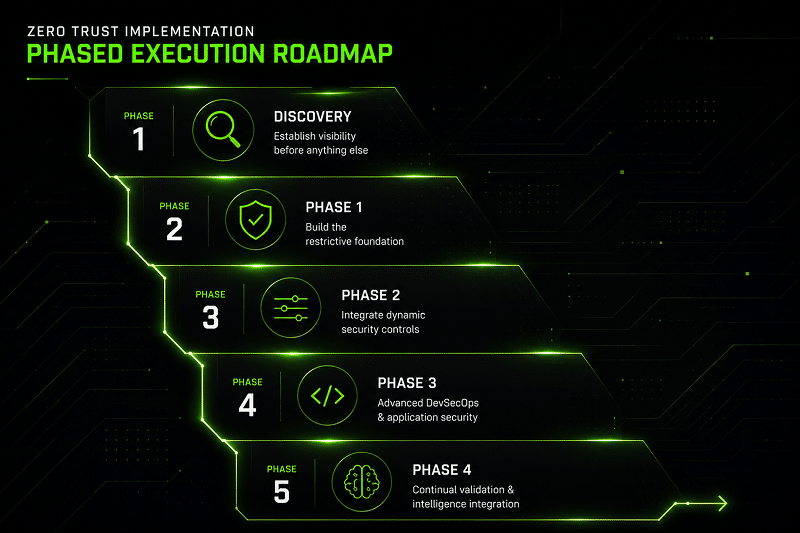
Phase 1: Build the restrictive foundation
With clean inventory data in hand, Phase 1 implements the core principle of “never trust, always verify.” Organizations deploy Deny User/Device by Default policies, eliminating implicit network trust. Identity infrastructure modernizes: centralized Identity Providers (IdPs), continuous MFA across all applications, and Identity Lifecycle Management (ILM) workflows. Baseline UEBA tooling begins observing the network to learn normal patterns.
Phase 2: Integrate dynamic security controls
Phase 2 transitions away from static permissions toward Rule-Based Dynamic Access, where access decisions fluctuate based on device health, user context, and real-time risk. Comply-to-Connect policies are rigidly enforced. A device that fails compliance scanning or lacks current patches is denied access. Next-Generation Antivirus and Endpoint Detection and Response (EDR) integrate into the runtime security stack.
These three steps, executed in order, deliver the Target Level baseline required by FY 2027.
Phase 3: Advanced DevSecOps and application security
Once Target Level is achieved, Phase 3 shifts focus to the software factory. Security checks are no longer bolted on at the end of the development cycle; they are integrated directly into CI/CD pipelines, enabling automated application security testing, real-time code remediation, and continuous vulnerability lifecycle management.
Phase 4: Continual validation and intelligence integration
The final phase realizes the fully matured ZT vision. Resource authorization becomes granular at the data layer rather than the application layer. Machine learning models identify micro-anomalies in milliseconds. External Cyber Threat Intelligence feeds integrate directly into automated defense engines, allowing the architecture to preemptively isolate nodes against emerging global threats.
Where Zero Trust meets CMMC 2.0
For the commercial defense contractors that make up the DIB, the DoD Zero Trust mandate is inextricably linked with Cybersecurity Maturity Model Certification (CMMC) 2.0. Since Level 2 requirements began phasing into DoD contracts in 2025, contractors handling Controlled Unclassified Information (CUI) face mounting pressure to modernize.
CMMC 2.0 does not explicitly require the term “Zero Trust,” but achieving its 110 NIST SP 800-171 controls is significantly accelerated by a ZT architecture. Identity-based microsegmentation directly satisfies Access Control (AC) requirements. Continuous MFA and conditional access fulfill Identification and Authentication (IA) mandates. Pervasive encryption satisfies System and Communications Protection (SC). Granular logging of every access decision exceeds the Audit and Accountability (AU) minimums.
In practice, contractors should not approach CMMC and Zero Trust as competing initiatives. They are the same security philosophy expressed in two different regulatory languages.
The ATO bottleneck: where compliance programs stall
Despite the clear technical and strategic benefits of Zero Trust, the most significant barrier for commercial software providers is regulatory, not technical. Achieving a DoD Authority to Operate (ATO) historically requires navigating the Risk Management Framework (RMF) over a span of 18 to 24 months, consuming millions of dollars and thousands of engineering hours.
The legacy process is plagued by manual evidence collection, static System Security Plans (SSPs) that drift out of alignment with production reality, and a systemic failure to plan for “Day 2” continuous monitoring. Failing to plan for Day 2 ConMon significantly increases Total Cost of Ownership (TCO) due to the dedicated staff and complex systems required to maintain compliance after the initial authorization.
For a Zero Trust implementation specifically, this bottleneck is especially painful because ZT is, by definition, dynamic. Trying to document a continuously verifying architecture in a static, document-heavy compliance package creates exactly the kind of “compliance drift” that AOs reject.
Accelerating Zero Trust with an accredited platform
The faster path to DoD Zero Trust compliance is to stop rebuilding controls that have already been authorized. ATOs are not transferable between systems, but under the DoD’s Risk Management Framework, organizations can inherit security controls when their system is deployed on a pre-accredited environment.
Second Front’s Game Warden is a FedRAMP High authorized, DISA-accredited DevSecOps platform engineered for exactly this challenge. Applications deployed on Game Warden inherit the platform’s authorization for the vast majority of physical, environmental, and foundational technical security controls. These are the same controls that map directly to the User, Device, Network, and Visibility pillars of the DoD ZT architecture.
The platform integrates compliant security testing directly into CI/CD pipelines, automates vulnerability scanning and container hardening, generates machine-readable Bodies of Evidence (BOE), and provides the continuous monitoring infrastructure required by the Automation & Orchestration and Visibility & Analytics pillars from Day 1. Crucially, CVE remediation is a common failure point for vendors attempting ATO independently, and Second Front addresses this directly with security experts who guide customers in identifying and fixing vulnerabilities before submission.
For tactical and edge deployments where Zero Trust principles must extend beyond the data center, Second Front’s Frontier offering enables secure deployment to autonomous platforms, IoT devices, and disconnected or contested environments while preserving the same continuous verification model.
The practical impact is significant. Commercial vendors deploying on Game Warden have moved from projected multi-year ATO timelines to authorizations measured in months, and in some cases weeks, while satisfying the technical underpinnings of the DoD Zero Trust mandate.
Turning the mandate into a competitive advantage
The transition to Zero Trust represents the most significant shift in federal cybersecurity strategy in modern history. The mandates are rigid, the FY 2027 and FY 2032 deadlines are fixed, and the seven pillars demand a fundamental rearchitecting of how software is built, deployed, and monitored.
For commercial vendors, attempting to engineer compliance with these baselines independently, from authorization boundary definition through continuous monitoring, is a high-risk, low-velocity strategy that often consumes years of runway before delivering a single line of production code to a defense network.
While no platform can streamline the entire process overnight, Second Front has built Game Warden to solve this exact challenge. By inheriting accredited Zero Trust controls through a pre-authorized DevSecOps platform, commercial innovators can refocus their engineering capital on building mission-critical capabilities rather than navigating compliance bureaucracy.
Ready to accelerate your path to DoD Zero Trust compliance? Speak with our team to learn how Game Warden can compress your timeline from years to months.