Not entirely, but for most companies starting fresh, yes. For most of FedRAMP’s history, the agency sponsor was the gate through which commercial software reached the federal market. A company could engineer a compliant architecture, pass a readiness assessment, and still stall indefinitely while it searched for a government entity willing to carry the authorization package. In the meantime, it could spend millions on speculative business development before a single control was formally assessed. The bottleneck was structural rather than technical, and it kept capable products out of federal environments for reasons unrelated to their security posture.
That gate is gone for most new entrants. Under the program structure in force since 2026, three paths lead to a listing on the FedRAMP Marketplace, and two of them require no sponsor at all: program-led certification under FedRAMP 20x, deployment onto a platform-as-a-service (PaaS) already holding its own FedRAMP Class D (High) Certification, and the traditional agency-sponsored route, still open through the transition. The PaaS and traditional agency-sponsored pathways are currently the only options for a small set of cases detailed below.
The sponsor requirement is only one part of the change. FedRAMP has also changed the terminology it uses to describe certification. What the market still calls FedRAMP Authorization is now FedRAMP Certification. The substantive shift underneath it: the FedRAMP program now grants certification on its own authority and no longer waits on an agency to volunteer first.
What follows is a breakdown of how each path works: the prerequisites, timelines, trade-offs, and decision logic behind choosing one, including where the sponsor requirement still applies. For companies pursuing both U.S. federal civilian, state and local government, and education markets, the decision reaches beyond FedRAMP. Security work completed for the federal market can also support GovRAMP Fast Track, creating a path to reuse federal security evidence across both programs.
Why sponsorship stopped being the gate
The U.S. Office of Management and Budget (OMB) Memorandum M-24-15 dismantled the old model in July 2024, rescinding the 2011 memorandum which had governed FedRAMP for over a decade. The memo dissolved the Joint Authorization Board (JAB) and its Provisional Authority to Operate process, consolidated all approvals under a single FedRAMP Certified designation, and empowered the FedRAMP Program Management Office (PMO) to certify cloud services directly, with no agency in the loop.
FedRAMP now describes the two resulting routes plainly in its certification path guidance. Program Certification is “provided directly by FedRAMP and does not require a federal agency to ‘sponsor’ the service,” while Agency Certification “requires a federal agency to authorize the service in advance.”
A central certification means very little if individual agencies refuse to honor it, which is where the 2022 FedRAMP statute does its work. Codified at 44 U.S.C. 3613(e), it establishes a Presumption of Adequacy compelling agencies to accept a FedRAMP Certification as sufficient for their security needs and bars them from layering on arbitrary agency-specific artifacts or custom reporting cadences. An Authorizing Official (AO) can overcome that presumption only by documenting a demonstrable need and notifying the program office.
Vendors consistently underrate this provision. Because every supplementary demand an agency makes is now visible to the FedRAMP PMO, the Presumption of Adequacy became enforceable rather than aspirational, and a certification earned without a sponsor carries exactly the same government-wide weight as one earned with an agency behind it. The old penalty for skipping sponsorship, redundant review at every new agency wanting to buy, no longer applies.
Dummies eBook
FedRAMP for Dummies
FedRAMP just got a new rulebook. Learn what changed in plain English.
First comes the Marketplace listing, then comes the Certification
Before a provider can apply for FedRAMP Certification under either the Program or Agency path, 20x or Rev5, FedRAMP requires a Marketplace listing in the Initial Implementation Phase. It is public and self-reported, and it comes with real obligations before a single control is formally assessed.
Getting listed clears three requirements:
- First, the provider demonstrates its offering fits an actual federal civilian use case: direct use in a system an agency will run under its own Authorization to Operate, or indirect use as a third-party resource inside another agency-facing offering.
- Second, the provider commits to publishing continuous progress toward certification in its Trust Center or on its website, updated at least quarterly, measured against the provider’s own stated goals and milestones.
- Third, and this is the requirement with teeth, the provider has two years from the date of that initial listing to schedule an assessment for a Class B, C, or D Certification. Miss that window and FedRAMP pulls the listing from the Marketplace until a scheduled assessment is back on record. Class A alone carries no such clock, since it functions as the entry pilot tier rather than a scheduled 3PAO assessment.
The practical effect: sponsorless does not mean unaccountable. A provider can sit in the Initial Implementation Phase building its OSCAL pipeline and its evidence automation, but it does so in public, on a clock, with its own stated milestones visible to any agency evaluating the offering.
Path 1: program certification under FedRAMP 20x
FedRAMP 20x is where the program is heading, and it removed the sponsor requirement outright for Classes A, B, and C. Class D is not there yet. FedRAMP opened a request for comment in September 2026 proposing how it will build that path: a Phase 4 pilot capped at 10 participants, open only to providers that already hold a clean FedRAMP 20x Class C Certification for six months, with detailed requirements due out October 14, 2026 and pilot certifications targeted around a tentative “FedRAMP Day” in March 2027. Those are FedRAMP’s own proposed target dates, not finalized rules, and general Class D availability beyond the pilot cohort will land later still, folded into the Consolidated Rules for 2027. Until then, the most sensitive civilian workloads keep routing through an agency.
The model replaces narrative documentation with continuous evidence, and the shift is more demanding than it first appears. Under the legacy baseline, a Class C system meant implementing roughly 323 to 325 NIST 800-53 controls and writing a narrative for each one, mostly prose describing intent rather than proving outcome. FedRAMP 20x collapses that into a much smaller set of Key Security Indicators (KSIs): machine-readable data points demonstrating a control is functioning at the moment of inspection, not on the day an assessor happened to visit.
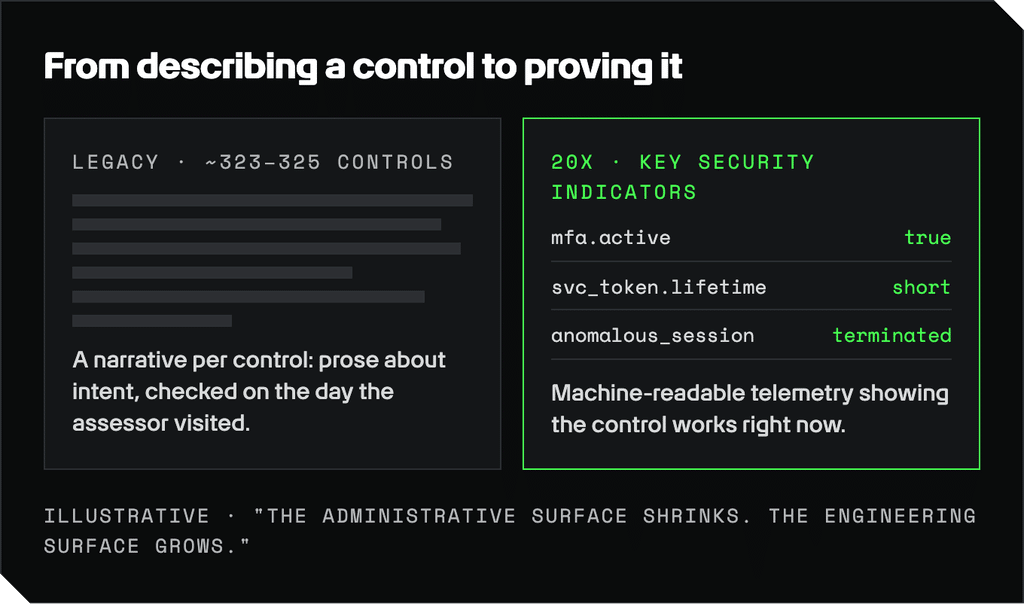
The difference is concrete. Where a legacy package contains a policy document asserting access control is enforced, a 20x architecture emits telemetry proving multi-factor authentication is active, service accounts hold short-lived tokens, and anomalous sessions terminate without human intervention. The administrative surface shrinks and the engineering surface grows.
Three prerequisites make or break this path:
- Your security package must be expressed in OSCAL, the Open Security Controls Assessment Language. OSCAL is a NIST data schema that represents controls, system descriptions, and assessment results as structured JSON, XML, or YAML.
- You need a public Trust Center at your own domain, where agencies and assessors read live posture instead of emailing you for a PDF.
- All of it has to be generated from your systems rather than written by hand, because a Class C package in OSCAL runs to thousands of lines of structured data in which a single broken cross-reference fails schema validation outright.
Who it fits: cloud-native companies already running infrastructure as code, continuous deployment, and a mature observability stack, for whom routing existing telemetry into a new format is an engineering project with a defined end. For companies without that telemetry, program certification requires building a compliance data platform before earning a dollar of federal revenue, a different proposition entirely.
Path 2: platform inheritance on a pre-certified platform
The second sponsorless route takes a different approach. Instead of certifying your own infrastructure, you deploy your application onto an already certified platform and inherit the controls running beneath it.
The stack relationship matters here, and it often gets muddled. Your application is the software-as-a-service (SaaS); the platform underneath is a platform-as-a-service (PaaS) that carries the certified controls, network segmentation, encryption, identity routing, and continuous monitoring apparatus. You don’t become the platform; you run on it, and the assurance you inherit belongs to the layer you didn’t build.
How much you inherit varies by architecture, and the spread is wide enough to drive the decision on its own. Deploying on raw infrastructure as a service inherits roughly 20 percent of required controls, while a specialized DevSecOps platform lifts that to approximately 60 percent for an out-of-boundary deployment and roughly 80 percent in-boundary. The mechanism is a Customer Responsibility Matrix (CRM) documenting which controls the platform owns and which remain yours, so the assessor examines your application and its boundary instead of the entire stack beneath it. (Our explainer on how does control inheritance work for GovRAMP, FedRAMP, and DOW ATOs? walks through the matrix mechanics).
2F Game Warden is one such platform. It is a fully managed, DevSecOps environment, FedRAMP Certified at Class D (High), and built on standing partnerships across major hyperscalers (AWS, Google Cloud, and Microsoft). It also carries authorizations spanning DOW Impact Levels 2 through 6 and JWICS, the intelligence community’s classified network. That last detail decides the path for anyone whose roadmap touches defense, because Class D stays closed on the 20x path until FedRAMP’s Phase 4 pilot produces its first ten certifications. Impact Level authorizations were never available on the 20x path at all.
The economics move with it. Applications reach the federal market in as little as 90 days rather than the year or more a documentation cycle demands.
Who it fits: containerized applications deployable into a managed orchestration layer, companies without the internal engineering capacity to build and maintain an OSCAL telemetry engine, and vendors needing FedRAMP or a defense Impact Level accreditations today without waiting for a ten-seat pilot cohort to reach general availability. The trade-off is worth naming plainly: you accept a platform’s architectural conventions in exchange for not building a compliance substrate of your own.
That inheritance model also matters for companies pursuing GovRAMP. Because Second Front and its Game Warden platform hold both FedRAMP Class D Certification and GovRAMP High Authorization, companies can build from an accredited foundation designed to support requirements across federal, state, and local markets–across FedRAMP Class A-Class D, and GovRAMP Low-High Authorizations.
Path 3: agency certification, the legacy route
Finding a FedRAMP sponsor remains an option, and for Class D workloads it is currently the only broadly available one. The process itself has not changed: you locate a federal agency willing to serve as your AO, draft a System Security Plan (SSP), run a control-by-control gap analysis, and submit to a point-in-time assessment by a Third-Party Assessment Organization.
It also remains the slowest and most expensive of the three. Timelines from sponsor engagement to certification routinely run 12 to 24 months, gated less by your engineering than by how responsive your sponsoring agency proves to be, while consulting and assessment costs commonly reach seven figures. None of that spend is recoverable if the sponsorship collapses partway through, a risk no amount of internal readiness can hedge against.
The path is closing as well. FedRAMP stops accepting new Rev5 applications on June 11, 2027, and CR26 becomes mandatory for every participant on January 1, 2027, at which point certifications already in force pick up the new control parameters at their next independent assessment.
Who it fits: companies already holding a formalized agency commitment, organizations pursuing Class D workloads the 20x path cannot yet serve, and legacy architectures with no realistic route to continuous machine-readable evidence. Second Front supports this legacy agency certification route alongside its sponsorless offerings. Additionally, Second Front Systems is actively adapting its platform architecture to fully support the core requirements of the 20x framework, with no significant adjustments expected to customers’ primary documentation or legacy FedRAMP templates.
Sponsored versus sponsorless, side by side
| Program certification (20x, sponsorless) | Platform inheritance (sponsorless) | Agency certification (legacy Rev5) | |
|---|---|---|---|
| Prerequisites | Cloud-native architecture, infrastructure as code, continuous telemetry, OSCAL generation, public Trust Center. Classes A, B, and C only. | A containerized application deployable onto the host platform. No sponsor and no OSCAL pipeline of your own. | A federal agency authorizing official who commits in advance, plus full narrative documentation and point-in-time readiness. |
| Timeline | Weeks to a few months, once evidence pipelines emit correctly. | 30 to 90 days, driven by application onboarding rather than documentation. | 12 to 24 months, gated by agency responsiveness. |
| Cost profile | High upfront engineering investment to build the automation, then low recurring audit cost. | Predictable platform subscription with minimal external compliance consulting. | Six to seven figures in consulting and assessment fees, plus heavy recurring manual monitoring labor. |
| What happens at renewal | Continuous validation checks Key Security Indicators in real time, replacing the annual audit event. | The platform maintains the boundary and its certification; you supply lightweight evidence for your application layer only. | A full annual assessment, with static artifacts regenerated and resubmitted to the agency authorizing official. |
How sponsorless FedRAMP can fast-track GovRAMP
The value of sponsorless FedRAMP extends beyond the federal market. State, local, tribal, and education buyers run their own program, GovRAMP, and it is built to read federal work rather than make you repeat it.
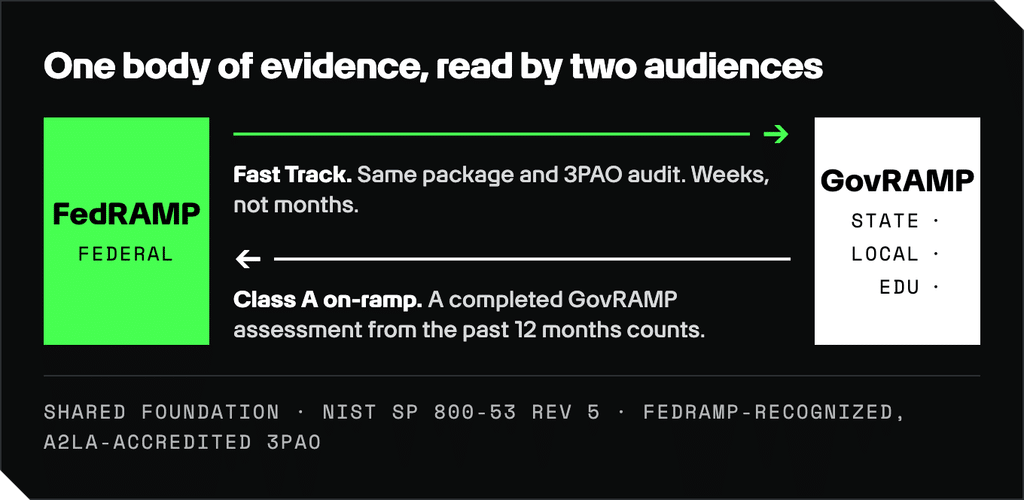
GovRAMP Fast Track exists for exactly this handoff. An offering qualifies when it holds FedRAMP ATO, PATO, or Ready status, and the provider submits the same security package and 3PAO audit already prepared for the federal program, formatted to FedRAMP standards, with 90 days of continuous monitoring where relevant. GovRAMP states the saving plainly: the process “takes weeks as opposed to months.” You do not have to finish federally before you start, either, since a package can go to GovRAMP while the federal certification is still in flight.
Three details are worth knowing:
- GovRAMP’s published eligibility still uses the federal program’s pre-CR26 vocabulary, so read “FedRAMP ATO” as the certification the program now grants under its class system.
- The relationship no longer runs only one direction, either. Under the Consolidated Rules for 2026, FedRAMP now accepts a completed GovRAMP assessment as an approved alternative security framework for its own sponsorless Class A Certification, the same role SOC 2 Type II and legacy FedRAMP Rev5 or Ready status play. That reverse path, using GovRAMP work to get a federal foothold, deserves its own full treatment, which we will cover in a dedicated piece; the short version for now is that certifying in either program no longer means starting the other one from zero.
- GovRAMP Authorized status still requires either a government sponsor or approval from the GovRAMP Approvals Committee, so the federal Presumption of Adequacy has no equivalent on the state and local side. The Approvals Committee route is what keeps the path open to a vendor with no state agency behind it, and a Fast Track package built on federal evidence is what keeps that review short.
The reuse works because the technical foundation underneath is the same. Both programs build on the NIST SP 800-53 Rev 5 catalog with Low, Moderate, and High baselines, and both require assessment by a 3PAO recognized by FedRAMP and accredited by A2LA. The artifacts your federal assessor produces are the artifacts GovRAMP wants to see.
Platform inheritance carries into this market on the same terms it carries federally. 2F Game Warden holds GovRAMP High Authorization alongside its FedRAMP Class D certification, so the controls a hosted application inherits for its federal package are inherited again for its GovRAMP submission rather than evidenced twice. Federal certification and state, local government and education authorization stop being two programs and become one body of evidence read by two audiences.
What sponsorless certification asks in return
Dropping the sponsor requirement did not make certification easier. It relocated the difficulty from business development into engineering, and the machine-readable mandate is where that relocation lands hardest.
RFC-0024 requires every certification package, legacy Rev5 packages included, to be submitted in OSCAL, which makes hand-authoring compliance documentation in a word processor unviable at any tier. Providers either adopt compliance-as-code tooling or build an internal engine generating OSCAL from live system state, and the second option is a product investment most companies have never budgeted for.
Continuous monitoring changed on the same principle. For more than a decade, providers scanned their boundary once a month, mapped findings to a spreadsheet, and patched on a flat schedule derived from severity scores, a method measuring theoretical severity in a vacuum. It ignored whether a vulnerable component was reachable from the internet or under active exploitation, and it generated enough noise that engineering teams patched isolated internal infrastructure to meet a deadline while genuine supply chain flaws sat open.
The Vulnerability Detection and Response and Vulnerability Evaluation and Reporting rules replace that model, aligning FedRAMP with Binding Operational Directive 26-04 from the Cybersecurity and Infrastructure Security Agency (CISA). Every finding is now weighed on four axes: internet reachability, exploitability against the Known Exploited Vulnerabilities catalog, automatability, and technical impact. Remediation clocks compress accordingly, and the “internal only” defense no longer holds, since an unexposed asset carrying an automatable, known-exploited flaw that grants full control must be remediated within days.
That shift toward continuous evidence also affects incident reporting. CR26 introduces the Potential Agency Impact N-rating, a 1 to 5 scale quantifying the blast radius of an event, and ties reporting deadlines to that rating in combination with your Certification Class. At the top of the scale, the window is measured in minutes.
Those changes also reshape what assessors are evaluating. The Third-Party Assessment Organization once read narrative plans and cross-referenced screenshots. It now audits automation: whether your infrastructure emits valid OSCAL, whether the APIs feeding your Trust Center are accurate and tamper-resistant, and whether automated responses fire as coded in production. Pilot assessments at Classes B and C finished in weeks when those pipelines were built correctly, and stalled when they were not.
Every burden in this section attaches to whoever owns the boundary, which is the quiet logic behind platform inheritance. A vendor deploying onto a certified platform does not stand up an OSCAL generation pipeline, does not re-architect vulnerability management around reachability and exploitability scoring, and does not build the monitoring apparatus feeding a Trust Center, because the platform underneath the application already runs all three and reports on them continuously. 2F Game Warden maintains this machinery as a condition of its own Class D certification and its GovRAMP High Authorization, which leaves the vendor answering for evidence at the application layer and nothing beneath it. Program-led certification is the alternative, and it means owning every one of these systems yourself, in both markets.
If you lost your sponsor mid-process
CR26 created a deliberate lifeline for companies stranded by the old model. Providers who began the legacy process with an agency sponsor between January 2025 and March 2026 but could not finish, whether the sponsorship lapsed, the contract slipped, or the agency simply went quiet, can convert that work into a sponsorless Program Certification at Class B or C.
The sponsor question is settled; the engineering question is not
Sponsorship is no longer the barrier to federal revenue, which means the companies still organizing their go-to-market around finding an agency champion are solving a problem the program has already retired. The real constraint is architectural. FedRAMP now rewards providers who can prove their security posture continuously and machine-readably, and it has stopped rewarding providers who can merely describe it well.
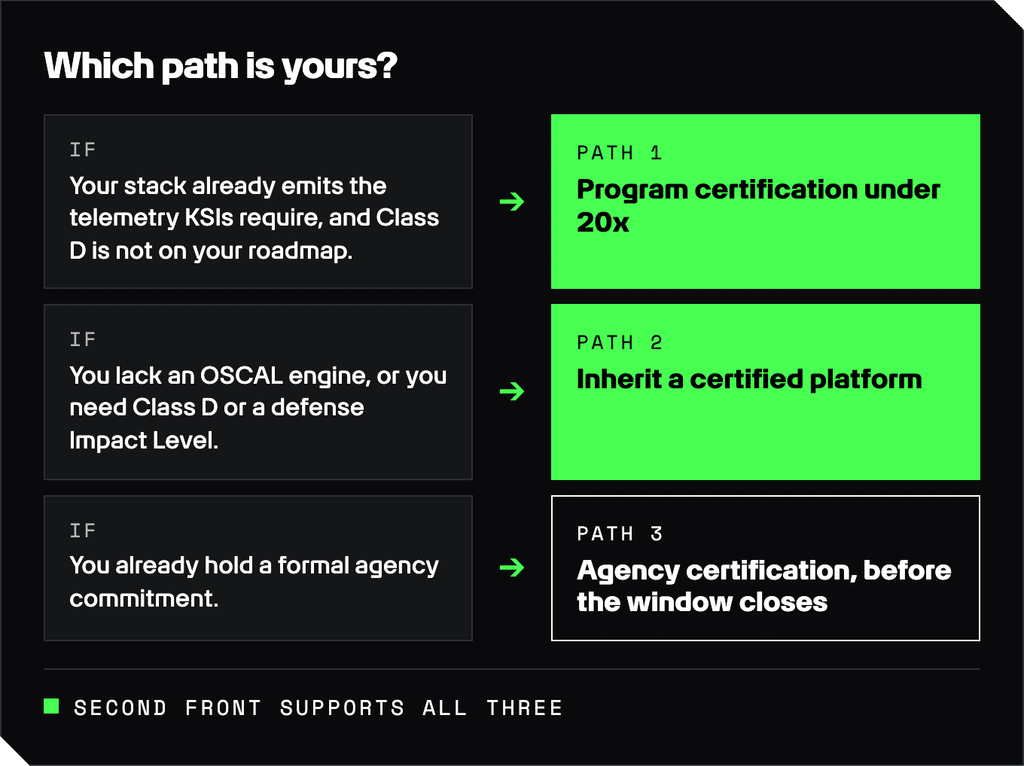
That reframes the decision as a question about your own engineering rather than your federal relationships. If your platform already emits the telemetry KSIs require, program certification under 20x is the direct route and the sponsor question never arises. If it does not, or if your roadmap needs Class D or a defense Impact Level, inheriting a certified platform’s controls gets you into the market while you build that capability on your own schedule. What is no longer viable is waiting for an agency to volunteer.
The choice compounds outward as well, in both directions now. Certify federally first, and GovRAMP Fast Track reads that package, turning the state and local market into a follow-on rather than a second program built from nothing. Start from GovRAMP instead, and that work now buys a sponsorless on-ramp into FedRAMP Class A. Either sequence produces one body of evidence read by two audiences, rather than two programs built from scratch.
Ready to map your path to the FedRAMP Marketplace and the GovRAMP Authorized Product List? Speak with our team to learn how 2F Game Warden compresses the route to certification, with or without a sponsor.
Frequently asked questions
Maybe. Under the Consolidated Rules for 2026 and OMB Memorandum M-24-15, you can begin certification without a sponsor. FedRAMP offers a Program Certification path for Classes A, B, and C, where the Program Management Office reviews and certifies your service directly rather than waiting for an agency to assume the risk. Class D is not on that path yet and still requires an agency, unless you deploy onto a platform already holding a Class D certification and inherit its controls. All FedRAMP pathways through Second Front are sponsorless for the vendor. By deploying on Game Warden, you either inherit Second Front’s existing agency sponsorship or leverage pre-built automated evidence to pursue an independent listing.
The FedRAMP 20x Program Certification path. Instead of one agency assuming the risk of a point-in-time audit, the program office validates automated evidence: Key Security Indicators, machine-readable OSCAL packages, and a public Trust Center reporting live posture. Under the Presumption of Adequacy at 44 U.S.C. 3613(e), other agencies must accept that certification rather than running their own redundant reviews, which is what gives a sponsorless certification the same government-wide weight as a sponsored one.
Yes, through GovRAMP Fast Track. An offering qualifies when it holds FedRAMP ATO, PATO, or Ready status, and it submits the same security package and 3PAO audit already prepared federally, formatted to FedRAMP standards, with 90 days of continuous monitoring where relevant. GovRAMP describes the result as a process that takes weeks rather than months. The reverse direction works now too; see the next question.
Yes, for Class A, though it’s a newer path than the reverse and merits its own deep dive elsewhere. Under the Consolidated Rules for 2026, a completed GovRAMP assessment from the past 12 months qualifies as an approved alternative security framework for FedRAMP Class A Certification, the same role SOC 2 Type II and legacy FedRAMP Rev5 or Ready status play. In short, it satisfies Class A’s entry prerequisite without a repeat federal assessment, getting you into the lightest certification tier rather than a full Class B, C, or D Certification outright.
Not necessarily. GovRAMP Authorized status requires either a sponsoring government entity or approval from the GovRAMP Approvals Committee, so a vendor with no state agency behind it can still reach the Authorized Product List through the committee. A Fast Track package built on federal evidence is what keeps that review short, which is why sponsorless federal certification and GovRAMP authorization work well in sequence.
Yes, until the legacy path closes. Agency Certification remains available for Rev5 Classes B and C, and it stays the required route for Class D until the 20x Class D pipeline opens in 2027. If your sponsorship lapsed mid-process between January 2025 and March 2026, the temporary conversion pipeline lets you carry that work over to a sponsorless certification instead of starting again.