Building, documenting, and defending a sovereign cloud compliance stack from bare metal to the application layer is a grueling operational hurdle. For a growth-stage software vendor, the traditional do-it-yourself path takes 18 to 24 months and drains upwards of $3 million in engineering labor and advisory fees. Control inheritance is the strategic antidote to this compliance tax. By leveraging a pre-accredited platform, a Common Control Provider like Second Front’s Game Warden Platform-as-a-Service (PaaS) implements the baseline security, while you formally inherit those certified safeguards through a Customer Responsibility Matrix (CRM). Your assessor then verifies the boundary rather than retesting the underlying stack.
What differs is the designation: under GovRAMP, it’s a verification status; under FedRAMP, a Certification; and under the Department of War (DOW), an ATO. Conflating these distinct instruments is why compliance roadmaps stall.
The inheritance mechanism in three steps
Inheritance is a formal relationship between two accreditation boundaries. If a foundational layer has already been assessed and authorized or certified by the government, systems deployed on that layer do not re-prove it. The relationship is created in three steps, each with a different owner.
Step one: the provider implements and documents the control
The Common Control Provider engineers the foundational safeguards, from physical access control and environmental protection to hypervisor separation and infrastructure logging. It documents them in a System Security Plan (SSP) and submits the package to an independent Third Party Assessment Organization (3PAO) or a Security Control Assessor (SCA). Once the government accepts the package, the safeguards become common controls: an assessed substrate other systems can point at.
Step two: the customer inherits it through the CRM
The CRM is the boundary document making inheritance real. It classifies every control in the NIST 800-53 baseline as common (fully provided by the platform), hybrid (split between platform and customer), or system specific (entirely the customer’s). Under a typical hybrid arrangement covering SI-4 System Monitoring, the platform continuously audits network traffic and infrastructure logs while the customer ingests application transactions and user logins into a SIEM. When the customer writes its own SSP, inherited controls become a reference to the provider’s package rather than an implementation narrative. A monumental engineering task becomes an administrative linkage.
The CRM is also where inheritance most often fails. A vague matrix yields controls that both parties assumed the other owned, which surface as time-wasting findings when neither can produce evidence. Ask for the CRM before you begin a vendor partnership, not after.
Step three: the assessor verifies the boundary
During your assessment, the 3PAO or SCA does not re-test the data center’s fire suppression systems or the platform’s patching cadence. Assessment reciprocity for inherited controls is built into the process, and assessment time is correctly limited to the app and boundary itself, confirming your application logic, access model, and data flows match what the CRM says you own. That is a large part of the financial argument for inheritance from a pre-authorized PaaS like 2F Game Warden. Reduce the count of controls in scope and you reduce assessment hours, remediation cycles, and time to accreditation in direct proportion. The underlying control taxonomy is covered in depth in How to Maximize Control Inheritance: A Guide to Reducing Your NIST 800-53 Workload.
Dummies eBook
U.S. Government Software Authorization for Dummies
Government authorization doesn’t have to be a black box. Learn how it actually works.
How does control inheritance work under FedRAMP certification?
FedRAMP enforces a hard architectural rule: an application seeking certification must run on infrastructure already FedRAMP Certified. There is no path where a vendor assesses its own cloud service offering, however, a Offerings By Government ruleset open for comments could make this unique to private companies.
The baseline you inherit from sets your ceiling
Inheritance cannot flow uphill. A platform certified at Class C cannot provide Class D protection to the application running on it. This asymmetry creates the retrofit trap.
Vendors frequently select a lower-assurance Class B or Class C environment because they assume it represents an easier entry point. However, the moment a lucrative defense or federal contract requires Class D (High) or Impact Level 5 (IL5) compliance, the compromise collapses. Because you cannot upgrade an existing, lower-tier boundary without re-platforming, you are forced to migrate to a higher-assurance environment and run your security assessments again from scratch. Designing for the highest necessary tier from day one is the only way to future-proof your federal go-to-market strategy.
How does control inheritance work for a DOW ATO?
The DOW runs its own Risk Management Framework (RMF) under DoDI 8510.01, with cloud requirements set by the Defense Information Systems Agency in the Cloud Computing Security Requirements Guide (CC SRG). The mechanism is identical: point at a Common Control Provider, inherit its assessed controls. The terminology, the architectural constraints, and the person who signs are all different.
FedRAMP is the floor the CC SRG builds on. A platform’s FedRAMP Certification gives a DOW Authorizing Official an established body of assessed controls to accept by reciprocity, shortening the route to an Impact Level authorization. There is no direct one to one correlation between a FedRAMP Class and a DOW Impact Level: the Class reflects civilian data sensitivity, the Impact Level reflects defense data sensitivity plus overlays.
Where inheritance from the civilian baseline fractures
Inheritance from FedRAMP holds cleanly at the bottom of the Impact Level ladder and fractures as you climb it.
IL2, public and non-critical DoD information. Maps cleanly onto the FedRAMP Class C (Moderate) baseline. An AO can accept it by reciprocity with no additional assessment. This is the one rung where a civilian certification does the whole job.
IL4, CUI and mission systems. Adds a US persons restriction on access and support with no civilian equivalent. The reciprocity package has to isolate and evidence the delta separately rather than folding it into the FedRAMP narrative.
IL5, higher sensitivity CUI and unclassified national security systems. Requires physical or strong logical separation of data alongside US citizen personnel restrictions.
IL6, information classified up to SECRET. Runs on SIPRNet under the CNSSI 1253 classified information overlay.
The practical consequence: a commercial cloud service offering cannot document its way into IL5+. The architecture beneath it either supports the separation natively or it does not. Understanding DoD cloud Impact Levels walks the full ladder, and Achieving DoD CC SRG compliance: navigating FedRAMP and DISA Impact Levels (IL4 vs. IL5) covers the IL4 to IL5 delta in detail.
How DISA Provisional Authorization and eMASS carry the inheritance
Getting past the deltas means inheriting from a platform already holding a U.S. Defense Information Systems Agency (DISA) Provisional Authorization (PA) at your target Impact Level. A DISA PA is the defense analogue of centralized FedRAMP review: DISA has vetted the offering and approved it for department-wide use. If the platform beneath you holds a PA at IL5, the containerized application running on it inherits the separation and personnel baseline, and your assessment narrows to your own code. DISA PA Approval: Accelerating DoD Market Access for Tech Innovators explains what the PA covers and what it does not.
Inheritance is then operationalized in the Enterprise Mission Assurance Support Service (eMASS), which holds RMF packages and decisions, along with the relationships between them. A provider system exposes controls and assessment procedures to receiving systems in one of two modes. Full inheritance passes the provider’s test results, artifacts, and POA&M items straight through, and the receiving system performs no independent assessment. Hybrid inheritance shows the receiving system the provider’s results but still requires a local assessment of its share. Control Correlation Identifiers (CCI) matter here, but the unit of inheritance in eMASS is the control and its assessment procedures, not the CCI.
Statute is pushing this harder. FY2025 NDAA Section 1522 directed modernization of the department’s ATO processes. FY2026 NDAA Section 1521 added department-wide cloud ATO timelines, guidance on expedited ATOs, and an appeals process. The industry shorthand for the intent is presumptive reciprocity: an ATO issued by one organization should be accepted by another. The impact of long ATOs on mission speed reciprocity whitepaper shows why.
In practice AOs extend the trust only when the shared responsibility matrix is unambiguous and the host platform supplies live monitoring data rather than a year-old static package. The gap between the policy and the practice is the subject of The Deploy-Anywhere ATO: A Guide to RMF and FedRAMP Reciprocity for DoW.
The Cybersecurity Risk Management Construct (CSRMC), announced in September 2025 as the successor to RMF, is built around closing it. Its tenets emphasize reciprocity and enterprise services and inheritance as first-class concepts, with continuous monitoring replacing point-in-time review. Implementation is still in progress and RMF remains the governing issuance for most efforts today, but the direction is set: inheritance plus live telemetry, not inheritance plus paperwork.
How much of the control baseline can you actually inherit?
The share you inherit is decided by deployment model, not by effort. Using the FedRAMP CRM as the accounting baseline:
| Deployment Model | Baseline controls inherited | What remains your engineering burden |
|---|---|---|
| IaaS (AWS GovCloud, Azure Government, Google Cloud) | ~20% inheritance | Operating system hardening, container orchestration, patching, FIPS validated cryptography, network ACLs, plus the entire evidence pipeline |
| Game Warden Out-of-Boundary (Customer-Owned ATO Pathway) | ~60% inheritance | Application logic, API security, data governance, and managing/defending your own separate ATO package to the agency. |
| Game Warden In-Boundary (Inherited ATO / utilizing GW’s Sponsor) | ~80% inheritance | Application-layer security only (your code, access model, and data handling). All continuous monitoring and infrastructure are fully managed by Second Front. |
How does control inheritance work for GovRAMP and state programs?
The same mechanism extends to the state, local, tribal, and territorial market, which is why a FedRAMP-first architecture is the most cost-effective way into both.
GovRAMP (formerly known as StateRAMP) runs on the same technical foundation as FedRAMP: the NIST SP 800-53 Rev 5 catalog, Low, Moderate, and High baselines, assessment by a 3PAO recognized by FedRAMP and A2LA accredited, and continuous monitoring from the moment status is awarded, with monthly scans and an annual 3PAO assessment covering roughly a third of controls. An identical control taxonomy implies identical inheritance mechanics. The platform controls you inherit for FedRAMP are the same controls satisfying GovRAMP.
GovRAMP’s Fast Track program is the reciprocity route. A provider with existing federal security documentation submits a security review request to the GovRAMP PMO along with its package, the SAR, RAR, and 90 days of continuous monitoring data, then reuses the documentation instead of commissioning a redundant assessment.
Two things to note:
- Fast Track is not gated on holding FedRAMP status; providers do not need to wait for federal certification to submit.
- However, the reciprocity is one directional, and the direction matters for sequencing. GovRAMP recognizes federal work. FedRAMP does not currently recognize GovRAMP status. Achieve GovRAMP first and you still face a full federal assessment. Achieve federal certification first, by inheriting a certified platform like Game Warden, and GovRAMP becomes a documentation exercise.
The Orchestration Mirage: Paperwork vs. Runtime Inheritance
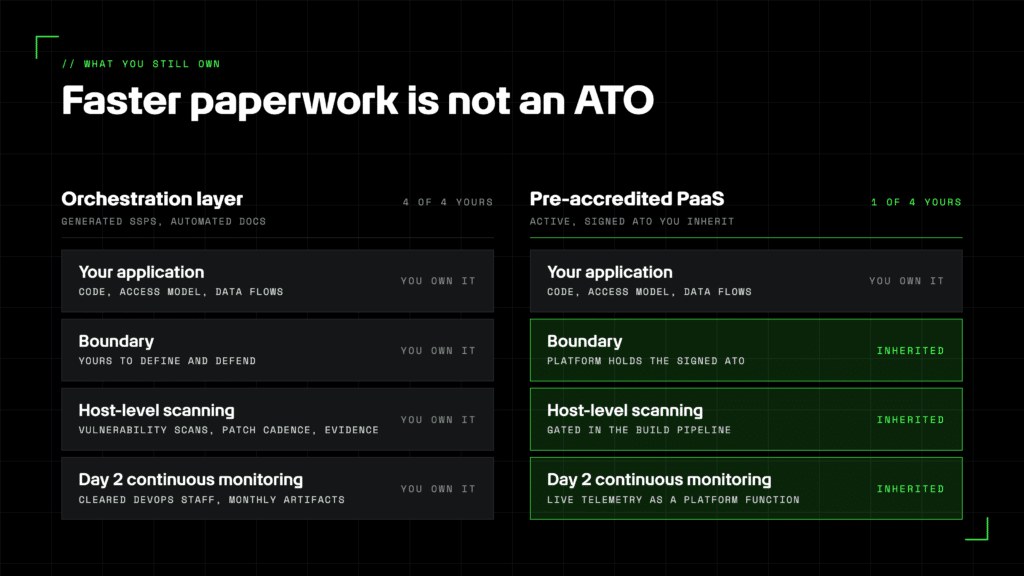
When evaluating compliance partners, software vendors must avoid the ‘orchestration mirage.’ Many solutions on the market offer ‘compliance orchestration’ or ‘automated documentation.’ They use software to generate System Security Plans (SSPs) or scan your code. While faster paperwork is helpful, it is not the same as inheriting a signed ATO.
If you deploy on a basic orchestration layer, you still own the underlying infrastructure boundary, host-level vulnerability scanning, and Day 2 continuous monitoring operations. This forces you to hire highly specialized, cleared DevOps engineers to maintain compliance. True runtime inheritance requires a pre-accredited PaaS. Platforms like Game Warden host your containerized application, manage your boundary, and assume operational responsibility for continuous monitoring. You inherit the platform’s active, signed ATO rather than pre-filled paperwork.
How does FedRAMP 20x change the inheritance equation?
It raises the value of inheritance sharply, because it changes what evidence has to be. FedRAMP 20x replaces narrative control prose with Key Security Indicators (KSIs), machine-checkable assertions grouped into families covering cloud native architecture, identity and access, configuration, and monitoring and logging. The Consolidated Rules for 2026 (CR26) define 46 KSIs across 10 families. Instead of writing a policy paragraph asserting accounts are audited, the provider emits telemetry proving least privilege is enforced in production right now.
Machine-readable packages are moving the same direction. FedRAMP is retiring DOCX and XLSX submissions and requiring structured data, comprehensive for Class D and semi-structured for Classes A through C. It is deliberately not mandating a single format: OSCAL is one option, not the requirement, and FedRAMP has said it will not dictate the underlying structure.
Either way, CSPs still have to do the work; someone has to build the pipeline, scraping the environment, validating the indicators, and delivering conformant structured data continuously. On IaaS, that someone is you, and hand-maintaining it at scale is not realistic. Inherit from a platform built for it and the pipeline arrives with the substrate: automated gating in the build, machine-readable evidence generated natively, telemetry managed as a platform function. Framework vs. Service Model: How FedRAMP 20x changes the cloud compliance equation works through the economics.
Inheritance is an architecture decision, and you make it once
The government compliance perimeter is not loosening. It is moving from annual document review to continuous machine-checked validation, for both FedRAMP and DOW ILs, with GovRAMP tracking behind on the same control catalog. In that world the question is not how many controls you can document. It is how many you never have to touch.
That number is fixed the day you choose what your software runs on. The era of treating accreditation as paperwork filed at the end is over; it is an architecture decision made at the start, and it compounds.
Ready to see how much of your control baseline you can stop owning? Speak with our team about inheriting Game Warden’s GovRAMP High Authorization, FedRAMP Class D (High) Certification, and support of the full DoW IL spectrum.