FedRAMP is changing its vocabulary. “FedRAMP Authorization” is now “FedRAMP Certification,” the four Impact Levels become Classes A through D, and the Consolidated Rules for 2026 (CR26) took effect July 4, 2026, with enforcement beginning January 1, 2027. The language on your website, your sales decks, and your marketplace listing is now on the clock. While building your own compliance path means the burden of these terminology and documentation updates falls entirely on your team, deploying on a pre-accredited platform allows you to automatically inherit these posture updates without re-running the work.
Here is the mapping, the reasoning, and the unchanged vocabulary.
Authorization is now Certification
The headline change is a single word with wide reach. FedRAMP Authorization is now FedRAMP Certification, and a service once described as “Authorized” is now “FedRAMP Certified.” Certification is the single official label for what the program grants, so any service still marketed with the old “Authorized” wording trails the program.
The reason is precision, not branding, and it traces straight back to statute. The authorizing law defines the program’s grant as a certification that a cloud service has completed the FedRAMP process, so “Certification” simply makes the statute’s own word the public label. The change also clears a long-running ambiguity. The old term did double duty, naming both what the program grants and the separate grant an agency issues to operate a system. Two decisions, two parties. Certification names what FedRAMP does and leaves “authorization” to mean what an agency does. A FedRAMP Certification still satisfies the statutory meaning of being authorized; “Certified” is just the term you now put in your copy.
For a cloud service provider, the practical work is a find-and-confirm pass across every customer-facing surface. The phrase hides in places easy to forget: image alt text, PDF datasheets, the boilerplate under a press release, the line in your email signature. The term carries weight with federal buyers, so getting it right signals you track the program closely. Getting it wrong, once the rules bind, signals the opposite.
Two related labels are worth knowing while you do the pass. There will be no separate “FedRAMP Validated” designation for the 20x and Rev5 paths; FedRAMP weighed it and agreed with commenters that a second label only adds procurement confusion, so the Marketplace will distinguish the paths with filters instead. The deliverable once called the authorization package is now the FedRAMP Certification Package. Its function is unchanged: the reusable set of materials an agency uses to decide whether to run your service in its environment. Only the name moved.
FedRAMP Insights
Ready to ignite your FedRAMP Journey?
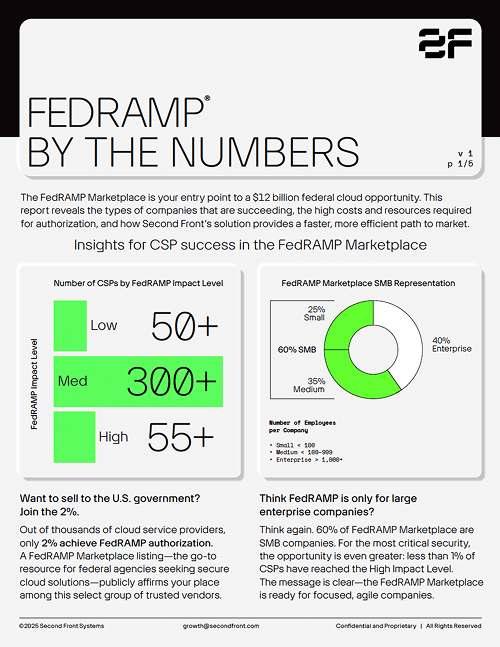
Unlock exclusive access to our FedRAMP By the Numbers Infographic—your front-row pass to a $12 billion federal cloud market opportunity!
Impact Levels are now Classes A through D
The four-tier sensitivity model keeps its structure and changes its labels. Impact Levels are now Classes, and the mapping is direct.
| New Label | Old Label | Notes |
| Class A | (new) | A new pilot baseline, not a rename of any existing tier |
| Class B | Low + Li-SaaS | Combines the old Low Impact Level and the Li-SaaS tailored baseline |
| Class C | Moderate | Systems holding controlled unclassified information; historically ~80% of certified applications |
| Class D | High | The most sensitive unclassified civilian data |
One label to call out: “FedRAMP Ready” is not becoming Class A. FedRAMP Ready is being retired, becoming legacy on July 28, 2026. No new FedRAMP Ready submissions will be accepted after that, and Class A is a separate new pilot baseline available only on the 20x path. Treat any lingering “FedRAMP Ready” in your copy as a term on its way out, not a tier mapping cleanly onto the new system.
Reading the letters as a security ranking is the other trap. A Class is not a grade of how secure a service is; it describes the scope of the assessment and the depth of information available for an agency’s decision. A Class B service is not “less secure” than a Class C service, it carries a different baseline of assessed information. This is the reason for dropping numbered “levels,” which invited the misreading. Keep it out of your copy: never imply a higher letter is a security upgrade, and never let a sales deck treat the Class as a quality score.
To state one more distinction plainly, because it slips into any copy touching both the civilian and defense worlds: a FedRAMP Class and a DoW Impact Level are not directly equivalent. The Class reflects civilian data sensitivity, the FIPS 199 high-water mark. The Impact Level reflects the sensitivity of defense data, with defense overlays layered on top. No direct one-to-one correlation links the two. A FedRAMP Class is the civilian floor a DoD Impact Level builds on, not a substitute for it. Erroneously map one onto the other as interchangeable and a federal reader will notice.
What stays the same
The rename is loud, but most of FedRAMP under the hood is not moving. Knowing what holds steady matters as much as knowing what changed, because it tells you which parts of your copy and your compliance work need no edit at all. The new labels do not change the requirements, purpose, or use of a FedRAMP grant; they relabel existing things to better fit the program’s statutory mandate.
The security requirements themselves are essentially unchanged. FedRAMP keeps four baselines of assessment, each demanding a different amount, and sometimes type or frequency, of information, with only minor changes to the baselines as the relabeling lands. A service pursuing the old Moderate baseline does not face a new control set under Class C; it faces the same controls under a new name. If your roadmap was scoped to a baseline before the change, the relabeling does not reopen it. The work you have already done still counts.
The underlying frameworks hold. FedRAMP still relies on NIST controls, and FIPS 199 security categories (low, moderate, high water marks) still drive how a system’s sensitivity is judged. The Class describes the depth of the assessment, not a replacement for the FIPS 199 categorization an agency relies on. The assessment lifecycle, an independent assessor evaluating the package and continuous monitoring sustaining it after the fact, all carry forward.
The authorization package keeps its function under its new name. Renamed the FedRAMP Certification Package, it is still the reusable set of materials an agency draws on to decide whether to run your service, and reuse across agencies is still the entire point. Build the package once, and many agencies can lean on it.
Agency responsibility is unchanged, and the rename actually sharpens why. A FedRAMP Certification is not a guarantee that a service meets all requirements for a given FIPS 199 category within a specific agency’s environment. The agency still makes the final risk-acceptance call under the Risk Management Framework (RMF) and may accept a Certification at a security category different from that of the certification itself. FedRAMP standardizes and accelerates that decision; it does not make it for the agency.
Two terms that look like rename candidates are not, and treating them as if they were is its own mistake. ATO, the Authorization to Operate, is still valid and still called an ATO. This is the term the Certification rename gets confused with most, so draw the boundary sharply. An ATO is an agency-level grant issued by an Authorizing Official, the decision a specific agency makes to accept the risk of running a system in its environment. A FedRAMP Certification is the program-level assessment that eases the decision. Distinct instruments, distinct parties, and the rename was built to keep them distinct, not merge them. When you mean the grant an agency issues, keep writing “ATO.”
The word “FedRAMP” alone is unchanged. The program is still FedRAMP, the website is still fedramp.gov, the marketplace is still the FedRAMP Marketplace. You are not renaming the program. You are renaming a handful of things inside it.
The rename travels with deeper changes
The terminology is the visible layer of CR26, but two structural shifts beneath it will shape how you actually maintain a certification, and both are worth knowing, even if they affect your operations more than your copy.
Evidence is going machine-readable. CR26 moves the program off hand-edited spreadsheets and word-processor templates toward structured, machine-readable requirements and packages, with providers expected to keep their certification data current through automation as changes occur rather than refreshing a static package once a year. If your compliance workflow still lives in Excel, that is the operational lift to plan for.
The package is splitting in two. What used to be a single authorization package now consists of the FedRAMP Certification Package, the assured information that FedRAMP manages, and the Security Decision Record (SDR), the agency-side record that an agency uses to make and document its own risk decision. The split is the concrete implementation of the rename’s logic: FedRAMP owns the assessed evidence, the agency owns the authorization decision, and the two are no longer blurred into a single artifact.
Where the new vocabulary meets the DoW
For commercial software vendors with defense ambitions, the change in terminology lands on a relationship that’s already easy to get wrong, so be precise about how the pieces fit. A platform’s FedRAMP Certification is a strategic bridge into the Department of War. It is the foundation for inheritance, not a defense authorization in its own right.
The mechanism matters. A FedRAMP Certification gives DoW Authorizing Officials (AOs) an established baseline of assessed controls to accept by reciprocity. That is the engine of DoW ATO reciprocity: the acceptance accelerates the path to a DoW Impact Level authorization such as IL4 or IL5. FedRAMP is the civilian baseline, the minimum. The Cloud Computing Security Requirements Guide (CC SRG), published by DISA, layers defense controls on top. A FedRAMP Certification is a prerequisite for high-level DoW reciprocity, not a replacement for the separate authorization the DoW still grants.
The policy environment is moving the same direction as the terminology. In September 2025, the DoW announced the Cybersecurity Risk Management Construct (CSRMC) as the successor to the legacy RMF. The transition is underway rather than complete, and RMF remains operative for most efforts today, but the trajectory is clear: CSRMC makes assessments threat-informed and mission-focused, requires continuous monitoring, and lets components revoke an ATO the instant risk thresholds break. That posture is what makes continuous ATO and real reciprocity work, because a receiving AO trusts live monitoring data over a year-old static package. The vocabulary is being cleaned up at the same moment the authorization model is being modernized, and both reward vendors who design for portability from the start.
How Game Warden absorbs the change for you
The shift in terminology points to a structural advantage independent of the wording. Build your own path to compliance and every rename is your burden: your documentation to update, your assessor conversation to repeat. Inherit a platform’s authorization and the platform carries that weight.
Your SaaS application deploys onto Game Warden, a FedRAMP Class D (High) Certified PaaS. Your software is the SaaS; the platform beneath it carries the inherited controls. That relationship is the point. You can obtain your ATO by leveraging and inheriting Second Front’s certification rather than assembling a control baseline from scratch, and you can get your own dedicated listing in the FedRAMP Marketplace rather than folding into someone else’s. Game Warden exists to streamline the route to authorization: control inheritance, automated evidence generation, a standardized body of evidence, continuous monitoring, and a clean separation between platform findings and your application’s findings. When FedRAMP changes its vocabulary, the platform’s certification updates, and customers running on it inherit the current posture without re-running the work.
The deadlines that should shape your roadmap
Between now and the start of 2027, the copy work runs in parallel with the compliance work. The deadlines are staggered rather than landing on a single day:
- July 4, 2026: CR26 published and took effect.
- January 1, 2027: Enforcement begins in earnest. Existing Rev5 certifications adopt new rules on their first independent assessment after this date.
- June 11, 2027: new Rev5 certifications (including agency-sponsored) stop being accepted as the program steers new entrants toward 20x
Individual rules include grace periods extending as far as October 2027 and February 2028, while existing Rev5 certifications remain active until at least December 31, 2028.
The vocabulary is changing because the program is getting more precise about what it grants and what an agency grants. Read the rename as the small, visible edge of a larger shift toward portable, continuously monitored authorization, and align your copy and your compliance strategy to where the shift is heading, not where it has been.
Ready to map your authorization path under the new terminology? Speak with our team to learn how Game Warden can compress your route to a FedRAMP certification you can inherit on day one.