Extreme risk aversion and fragmented compliance tools have traditionally forced software vendors to endure redundant, siloed Authority to Operate (ATO) assessments for every new U.S. Department of War (DoW) organization. However, a major shift is underway. The FY25 National Defense Authorization Act (NDAA) legally mandates presumptive reciprocity, while the DoW’s transition to the CSRMC replaces static paperwork with live, trustworthy continuous monitoring metrics. By architecting for portability from day one, maximizing control inheritance and cleanly isolating architectural deltas, vendors can escape the redundancy trap. Deploying on a pre-accredited DevSecOps platform like Game Warden generates standardized, eMASS-compliant evidence automatically, cutting compliance costs by up to 85% and compressing cross-command timelines from years to as little as 90 days.
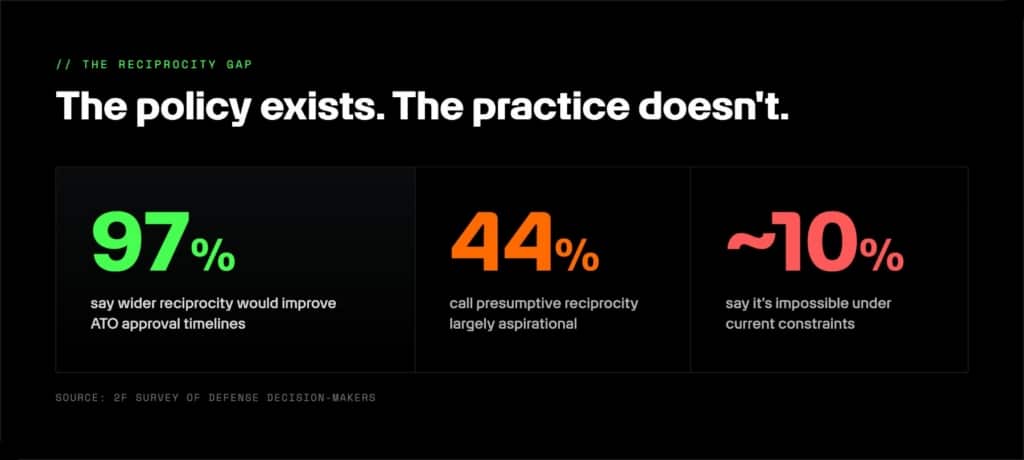
DoW ATO reciprocity lets one military organization reuse the security assessment and ATO granted by another, eliminating redundant cybersecurity reviews and accelerating deployment to the warfighter. The policy exists. The practice does not. A survey of defense decision-makers capture the gap precisely: 97% say wider use of reciprocity would improve ATO approval timelines, yet 44% call “presumptive reciprocity” largely aspirational and ~10% dismiss it as impossible under current constraints. That skepticism persists even as Congress and the Pentagon write reciprocity into law and policy. SecWAR Hegseth observed that when software acquisition and deployment doesn’t move fast enough, it’s “the warfighter that pays the price”.
The friction is structural. Traditional ATO processes are slow, unpredictable, and fragmented, undermined by inconsistent implementation, varying risk tolerances among Authorizing Officials (AOs), and a fractured set of compliance tools that do not talk to each other. Closing the gap is not a matter of issuing another memo. It demands an architectural shift in how vendors, defense contractors, and mission owners build for risk management.
A true deploy-anywhere ATO depends on three things:
- The legislative changes inverting the burden of proof
- The modernization reshaping the civilian cloud baseline beneath every DoW authorization
- The precise control deltas between DoW Impact Levels
Vendors who master all three can engineer their architectures to be reciprocity-ready and win faster acceptance across DoW commands.
The paradigm shift: from risk avoidance to presumptive reciprocity
For decades, AOs have been forced to take a risk averse posture. An AO assumes formal, personal responsibility for the security posture of their enclave, so the bureaucratic incentive has been to demand a fresh, ground-up Risk Management Framework (RMF) assessment for every new piece of software, regardless of prior accreditation elsewhere in the government. This “re-check everyone’s homework” reflex has paralyzed the deployment of commercial technology. Recent legislation and executive memoranda attack the reflex directly, moving the enterprise from a posture where reciprocity is a permissible option to one where it is a presumptive mandate.
The FY25 NDAA and the inversion of the burden of proof
The most consequential forcing function is Section 1522 of the Fiscal Year 2025 NDAA, which writes presumptive reciprocity into defense procurement law. An AO in any military department is now legally required to presume the cybersecurity adequacy of a cloud platform, service, or application already accredited by a peer AO for a similar purpose at an equivalent classification level. Obtain an ATO from an Air Force AO, and the Navy’s AO is expected to accept the package by default.
The point is to invert the burden of proof. Vendors once had to re-prove their security posture from scratch for every enclave. Now the receiving AO must produce a definitive, mission-specific technical justification to reject an existing authorization, and if an AO objects, the law mandates a formal adjudication process. Arbitrary rejection without data-driven reasoning is no longer an option.
Section 1522 also attacks the opacity of the authorization landscape, tasking the DoW Chief Information Officer and Military Department CIOs with building and maintaining a centralized digital directory of every AO across the DoW, including current contact information and training credentials. A vendor should finally be able to see who grants authorizations and how to reach them. However, the DoW CIO hasn’t yet satisfied this requirement.
The Hicks memorandum and the reciprocity playbook
A Deputy Secretary of Defense memorandum reinforces the legislation from the executive side, ordering testing reuse and reciprocity as the default standard for all AOs, except when cybersecurity risk is proven too great. Reciprocity comes first; a fresh assessment is the exception that must be justified. Denials cannot be quietly filed away. They escalate through service chains of command to the appropriate Agency Official for rapid resolution. The accompanying Cybersecurity Reciprocity Playbook gives AOs and Security Control Assessors tactical guidance, stressing that RMF demands informed risk management, not absolute risk avoidance, and requiring program managers to certify reciprocity was considered before any redundant authorization begins.
These directives are ironclad, yet translating them into practice stays hard. The obstacles sit one layer down, in the civilian cloud frameworks every DoW authorization is built on.
Navigating the civilian baseline: the evolution of FedRAMP reciprocity
For commercial vendors, the road to DoW reciprocity rarely starts at the Pentagon. It often starts at the Federal Risk and Authorization Management Program (FedRAMP), the civilian baseline the Cloud Computing Security Requirements Guide (CC SRG) is built on top of. FedRAMP is now undergoing systemic modernization, and the changes reshape what FedRAMP reciprocity requires of any vendor seeking cross-government deployment.
The demise of the JAB and the rise of the FedRAMP Board
OMB Memorandum M-24-15, “Modernizing the Federal Risk and Authorization Management Program,” overhauled FedRAMP governance and launched the FedRAMP 20x initiative. Its most disruptive move is dissolving the Joint Authorization Board (JAB). For over a decade a JAB P-ATO (Provisional Authority to Operate) was the gold standard for FedRAMP reciprocity, the signal that a cloud service had cleared the most rigorous review available and could be accepted by any federal agency. But the process was slow, fiercely competitive, and capacity-constrained, reaching only services with the broadest government-wide applicability.
The JAB is gone, replaced by the FedRAMP Board, a body of federal technology and cybersecurity executives including Chief Information Security Officers from DHS, the DoD, and GSA. The legacy JAB P-ATO designation is being retired and existing provisional authorizations re-designated. In place of one centralized, monolithic provisional authorization, the FedRAMP PMO, OMB, and the FedRAMP Board now champion Joint Authorization Groups: coalitions of agency IT leaders who identify Cloud Service Offerings with high reuse potential and issue joint authorizations, applying the presumption of adequacy by default.
Decentralized monitoring
A further shift changes what reciprocity demands. Continuous monitoring is decentralizing. FedRAMP once centrally managed continuous compliance monitoring for Cloud Service Providers holding a P-ATO; it has now ceased that function, handing responsibility to individual leveraging agencies, and the FedRAMP PMO no longer issues bespoke implementation guidance. Vendors must produce automated, data-driven security reporting to hold authorized status across multiple environments. Manually compiled documentation no longer scales.
The hierarchical reality: why FedRAMP alone does not travel
Holding FedRAMP Class C (Moderate) or Class D (High) does not guarantee DoW ATO reciprocity, and assuming it does is a costly failure mode. FedRAMP and the CC SRG are hierarchical, not parallel. A 2014 DoW CIO memorandum set FedRAMP as the absolute minimum security baseline for all DoW cloud services, and the CC SRG, published by the Defense Information Systems Agency (DISA), does not replace it. The CC SRG takes FedRAMP as its foundation and overlays defense-specific security, physical, and personnel controls on top. A FedRAMP Certification is best understood as a strategic bridge: it gives DoW AOs an established baseline of assessed controls they can accept by reciprocity, accelerating the path to a DoW Impact Level authorization. It is a prerequisite for that path, never a substitute for it.
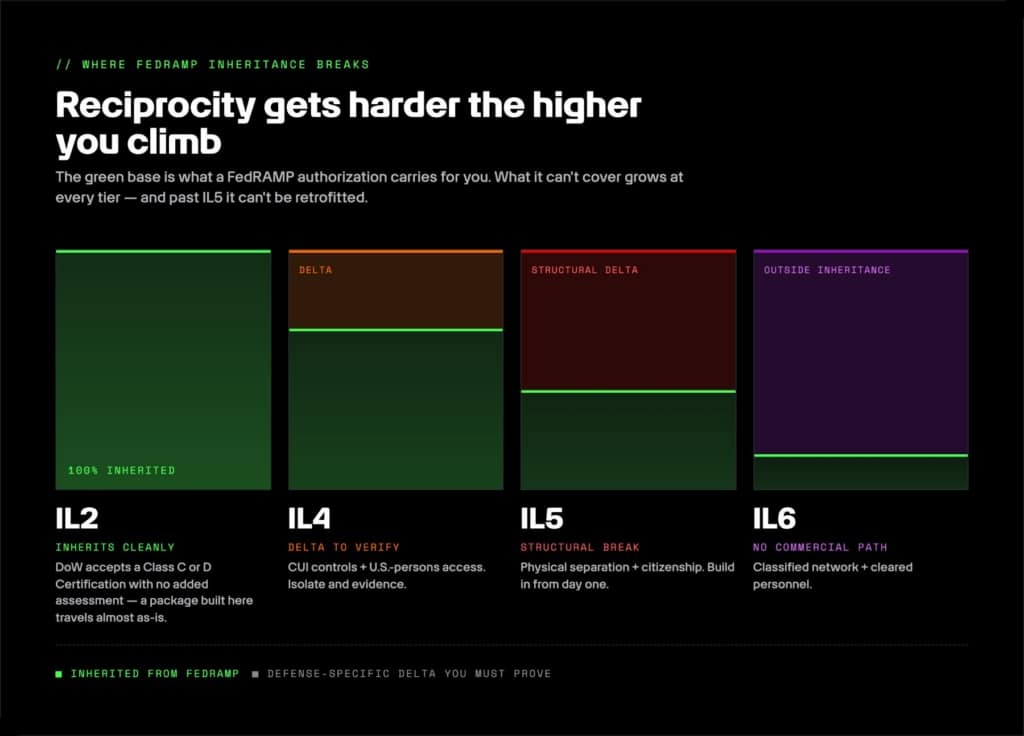
What matters for a reciprocity package is not the full taxonomy of Impact Levels but where the deltas between them break inheritance. IL2 inherits cleanly: it maps to the FedRAMP Class C baseline, so the DoW accepts a Class C or Class D Certification with no additional assessment, and a reciprocity package built at that tier travels almost as-is. The break points appear higher up. At IL4, the CUI-specific FedRAMP controls and the U.S.-persons access restriction introduce a delta a receiving AO must verify, which means the package has to isolate and evidence those controls separately rather than fold them into the civilian baseline. At IL5, the divergence is structural: the move from logical to physical separation and the citizenship requirement are not control refinements but architectural, and a package that does not already demonstrate them cannot be made reciprocal after the fact. IL6 compounds this with classified-network, and cleared-personnel requirements that sit outside any commercial inheritance path entirely.
The practical takeaway for reciprocity is that the higher the tier, the more of the package consists of deltas the receiving AO cannot take on faith from the FedRAMP baseline, and the more those deltas must be pre-built and cleanly evidenced rather than retrofitted. For the full control-by-control breakdown of how IL4 and IL5 differ, see Achieving DoD CC SRG compliance: navigating FedRAMP and DISA Impact Levels (IL4 vs. IL5); for how the FedRAMP classes line up against each Impact Level, see FedRAMP vs. DoD IL levels: key differences explained.
The architectural friction of RMF reciprocity
DoDI 8510.01 makes ATO reciprocity the default operational posture for systems already deployed in the DoW, directing organizations to reduce redundant testing and documentation. Technical and cultural flaws sabotage that intent the moment a vendor tries to move an authorization between components.
The mechanism for managing RMF compliance in the DoW is the Enterprise Mission Assurance Support Service (eMASS). A vendor makes its authorization documentation available, and reciprocity users in the receiving command review it to identify common controls. Tool fragmentation breaks the exchange. The federal ecosystem has no single system of record; components run a fractured mix of eMASS, Xacta, and CSAM, each with its own workflows, and moving data between them requires intensive manual translation. DoDI 8510.01 compounds the problem by declining to dictate standardized artifact formats, so packages vary wildly in structure, depth, and quality. When a vendor hand-transfers non-standardized artifacts between fragmented tools, organizations frequently repeat up to 80% of the authorization work for each new enclave boundary.
Reciprocity is ultimately an exercise in trust, and the human element is the hardest barrier to a deploy-anywhere ATO. A control implementation an Air Force AO accepts may fall short of a Navy AO’s risk threshold under a different mission context. Receiving AOs can refuse reciprocity whenever they judge the inherited package thin on technical content. Without automated gap analysis to map control deltas instantly, a single rejection triggers a full, redundant reassessment, and risk-averse default rejection becomes the path of least resistance.
Operationalizing agility: cATO and joint authorization frameworks
To get past manual artifact reviews and subjective trust gaps, the DoW is pivoting to the Continuous Authority to Operate (cATO) framework. Traditional RMF treats assessment as a discrete, periodic event; cATO integrates validation continuously into the development lifecycle. The governing policy shift is explicit: in September 2025, the DoW announced the Cybersecurity Risk Management Construct (CSRMC) as the successor to the legacy RMF. Where RMF made monitoring periodic and ran eMASS updates annually, CSRMC makes assessments threat-informed and mission-focused, integrates security directly into pipelines, requires continuous monitoring, and lets components revoke an ATO the instant risk thresholds are breached.
The effect on reciprocity is decisive. Under static RMF, reciprocity was permitted but rarely used because the documentation decayed fast. Under cATO it becomes an operational expectation: receiving components accept peer authorizations because their reliance shifts from a year-old PDF to live monitoring data flowing from an accredited DevSecOps pipeline. Because a cATO can be revoked the moment a critical vulnerability surfaces, receiving AOs get the real-time visibility and confidence to trust external authorizations.
Architecting for “build once, deploy anywhere”
A bespoke, one-off authorization for a single command is no longer a viable strategy. It traps the vendor in an accreditation silo and blocks scaling across the enterprise. The alternative is to architect for a deploy-anywhere ATO from day one, the foundational mechanism being control inheritance. Instead of satisfying every NIST 800-53 control natively, a vendor deploying on a pre-accredited DevSecOps platform inherits most of the underlying infrastructure and platform-level controls automatically. What makes the inheritance portable is a standardized, machine-readable Body of Evidence (BoE) that anticipates the delta between agency requirements and cleanly demarcates which controls are native to the application, which come from the cloud service provider, and which come from the CI/CD pipeline. During cyber test and evaluation, infrastructure-layer and application-layer findings stay separated so a receiving AO can run a fast, accurate gap analysis without re-evaluating an already-accredited stack.
Second Front Systems built Game Warden to operationalize this model and streamline the path to a DoW Impact Level authorization. The platform itself is FedRAMP High (Class D) Certified, along with holding a Provisional Authorization from DISA for Impact Levels 2, 4, and 5; this serves as the foundation for inheritance that gives DoW AOs an established baseline of controls they can accept by reciprocity, which is what shortens the route to an IL4 or IL5 authorization rather than starting the assessment over. A vendor deploying on Game Warden inherits that ATO and meets strict Zero Trust standards from the outset rather than bolting defense compliance on later. The platform generates comprehensive, eMASS-compliant evidence packages automatically, removing the documentation ambiguity that pushes AOs to reject reciprocity requests. Because it scales across major cloud providers and supports deployments from FedRAMP Class B through Class D and across IL2 to IL6, the resulting authorization is portable by design.
Leaning into FedRAMP reciprocity pathways and continuous authorization platforms can compress ATO timelines to as little as 90 days and cut overall compliance costs by an estimated 40% to 85%. More importantly, it puts best-in-class capability in the warfighter’s hands at the speed of relevance instead of stalling it in administrative gridlock.
Strategic synthesis
DoW software authorization has crossed an irreversible line. The isolated, single-use ATO is being driven out by operational necessity, nation-state threats, and explicit legislative mandate. The FY25 NDAA and the DoD CIO memoranda have reset the burden of proof, making RMF reciprocity the presumptive standard and forcing AOs toward data-driven risk management over reflexive risk avoidance. At the same time, the civilian baseline is modernizing underneath them: the centralized JAB is retired, the taxonomy is going class-based, and continuous monitoring is devolving to joint agency coalitions. Vendors now have to understand exactly how FedRAMP baselines map to the physical separation and personnel requirements of the DoW Impact Levels.
The wrong move is to chase a single authorization and hope it travels. The right move is to architect for portability from the start, generating the real-time, transparent trust metrics that let an application inherit cross-command authorizations. Reciprocity readiness is no longer a compliance tactic. It is the technical requirement for market scale, lower friction, and outsized mission impact in the modern defense enterprise.
Ready to position your authorization for reciprocity across DoW commands? Speak with our team to learn how Game Warden can compress your path to a portable, deploy-anywhere ATO.