A pre-accredited DevSecOps platform is a managed software development and delivery pipeline with pre-configured compliance controls, security, tooling, and pre-certified hosting infrastructure. Commercial independent software vendors (ISVs) can inherit a FedRAMP Certification or DOW Authorization, rather than building and documenting those environment requirements from scratch. For ISVs crossing the federal security perimeter, it removes the single biggest bottleneck in government procurement: the compliance timeline. A vendor taking the traditional do-it-yourself path toward an Authorization to Operate (ATO) typically spends 12 to 36 months re-architecting systems, writing documentation, and waiting on assessors before a single dollar of federal revenue arrives. Deploying on a pre-accredited platform compresses the path to as little as 90 days. Second Front customer Sustainment reached full DOW accreditation in 58 days.
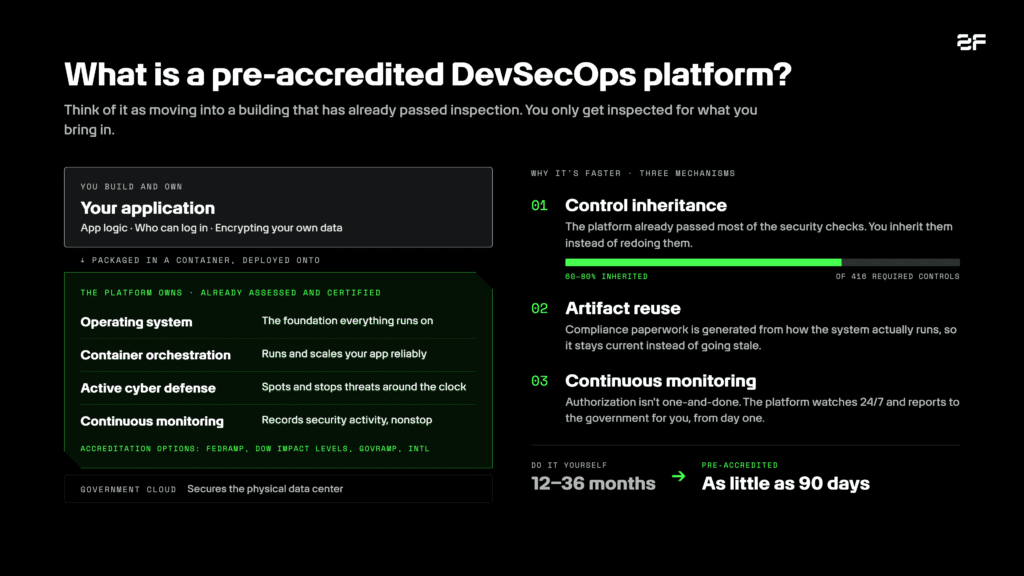
The acceleration is not a procedural shortcut or a waiver. It is inheritance math. A system at the FedRAMP Class D (High) impact level carries 416 discrete security controls an organization must implement, document, and have independently assessed. A pre-accredited platform strikes 60 to 80 percent of them off the vendor’s list, because the platform has already built those controls, evidenced them, and carried them through certification.
What is a pre-accredited DevSecOps platform?
A pre-accredited DevSecOps platform is a managed Platform as a Service (PaaS) pairing modern continuous integration and continuous delivery (CI/CD) tooling with a federal compliance boundary already carried through accreditation. The distinction matters most when compared with raw Infrastructure as a Service (IaaS). On an IaaS deployment, such as virtual machines provisioned on a government cloud, the provider secures the physical data center and the hypervisor. Everything above the hypervisor belongs to the vendor: hardening the guest operating system, configuring network firewalls, standing up vulnerability scanning, managing cryptographic boundaries, and writing hundreds of pages of documentation. The difference shows up in the numbers. A bare metal IaaS deployment inherits roughly 20 percent of required controls, while a specialized DevSecOps platform lifts the share to 60 percent or more before the vendor writes a line of compliance documentation.
A pre-accredited platform absorbs the difference by taking on the layer IaaS leaves exposed. Built to the U.S. Department of Defense Enterprise DevSecOps Reference Design, the platform owns the operating system, the container orchestration plane, active cyber defense, and continuous monitoring telemetry. A vendor containerizing its application and deploying onto the platform enters an environment whose underlying controls have already been independently assessed and then certified by FedRAMP or authorized by the relevant DOW authority. The vendor’s application is the SaaS; the platform beneath it is the PaaS carrying the inherited controls.
A FedRAMP Certification Class and a DOW Impact Level (IL) sit on separate axes, one reflecting civilian data sensitivity and the other reflecting defense sensitivity with additional overlays, and a certification does not by itself confer an ILl authorization. A pre-accredited platform offers a single substrate that supports deployment across the spectrum. Second Front’s Game Warden, for example, holds a Defense Information Systems Agency (DISA) Provisional Authorization at IL5 alongside FedRAMP Class D (High) Certification, in addition to multiple service-specific ATOs. The Certification works as a bridge into defense reciprocity: its controls are already independently assessed, so a DOW Authorizing Official (AO) can accept them rather than reassess them from scratch. Reciprocity shortens the path to an IL authorization.
How it speeds accreditation
Compressing a multi-year federal audit into a 90-day deployment comes down to three mechanisms: control inheritance, artifact reuse, and continuous monitoring.
Control inheritance
The federal Risk Management Framework (RMF), governed by NIST SP 800-37 and NIST SP 800-53 Revision 5, sets the specific security and privacy controls a system owner must identify, implement, and have independently assessed. Inheritance changes the arithmetic by formally connecting two accreditation boundaries through a Customer Responsibility Matrix (CRM). The CRM sorts every NIST 800-53 requirement into three categories:
- Common controls belong to the platform outright. The platform has already carried its own System Security Plan (SSP) through a third-party assessor and government accreditation, so the vendor’s assessor can rely on existing assessment evidence rather than reassessing the physical perimeter, incident response, or patching cadence from scratch.
- Hybrid controls split the work. Under the Audit and Accountability NIST control family, the platform supplies the centralized, tamper-evident logging repository, and the vendor routes its own application logs into it.
- System-specific controls stay with the vendor. They stay narrow: application logic, role-based access control, and the data-layer encryption the vendor’s own code enforces.
The net effect is a radically narrower audit scope. The assessor examines the vendor’s application logic, not the complex stack beneath it. Executed under an In-boundary model on a platform certified at FedRAMP Class D removes 60 to 80 percent of the required 416 controls from a vendor’s direct scope, the single largest lever on certification velocity. Second Front’s How to Maximize Control Inheritance guide walks through the full breakdown for a team scoping its own CRM.
Artifact reuse
Automated, machine-readable evidence replaces static documentation. The old approach earned its own nickname, the “Frankenstein SSP”: a 500-page document, stale the moment a deployment changed a configuration beneath it. A pre-accredited platform treats compliance as code instead, pulling deterministic telemetry from the running infrastructure and generating the configuration state as evidence, rather than asking an engineer to write a paragraph asserting a control is in place. The output follows the Open Security Controls Assessment Language (OSCAL), the NIST standard for structured, machine-parseable authorization data, and federal assessment is moving toward it as agencies retire narrative packages. SSP generation drops from hundreds of manual engineering hours to a fraction of the time, and the document stays current, because the system generates it from how it actually runs rather than from how an engineer described it months earlier.
Continuous monitoring
An accreditation under NIST SP 800-53 control CA-7 is not a one-time achievement. It requires a sustained state of secure operations, and vendors on the do it yourself path routinely underestimate the infrastructure and staffing behind it: 24/7 logging, real-time alerting, and remediation of high-severity vulnerabilities inside strict service windows. A pre-accredited platform provisions all of it as a managed capability from day one, aggregating threat intelligence, tracking container health, and feeding compliance data into federal systems such as the Enterprise Mission Assurance Support Service (eMASS).
Uninterrupted telemetry is the precondition for a Continuous Authorization to Operate (cATO). Instead of trusting a single software release, the AO trusts the pipeline producing every release, because the pipeline can show static and dynamic code analysis, container hardening, automated Software Bill of Materials (SBOM) generation, and active cyber defense at each stage. The same telemetry supports the DOW’s Zero Trust Target Level requirements and the zero trust principles described in NIST SP 800-207, which assume a hostile network and demand continuous verification of every identity and workload rather than a one-time perimeter check.
Pre-accredited vs. standard DevSecOps
The two paths diverge on every axis a vendor cares about.
| Metric | Standard do it yourself DevSecOps | Pre-accredited DevSecOps platform |
|---|---|---|
| Initial ATO timeline | 12 to 36 months | As little as 90 days (58-day record) |
| Control Baseline Burden | Vendor implements and evidences all 416 controls | Vendor inherits 60 to 80 percent through a CRM |
| Artifact generation | Manual, static documentation | Automated, machine-readable telemetry (OSCAL / Evidence-as-Code) |
| Source Code & IP Risk | Requires exposing source code / self-managed infra | Container-level scanning only; source code stays private. |
| Continuous monitoring | Built, staffed, & maintained internally | Provided as a managed Day 2 platform capability |
| Market scalability | Prone to the retrofit trap at each new tier | Single substrate supporting civilian through classified tiers |
A do it yourself FedRAMP Certification or DOW authorization effort typically runs about $1.5 million in its first year, and a complex build requiring real architectural rework, repeated assessments, or a dedicated security tooling stack, can push toward $3.7 million before a vendor books its first dollar of federal revenue. Second Front’s accreditation dilemma breakdown covers the spend phase by phase and shows how a platform model can reduce the architecture, engineering, and tooling burden of authorization.
The time lost matters as much as the money. Programs of Record, competitive procurements, and SBIR Phase III awards all run on fixed delivery clocks, and a vendor spending 36 months on a do it yourself accreditation risks watching its funding window close or its capability age out before the ATO arrives. Compressing the path to 90 days converts 12 to 30 of those months into federal revenue.
Real-world example
Collaboration.AI shows the model on the defense side. The company needed DOW network access for CrowdVector, its AI-driven innovation management platform, without the multi-year ATO path a startup can’t absorb. Deploying on Game Warden with a registry of minimal, hardened container images, Collaboration.AI secured a Certificate to Field for DoD networks in under 90 days, saving nearly two years of work and roughly $2 million in compliance costs.
Onebrief shows it at the top of the civilian baseline. The AI-powered command decision platform achieved FedRAMP Class D (High) Certification through Game Warden, which supplied the inherited security controls and continuous monitoring beneath the application. Onebrief is now listed on the FedRAMP Marketplace under the Game Warden authorization, so agencies can deploy it for sensitive unclassified planning without running duplicative security reviews. That is reciprocity working as designed. Onebrief pairs the certification with DOW IL5, IL6, and Top Secret authorizations for its AtomEngine, covering both axes of the federal market from a single compliance strategy.
The regulatory perimeter around federal software is not softening. A pre-accredited DevSecOps platform turns that crossing from a multi-year engineering crisis into a scoped, repeatable step in the deployment plan. Ready to map your own path to authorization? Talk to Second Front’s team about how Game Warden can compress your route to FedRAMP Certification, DOW authorization, and beyond.