Providers holding or pursuing FedRAMP Class D (High) Certification face a practical question from state, local, education, and tribal (SLED) buyers: will GovRAMP require another assessment, and how much of their federal work counts? In most cases, a provider’s technical evidence carries over, because GovRAMP’s Fast Track process accepts a FedRAMP security package, its third-party assessment, and its continuous monitoring data in federal format. Whatever remains is normally administrative or tied to the type of data a state agency handles.
GovRAMP grew out of a gap in federal coverage. FedRAMP’s protections reach only cloud providers selling to federal agencies, which left state and local governments without a consistent way to see a provider’s security package or monitoring record before trusting it with their data. States responded by writing GovRAMP status into procurement rules. Georgia and North Carolina went further and set full-compliance dates in 2027, which puts a deadline on any provider’s reuse decision in either state.
Our earlier post, FedRAMP 20x vs. traditional sponsorship compared two paths to FedRAMP Certification and showed how federal evidence can feed GovRAMP Fast Track. Here, we follow the same evidence into state and local procurement. Below, we cover two routes into GovRAMP, detailing:
- Who decides whether a state accepts a package
- Whether a Class D package covers lower impact levels
- Whether buyers require a GovRAMP listing
- Which data rules sit outside GovRAMP
- What a provider still owns after inheriting controls
- How state deadlines set a start date
When GovRAMP becomes a requirement for state contracts
Utah’s requirements took effect in 2025, and Nevada’s GovRAMP-based requirements for executive branch agencies followed on July 1, 2026. Georgia and North Carolina subsequently published fixed dates for GovRAMP compliance. Georgia’s requirements took effect on October 1, 2026, for new state procurements with a cloud service component, and full compliance with GovRAMP verification becomes mandatory on July 1, 2027. Between October 1, 2026, and July 1, 2027, Georgia runs an on-ramp period, during which qualifying providers actively progressing through GovRAMP can use interim verification pathways. North Carolina started earlier, attaching GovRAMP-aligned requirements to new contracts with a cloud component from April 1, 2026, under its own on-ramp period. In North Carolina, full compliance becomes mandatory on April 1, 2027.
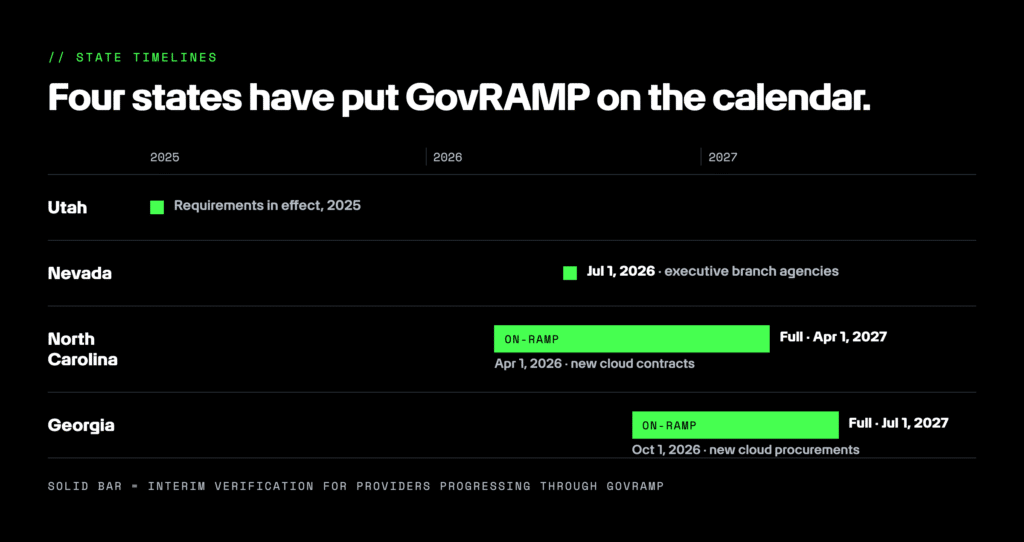
For a provider already under contract, a renewal or amendment can bring GovRAMP terms earlier than current and future states’ full-compliance date, meaning their first deadline falls on whichever arrives first.
Other states adopted GovRAMP through contracts, security reviews, and vendor risk programs, according to a GovRAMP release on state adoption. Arizona moved its statewide vendor risk program into GovRAMP. Indiana uses GovRAMP to set a vendor security standard under Governor Mike Braun’s executive order calling for an enterprise standard. Massachusetts uses GovRAMP in technology vendor security reviews, while Minnesota relies on it to evaluate vendors handling highly sensitive data. New Hampshire references GovRAMP in state contracts, and Oregon uses it in contracting to hold every vendor to one security baseline. North Dakota folded GovRAMP into its third-party risk management program and draws on authorization package documents to monitor critical vendors.
State officials quoted in GovRAMP’s release credited GovRAMP with shorter vendor reviews and fewer repeated assessments. Even in states without a published deadline, procurement and vendor risk teams check a provider’s GovRAMP status. Once a provider knows which dates apply, its next decision concerns which route it takes into GovRAMP.
Two routes to GovRAMP
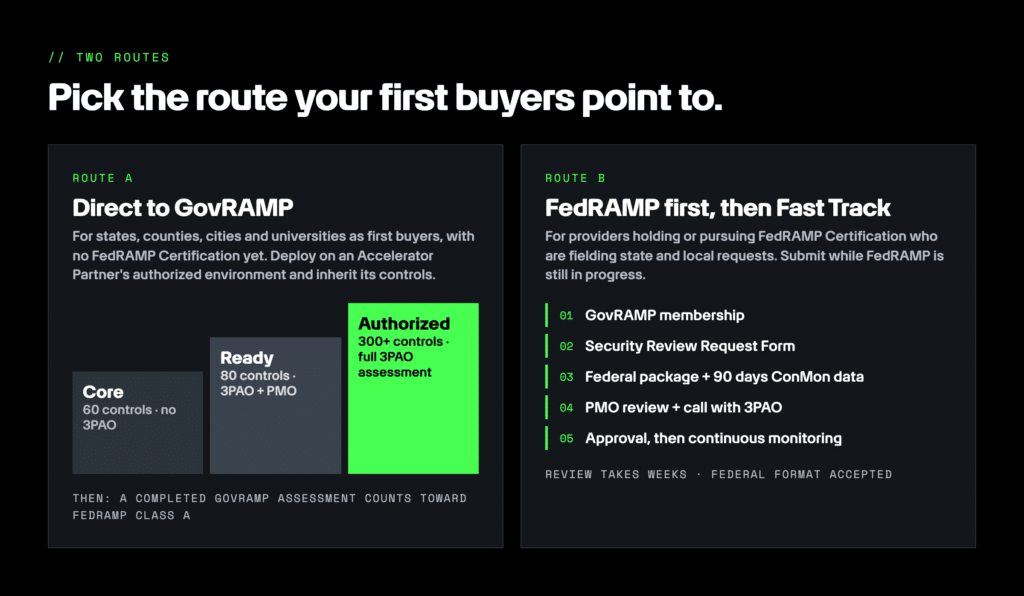
A provider can pursue GovRAMP directly or carry an existing FedRAMP effort into GovRAMP through Fast Track. A provider’s first customers should guide its choice, since a provider reuses its first assessment in whichever program it adds second. Reuse now runs in both directions: GovRAMP’s Program Management Office (PMO) accepts FedRAMP packages through Fast Track, and FedRAMP counts a recent GovRAMP assessment toward Class A Certification under its 2026 rules.
Direct to GovRAMP on an authorized platform
Who it fits: Providers whose first buyers are states, counties, cities, or universities and who do not yet hold FedRAMP Certification.
Under GovRAMP’s Accelerator Partner Program, a provider deploys on an accelerator’s GovRAMP Authorized environment and inherits the environment’s validated security controls. The provider keeps an individual listing on GovRAMP’s Authorized Product List. Second Front joined as a founding Accelerator Partner when GovRAMP launched the program.
The direct route progresses through three GovRAMP verification levels, each with a different assessment scope:
- Core covers 60 prioritized NIST controls and does not require a third-party assessment.
- Ready covers 80 controls validated by a third-party assessment organization (3PAO) and GovRAMP’s Program Management Office (PMO).
- Authorized requires a comprehensive 3PAO assessment of more than 300 controls.
Starting with GovRAMP leaves a path into the federal market. Under FedRAMP’s Consolidated Rules for 2026, a completed GovRAMP assessment qualifies as an approved alternative security framework for FedRAMP Class A Certification. A provider can pursue GovRAMP for its first customers and add FedRAMP later.
FedRAMP first, then Fast Track
Who it fits: Providers holding or pursuing FedRAMP Certification who are fielding requests from state and local buyers.
GovRAMP’s Fast Track process accepts a provider’s FedRAMP security package and 3PAO audit in their federal form. GovRAMP says the review takes weeks, and providers can submit while their FedRAMP Certification is still in progress.
The process begins with GovRAMP membership. A provider then submits a Security Review Request Form to open intake with the PMO and works with its 3PAO to assemble the federal package. The submission includes 90 days of continuous monitoring data where applicable, along with any required GovRAMP templates.
Once the package is complete, the PMO reviews the submission and holds a call with the provider and its 3PAO to finalize documentation. Approval begins the next obligation: continuous monitoring to maintain GovRAMP status and the product listing.
How the FedRAMP boundary carries over
GovRAMP and FedRAMP share a technical foundation: both build on NIST SP 800-53 Rev 5 with Low, Moderate, and High baselines, and both require a FedRAMP-recognized 3PAO accredited by A2LA. Those shared requirements give GovRAMP reviewers a familiar body of federal assessment evidence to evaluate.
A FedRAMP Class D (High) package aligns with GovRAMP’s High impact level. Because NIST SP 800-53 baselines nest, a High control set contains every Moderate and Low control. Under FedRAMP’s Rev. 5 baselines, Class D (High) includes 410 controls, compared with 323 for Class C (Moderate) and 156 for Class B (Low).
Through Fast Track, providers submit that federal package to GovRAMP’s PMO for review. The system security plan, 3PAO assessment, and continuous monitoring record document a specific authorization boundary and its security controls. State reviewers can therefore examine the same boundary federal assessors already tested.
For providers deployed on a certified platform, the package also documents control inheritance. A Customer Responsibility Matrix (CRM) records how responsibilities are divided: which controls the platform provides, which the provider owns, and which belong to the customer agency.
The share of inherited controls depends on the deployment model. Raw infrastructure as a service supplies roughly 20 percent of required controls, while a DevSecOps platform such as Game Warden raises inheritance to approximately 60 percent for an out-of-boundary deployment and roughly 80 percent for an in-boundary deployment. Inheritance reduces the evidence a provider must produce, but the division of responsibility remains explicit. Controls assigned to the provider stay with the provider in both the federal and GovRAMP packages.
What carries over and what does not
Most of the federal package transfers to GovRAMP intact. Membership, an approval decision, and data-specific agreements require separate work. The table below shows how GovRAMP treats each element of a FedRAMP Class D (High) package.
| Element | Carries over? | What to know |
|---|---|---|
| NIST SP 800-53 Rev 5 control implementation | Yes | Both programs use Rev 5 with Low, Moderate, and High baselines. |
| 3PAO assessment | Yes | The PMO accepts FedRAMP formatting. The 3PAO must be FedRAMP-recognized and A2LA-accredited. |
| Authorization boundary and system documentation | Yes | The PMO reviews the federal package. Confirm the boundary’s scope with the PMO at intake. |
| Continuous monitoring data | Partly | 90 days of federal continuous monitoring logs transfer directly. However, ongoing monthly state reporting runs separately unless fully automated and managed by your platform provider. |
| Authorization decision | No | FedRAMP’s statutory Presumption of Adequacy does not bind states. Approval requires either a specific state agency sponsor or review by the 5-member GovRAMP Approvals Committee. |
| Membership and fees | No | Providers must become members before entering Fast Track. Fast Track fees match the standard process. |
| Protected federal agency information | Check | Providers may need to redact protected information from the package. The PMO handles restricted information case by case. |
| CJIS | No | Each state’s CJIS Systems Agency and the CJIS Security Addendum govern the requirements. FedRAMP evidence supports the agreements. |
| IRS Publication 1075 | No | Federal tax information in the cloud requires FedRAMP Certification, onshore services, FIPS 140 encryption, and multifactor authentication for remote access. |
Technical evidence accounts for every row marked yes. Rows marked no involve a decision, membership, or data-specific agreement controlled outside FedRAMP. Reusing the assessment preserves the federal work while leaving those separate obligations with the provider.
Where state requirements go beyond GovRAMP
State buyers specify the GovRAMP status and impact level a contract requires. Under GovRAMP’s procurement guidance, a government can make verification a mandatory RFP requirement for systems handling Moderate or High impact data, or regulated information such as personal, health, criminal justice, or financial data. In GovRAMP’s sample clause, a contractor agrees to “maintain a current GovRAMP [Authorized/Provisional] status at the applicable impact level” and to take part in GovRAMP’s continuous monitoring program.
Buyers can check status on GovRAMP’s Program Participants List, which combines the Authorized Product List and the Progressing Product List and updates daily. For a Moderate or High solicitation built on GovRAMP’s guidance, an Authorized or Provisionally Authorized listing satisfies the clause. Buyers can also request a provider’s continuous monitoring information through GovRAMP, which releases it only after the provider approves access.
GovRAMP’s guidance also outlines options for providers that do not hold full authorization. Buyers may accept Core for low-risk tools or make a conditional award with a defined authorization timeline, such as moving from Ready to Authorized within 12 months. The Progressing Product List identifies participants in GovRAMP’s Progressing Security Snapshot program, where quarterly assessments track each provider’s improvement. On-ramp periods, including those available through Georgia’s interim verification pathways, give providers actively progressing through GovRAMP time to reach the required status. Providers should therefore check the status, impact level, and on-ramp terms in each solicitation, then confirm that their listing meets those requirements.
Georgia adds a separate approval layer. Under the state’s GovRAMP adoption, cloud services purchased through Georgia’s enterprise IT procurement process need GovRAMP validation and approval from the Georgia Technology Authority (GTA). GTA states requirements can vary by policy, risk, data, procurement method, contract, and use case. GTA also notes GovRAMP status does not guarantee an agency can use a product, because other technology, cybersecurity, privacy, legal, and procurement requirements can apply. Georgia agencies keep responsibility for business needs, risk decisions, and agency-specific controls. In Georgia, a GovRAMP listing qualifies a product for consideration, and GTA and the purchasing agency make the final call.
CJIS agreements remain state-specific
CJIS (Criminal Justice Information Services) requirements for criminal justice data sit outside GovRAMP verification. The FBI does not certify cloud services for CJIS compliance; a provider instead signs the CJIS Security Addendum and enters an agreement with each state’s CJIS Systems Agency (CSA), a state agency responsible for CJIS compliance. Under the Addendum, a uniform agreement approved by the U.S. Attorney General, a contractor commits to a security program consistent with federal and state requirements and agrees to use criminal justice information only for an agency’s stated purposes. CSA agreements also cover screening of provider personnel with access to criminal justice information.
Starting with version 6.0, the CJIS Security Policy is structured around the NIST SP 800-53 Rev. 5 control families, replacing 13 policy areas used in version 5.x. A CSA can therefore review a provider’s FedRAMP evidence family by family. GovRAMP also publishes a CJIS-aligned overlay for law enforcement and criminal justice environments. Providers must still execute the Addendum and a CSA agreement in every state where they serve criminal justice customers, so a provider serving police departments in five states signs five CSA agreements.
Federal tax information has additional requirements
Federal tax information (FTI) has its own requirements under IRS Publication 1075, and the IRS Office of Safeguards states FedRAMP certification and 3PAO attestations alone do not meet them. Under IRS cloud computing guidance, an agency may place FTI only in a FedRAMP-certified cloud service at Class C (Moderate) or higher, and all FTI must physically reside onshore. Access to and support of the agency’s system must come from within the United States, with no administrator access from offshore networks. FTI must be encrypted in transit and at rest with FIPS 140-validated modules, and the agency must retain control of its encryption keys. Remote access requires multifactor authentication at Authenticator Assurance Level 2, and contracts must cover background checks and FTI training beyond FedRAMP’s requirements. If an unauthorized disclosure or breach occurs, the provider and agency report it to IRS Safeguards within 24 hours.
What state technology leaders are prioritizing
Artificial intelligence ranked first in NASCIO’s 2026 State CIO Top Ten for the first time. The list’s 20th edition drew responses from 51 state and territory CIOs, and cybersecurity and risk management moved to second after 12 consecutive years at the top. Modernization, digital government services, identity and access management, data management and analytics, and cloud services also made the list.
In NASCIO’s companion 2026 State CIO Survey, CIOs said states will need to strengthen governance, cybersecurity, data, procurement, workforce readiness, and cost controls as AI use expands. In the same survey, 73 percent of CIOs planned to expand public cloud use. State AI projects and cloud expansion both reach agencies through procurement, where GovRAMP terms now appear.
Georgia’s GovRAMP requirements cover any procurement with a cloud service component. Under Georgia’s rule, AI models, analytics platforms, and identity services purchased as cloud services on new Georgia contracts all fall within GovRAMP requirements, so an AI provider selling into Georgia meets GovRAMP at the procurement stage.
Cohere provides an example from enterprise AI. Cohere, a frontier AI provider, achieved GovRAMP Authorized verification through Game Warden, the highest verification level in its security program. Cohere also achieved FedRAMP Class D (High) Certification through Game Warden by inheriting Second Front’s certification. Cohere reached federal and state accreditation through one platform.
Where Second Front fits
Game Warden holds GovRAMP High Authorization alongside FedRAMP Class D (High) Certification. Second Front also participates in GovRAMP as a founding Accelerator Partner and an Elite Member.
Deploying on Game Warden lets a provider pursue multiple accreditations from the same boundary. The provider deploys its application once, then pursues FedRAMP Certification for federal civilian agencies, GovRAMP Authorization for state and local buyers, and War Department Impact Level Authorizations for defense customers. Mamie Cruse of Second Front described pursuing FedRAMP and GovRAMP together as “its own fast track” for software vendors.
For providers taking the FedRAMP-first route, Second Front’s GovRAMP Fast Track service operates as an add-on to the federal framework. The service requires an active or in-flight FedRAMP Marketplace listing and covers membership and renewals, service request submission, and PMO intake calls. Second Front also coordinates the audit and compiles the package, including conversion to Open Security Controls Assessment Language (OSCAL) or GovRAMP templates. After approval, the service covers monthly continuous monitoring and upkeep of the plan of action and milestones (POA&M).
What comes next: evaluating the proposed 20x delta assessment
GovRAMP has opened public comment on RFC GR-2601, a proposed 20x Delta Assessment. Comments close December 4, 2026, at 5 p.m. ET.
The proposal has two parts. Part A sets out assessment guidance based on a crosswalk of FedRAMP 20x Key Security Indicators (KSIs) to NIST controls. Part B proposes a risk-based method for evaluating NIST controls without a KSI mapping.
GovRAMP describes the proposal as a bridge between 20x assessment concepts and the NIST-based requirements behind GovRAMP. The goal is to reduce duplicate assessment work and encourage evidence reuse. Any cloud service provider or 3PAO can comment, regardless of GovRAMP membership. Second Front will examine the proposal in a later post.
Ready to map your state and local path? Speak with our team about reaching GovRAMP Authorization on Game Warden.