Companies acquire software for innovation, not compliance. A growth-stage software company expects to attract engineering talent, accelerate time-to-market, and integrate the target’s product into a broader portfolio to realize gains rapidly. But when an acquired software solution must climb a traditional FedRAMP or DoW Authority to Operate (ATO) ladder, the reality sets in: engineering shifts from building products to building paperwork. That shift can freeze the product roadmap for 18 to 24 months, drive away the engineers the deal was meant to keep, and quietly destroy the valuation upside the acquirer priced in.
The deal thesis said nothing about this. The financial model assumes rapid time to value. Boards and investors expect cross-sell revenue within the first 12 months. Then the acquired engineering team inherits a mandate divorced from that thesis. Their job is no longer to build differentiated features and expand market share. Their job is to satisfy NIST 800-53, produce hundreds of pages of System Security Plans, implement granular security controls, and survive Third-Party Assessment Organization (3PAO) audits.
This shift triggers an innovation freeze. Roadmap execution halts. Competitive advantage erodes. The acquirer pays both the acquisition premium and the compliance tax.
How the freeze works
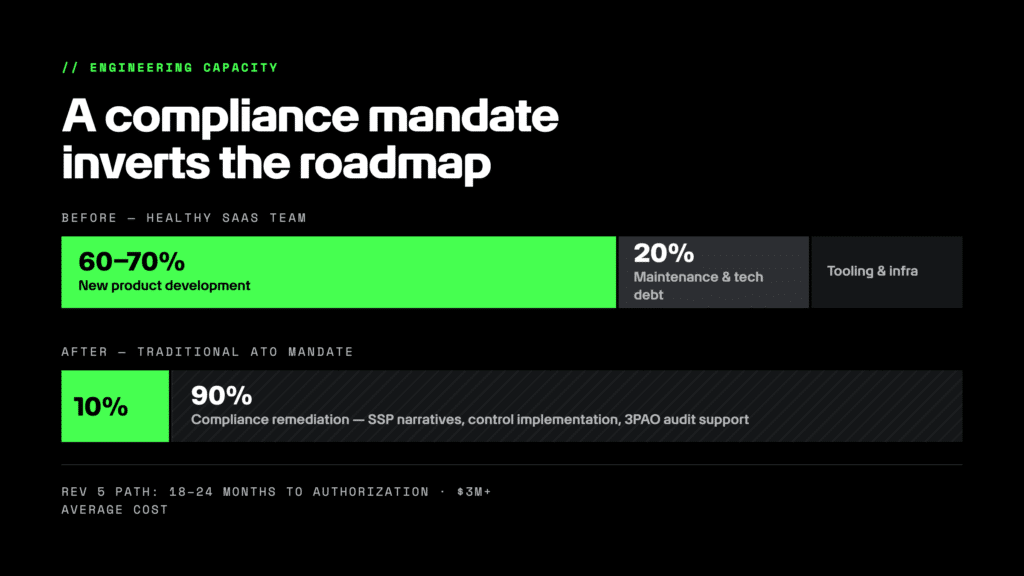
A healthy pre-acquisition SaaS engineering team allocates roughly 60 to 70 percent of its capacity to new product development, 20 percent to maintenance and technical debt, and the rest to internal tooling and infrastructure. The roadmap moves forward. Feature velocity is the north star.
Once an acquirer mandates federal or enterprise-grade compliance, that allocation inverts violently. New product development drops to 10 percent of capacity or less. Compliance remediation absorbs the remaining 90 percent.
The inversion happens across several overlapping workstreams
The team first sizes the system boundary and categorizes its impact level against a NIST SP 800-53 baseline. A product touching even a single category of Moderate-impact data pulls the entire boundary under the Moderate control set, nearly 300 requirements, each of which must be implemented, documented, and demonstrated to auditors.
Then comes the System Security Plan (SSP): exhaustive narratives plus 17 appendices covering architecture diagrams, data flow, inventory workbooks, configuration management, cryptographic module tables, and a full Control Implementation Summary. Compliance staff can’t write these alone, the narratives require real knowledge of how the application behaves, so senior engineers end up drafting, reviewing, and continuously validating documentation instead of shipping.
Beyond the paperwork, the team retrofits the codebase and infrastructure itself: role-based access control, MFA enforcement, audit logging into Security Information and Event Management (SIEM) systems, immutable Infrastructure as Code (IaC) pipelines. Every third-party dependency must independently hold FedRAMP Certification at or above the system’s impact level, which often forces a rip-and-replace of core components.
Under the traditional Rev 5 path, this runs 18 to 24 months from authorization start to grant, averaging over $3 million once consultants, 3PAO fees, and internal labor are counted. Every engineer pulled into this work is one fewer engineer shipping revenue-generating code.
Where 20X actually helps — and where it doesn’t
FedRAMP 20X keeps the same NIST 800-53 controls underneath, but it changes two things that matter for timeline: it drops the agency sponsorship requirement that used to gate the start of the process, and it replaces static SSP narratives with machine-readable evidence reviewed on a rolling basis rather than annually. In the pilot, that’s translated into real speed — assessments completing in weeks rather than the year-plus Rev 5 typically takes, and simple environments authorized in as little as 90 days.
That’s a genuine gain for a newly acquired team, but it’s not a free one. The speed comes from having already built the automated evidence pipeline the 20X model expects — continuous monitoring, telemetry, centralized logging feeding live validation instead of a point-in-time audit. A team absorbing a 90 percent capacity hit to build that pipeline for the first time is still doing real, upfront engineering work; 20X just changes what that work produces evidence for, and rewards teams that get it built quickly with a much shorter runway to authorization on the other side.
See how the shift from framework to service model changes the calculus.
The documentation mountain
The SSP is the single most resource-intensive deliverable in the traditional ATO process. The assumption that a compliance team can write it in isolation collapses the moment an auditor validates the document against observed system behavior.
The bottleneck compounds when the SSP meets the Authorizing Official’s (AO) risk acceptance decision. The AO evaluates the SSP, the Security Assessment Report (SAR) from the 3PAO, the Plan of Action and Milestones (POA&M), and the continuous monitoring strategy as a single package. If any element contains inaccuracies, the AO can request revisions, delay authorization, or mandate additional remediation rounds. Each revision cycle costs weeks of senior engineering time.
The documentation does not disappear after certification or authorization. Every system change, control modification, or vulnerability finding sends engineers back to revise, re-review, and re-validate the package. The compliance lift isn’t one and done. It’s a forever commitment.
The continuous monitoring anchor
Corporate acquirers persistently mistake an ATO for a finish line. They treat certification/authorization as a point-in-time audit and assume engineering returns to standard roadmaps the day it passes.
This belief is structurally wrong. An ATO carries a continuous monitoring obligation converting compliance from a temporary project into a permanent engineering function. Post-certification or -authorization, systems must sustain ongoing vulnerability management, regular scan execution, and perpetual artifact maintenance.
Authenticated vulnerability scans run at least monthly, often weekly on Moderate-impact systems. Container and image scanning must continuously validate against NIST SP 800-70 benchmarks. When scans surface vulnerabilities, engineering teams must remediate them within strict, non-negotiable Service Level Agreements keyed to Common Vulnerability Scoring System (CVSS) severity:
- High-severity vulnerabilities (CVSS 7.0 to 10.0): remediation within 30 days.
- Medium-severity vulnerabilities (CVSS 4.0 to 6.9): resolution within 90 days.
- Low-severity vulnerabilities (CVSS 0.1 to 3.9): remediation within 180 days.
The FedRAMP PMO has signaled that these timelines will shrink dramatically when full implementation of DHS CISA BOD 26-04 becomes mandatory in December, 2026.
Missing these SLAs triggers automatic escalation. Ten unique vulnerabilities past the 90-day threshold activate a Detailed Finding Review. If unresolved, that review escalates to a Corrective Action Plan, placing the entire ATO at immediate risk of revocation.
Every month, the team generates fresh artifacts: a revised POA&M, an updated system inventory, and raw vulnerability scan files. Teams also support annual penetration testing and control validations. This cumulative burden permanently commits a substantial share of engineering capacity to compliance maintenance, cementing the innovation freeze as a long-term operational state.
The DoW’s shift to the Cybersecurity Risk Management Construct (CSRMC), announced in September 2025 as the successor to the legacy Risk Management Framework (RMF), begins addressing this structural flaw. CSRMC introduces threat-informed, mission-focused assessments with continuous monitoring at the center, and lets components revoke authorization the instant risk thresholds are breached. The construct points toward a model where live monitoring data, not a stale static package, becomes the basis for trust. Implementation is still underway, so RMF mechanics remain operative across most active defense efforts today.
The human cost
An innovation freeze is not merely a mechanical delay. It also impacts human capital directly.
Software engineers are motivated by the intellectual challenge of building robust, scalable systems. When an acquisition abruptly shifts their daily work from creative problem-solving to perpetual compliance and legacy-debt remediation, job satisfaction may collapse.
The toll begins with role dissonance. Engineers hired to architect scalable platforms or optimize user experiences instead gather evidence for external auditors, manually trace data flows through legacy code, and patch outdated dependencies to satisfy NIST controls. The highly manual nature of the traditional process, built on static Word documents, tracking spreadsheets, and repetitive configuration checks, breeds severe burnout.
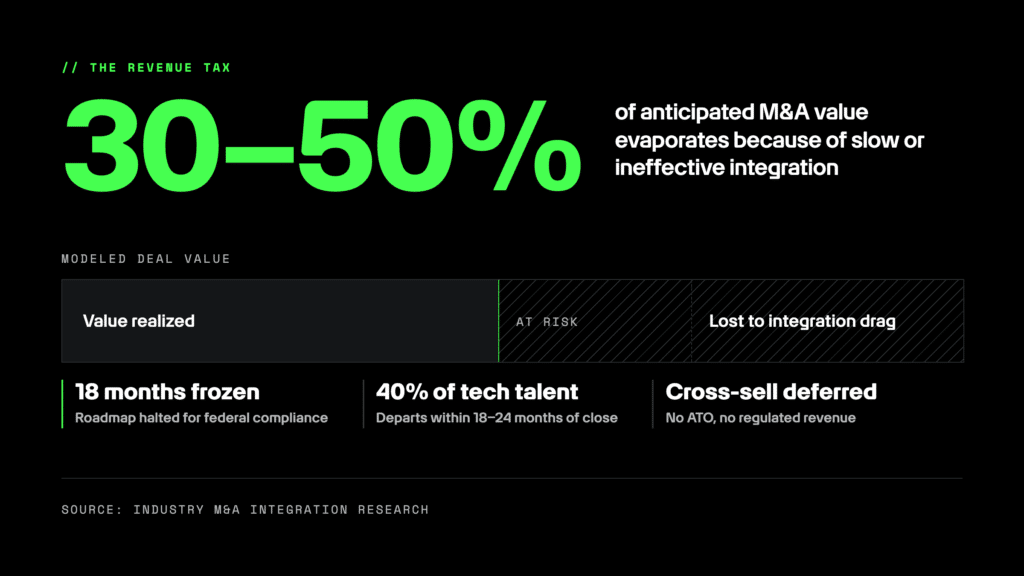
Attrition confirms what psychology predicts. Research indicates 47 percent of employees leave within the first year following a merger, rising to 75 percent within three years. Among critical technical talent, specifically, 40 percent depart within 18 to 24 months of close. The exodus stems from reporting-line uncertainty, a stagnant roadmap, and deep frustration with the compliance burden. Competitors recognize the vulnerability immediately, and within weeks of an acquisition announcement, recruiters aggressively target the acquired engineering staff.
Every departure levies a Knowledge Transfer Tax. Senior engineers who leave take irreplaceable knowledge of system architecture, undocumented data flows, and context-specific troubleshooting logic. The remaining team pauses compliance and development to train replacements.
Edge cases go unaddressed. Superficial patches stand in for proper systemic refactoring. In enterprise environments, downtime from these unmitigated defects can exceed $300,000 per hour.
The revenue tax
A traditional ATO extracts a severe compliance tax, slashing engineering velocity and introducing large unplanned operating costs corporate models rarely capture.
Industry research consistently finds 30 to 50 percent of anticipated M&A value evaporates because of slow or ineffective integration. The longer technology integration drags, the more enterprise value erodes, across three dimensions.
Delayed revenue recognition comes first. Acquired systems cannot deploy into secure acquirer environments or sell to regulated government clients without an active ATO, so the cross-sell and upsell justifying the deal premium stay frozen. Freezing a roadmap for 18 months to accommodate federal compliance forces engineering to build features dictated by NIST, specific audit trails, complex session lockouts, government identity management, while standard commercial users watch their requests deprioritized.
Modern frameworks that preserve velocity
With Second Front’s Game Warden, a SaaS platform lacking FedRAMP readiness or automated DevSecOps no longer requires a multi-year refactor or a valuation penalty. Deploy the target application onto an inherited boundary platform and the acquirer remediates infrastructure-layer technical debt on contact, inherits automated CI/CD pipelines, and secures a FedRAMP certification or DoW authorization posture on day one.
The platform operator owns the underlying IaC pipelines, host vulnerability scanning, and infrastructure continuous monitoring. The customer’s engineering team focuses solely on application-layer controls: role-based access control, application audit logging, and code-level patching. This architecture compresses the FedRAMP timeline from 18 to 36 months down to roughly 90 days while cutting compliance costs by up to 90 percent, and it keeps the acquired team on the product roadmap rather than on infrastructure remediation.
| Approach | Timeline | Cost | Engineering impact |
|---|---|---|---|
| DIY ATO | 18 to 24 months | $3M+ | Severe: ~90% capacity diverted, 12 to 18 month feature freeze |
| Compliance as code (cATO) | 6 to 12 months | $500K to $1.5M | Moderate: pipeline build, then acceleration |
| Inherited boundary (2F Game Warden) | ~90 days | Predictable OpEx | Minimal: app-layer controls only, no freeze |
Continuous Authorization to Operate (cATO) aligns authorization with modern software delivery. Rooted in the NIST Risk Management Framework and evolving under CSRMC, cATO uses active, real-time monitoring to provide dynamic, ongoing authorization. Instead of forcing systems through multi-year reauthorization cycles, it lets DevSecOps organizations push updates continuously: as long as automated security guardrails and monitoring metrics stay within acceptable thresholds, authorization persists. Agencies running advanced cATO methodologies show up to a 74 percent reduction in compliance overhead, a 30 percent decrease in authorization time, and software delivery up to 25 times faster than traditional methods.
Compliance as code automates the implementation, verification, remediation, and reporting of security controls. Using machine-readable compliance languages like NIST’s OSCAL, teams fold security testing directly into DevSecOps pipelines. When scanning tools detect a gap during development, the automation platform generates the required Infrastructure as Code fix, so engineers start from a proposed remediation rather than hunting blindly through legacy code. Automation absorbs high-volume, repetitive control mapping and monitoring logging, moving compliance into the normal engineering workflow and ending the need to exit the toolchain to update static documents.
Inherited authorization boundaries are the most potent structural fix for post-acquisition freezes. Implemented as FedRAMP-certified landing zones or FedRAMP-as-a-service platforms, they provide pre-authorized, highly secure cloud infrastructure across AWS, Azure, and Google Cloud. When an acquired application deploys into one of these zones, it inherits the vast majority of infrastructure-layer controls automatically.
The road ahead
The innovation freeze is not an unavoidable cost of operating in regulated markets. It is the direct consequence of applying a point-in-time, document-heavy authorization model to a continuous software delivery environment.
The alternative is not abandoning compliance. It is redesigning authorization to match how modern teams build and ship. Organizations designing backward from their required authorization tier integrate acquired technology in a fraction of the traditional timeline, keep their critical talent, and turn compliance into a by-product of security rather than a tax paid late.
Ready to map your authorization path? Speak with our team to see how 2F Game Warden can compress your route to an accredited platform and keep your engineers building.
Let’s get your software where it matters.