FedRAMP 20x shifts federal compliance from static checklists to real-time, continuous authorization. However, a costly misconception has followed it into the market: the belief that automated standards eliminate the need for a specialized Platform-as-a-Service (PaaS). The opposite is true. Realizing the promise of 20x makes a PaaS more critical, not less.
The confusion conflates two separate things:
- A security framework (like FedRAMP 20x) defines what must be true about your system and how you prove it.
- A cloud service model (SaaS, PaaS, or IaaS) defines who builds and operates each layer of the stack.
The framework sets the bar; the service model determines how much of the bar you must clear yourself. Navigating the relationship between the two is a consequential choice a commercial software provider makes before entering the federal market.
Continuous authorization demands automated evidence-as-code, real-time telemetry, and hardened infrastructure on an ongoing basis, not just once a year. Second Front’s Game Warden delivers that maturity as a native compliance wrapper, letting commercial providers inherit it on day one and turning the demands of 20x into a durable advantage.
A compliance question and an architecture question
The first asks which certification pathway governs your system; the second asks which service model you deploy on. The decisions are independent, but their interactions determine your cost, timeline, and risk profile.
SaaS, PaaS, and IaaS are not FedRAMP designations. They are categories of commercial cloud service, and FedRAMP certification is a separate determination layered on top of whichever model you choose. FedRAMP itself advises providers to map how IaaS, PaaS, and SaaS stack within an offering and to clearly delineate the layering within the authorization boundary. The framework cares about outcomes; the service model decides who produces them.
FedRAMP Insights
Ready to ignite your FedRAMP Journey?
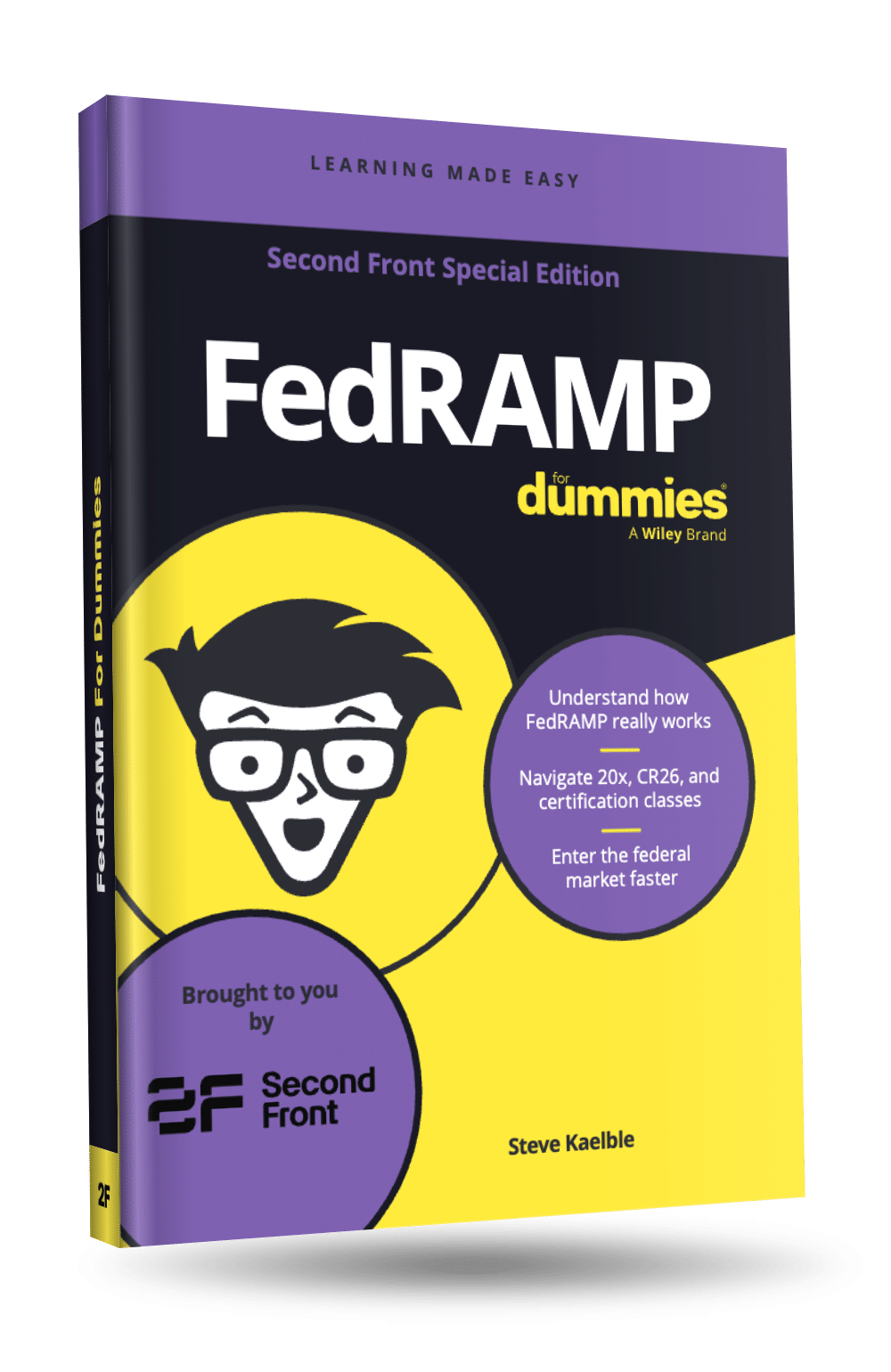
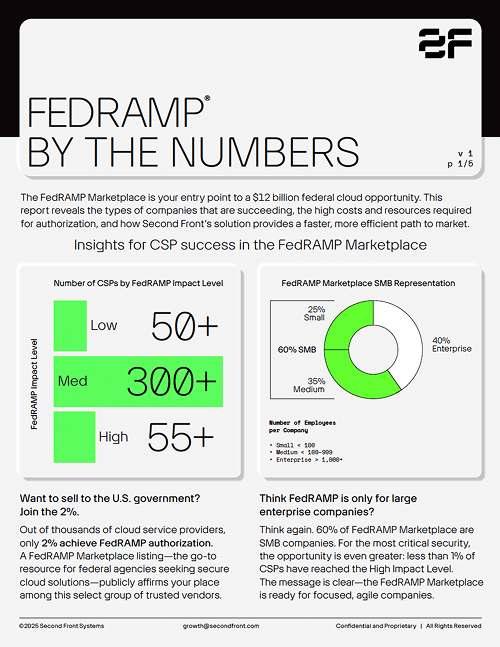
Unlock exclusive access to our FedRAMP By the Numbers Infographic—your front-row pass to a $12 billion federal cloud market opportunity!
The shift: NIST Rev 5 vs. FedRAMP 20x
A control baseline and an operational pathway drive the conversation, and they are partners, not competitors.
FedRAMP Rev 5 (NIST SP 800-53): the “what”
Rev 5 is the security control baseline, the what of compliance. It defines the technical, operational, and management safeguards a system must implement across impact levels: roughly 156 controls for Class B (Low)-impact data, around 325 for Class C (Moderate)-impact data such as Controlled Unclassified Information, and over 400 for Class D (High)-impact systems.
Each of these controls has many subcontrols or enhancements, increasing the total number of individual requirements. Under the legacy process, every control required a written narrative; certifications routinely took 12 to 18 months, cost millions, and produced System Security Plans (SSPs) over 1,000 pages long.
FedRAMP 20x: the “how”
20x is the next-generation operational pathway, the how of continuous authorization. It uses the same NIST 800-53 Rev 5 control baseline, so the underlying security requirements are unchanged.
The validation cadence changes instead: continuous, machine-readable attestation against running systems replaces point-in-time snapshot audits. Where Rev 5 asked you to describe your safeguards, 20x asks your system to prove they are active right now.
20x abstracts hundreds of narrative controls into Key Security Indicators (KSIs): concrete, binary security outcomes proven through automated evidence. The Class B baseline carries 56 KSIs and Class C carries 61, organized across identity, encryption, logging, change management, supply chain, and incident response.
One word recurs relentlessly through the KSI documentation: persistently. Providers must persistently validate, persistently monitor, and persistently review. For Class C systems, machine-based KSIs revalidate on a rolling cadence measured in days, not months.
The Bottom Line: The era of the annual audit is coming to an end. If your compliance evidence cannot regenerate itself automatically and continuously, you do not have a 20x-ready system, however secure your software actually is.
Rev 5 vs. 20x at a glance
| Dimension | FedRAMP Rev 5 (Legacy) | FedRAMP 20x |
| Nature | Control baseline (the “what”) | Operational pathway (the “how”) |
| Underlying controls | NIST 800-53 Rev 5 | Same NIST 800-53 Rev 5 baseline |
| Evidence | Narrative SSPs, manual screenshots | Key Security Indicators, machine-generated |
| Validation Cadence | Point-in-time, annual | Persistent, revalidated on a rolling basis |
| Format | Human-readable PDFs/Word | Machine-readable (OSCAL) |
| Sponsorship | Agency sponsor typically required | PMO can authorize eligible services directly |
| Typical Timeline | 12 to 18+ months | Potentially 3 to 6 months |
SaaS vs. PaaS vs. IaaS under continuous authorization
Every cloud service model runs on a shared responsibility model, and FedRAMP rewards inheritance: the more of the stack your provider operates and attests, the fewer controls and KSIs land on you. The gap is not marginal; it separates a multi-year compliance program from a focused application-security effort.
IaaS: maximum control, maximum burden
Infrastructure-as-a-Service gives you raw compute, storage, and networking. You inherit the physical security of the cloud but own nearly everything in it: operating-system patching, network ACLs, container security tooling, FIPS-validated cryptographic boundaries, and, under 20x, the entire telemetry pipeline scraping your environment, validating KSIs on cadence, and emitting valid OSCAL. Industry estimates put IaaS control inheritance near 20%. IaaS rewards infrastructure innovators who need maximum customizability versus Mission Owners who just need to ship capability.
SaaS: the boundary illusion
Software-as-a-Service can reach the highest inheritance levels when it sits on FedRAMP-certified infrastructure. However, a major catch blindsides many vendors: certification does not flow automatically up the stack.
A FedRAMP-certified IaaS beneath you does not make your SaaS certified; each layer must meet the controls for its impact level. A standalone SaaS vendor on raw cloud carries the heaviest burden of all three models, because the application is the certification boundary, and multi-tenant architectures make the boundary harder to define, not easier.
PaaS: the structural advantage under 20x
A purpose-built DevSecOps PaaS moves the shared-responsibility line decisively in your favor. The platform owns everything beneath the application layer: OS hardening, infrastructure scaling, zero-day patching, network security groups, and, most importantly under 20x, the continuous generation of compliance telemetry and machine-readable evidence.
Industry analysis places PaaS control inheritance at 60% or more, and a fully accredited platform pushes the figure substantially higher. Your engineers spend their time on software logic and mission outcomes rather than building an always-on compliance substrate from scratch.
The Strategic Choice:
- Build the substrate (IaaS / DIY SaaS): Stand up identity, encryption, logging, network, and evidence-emission infrastructure in-house, then keep every KSI check green continuously while holding authorization.
- Inherit the substrate (Purpose-built PaaS): Deploy into a pre-authorized boundary where the infrastructure already runs, already passes, and is already attested for multiple federal agencies.
Service model comparison under FedRAMP 20x
| Factor | IaaS | SaaS (DIY) | Purpose-built PaaS |
|---|---|---|---|
| Control inheritance | ~20% | Varies (none if self-hosted) | 60%+ (higher when accredited) |
| KSI telemetry pipeline | You build & operate | You build & operate | Inherited & managed |
| OSCAL evidence | Your responsibility | Your responsibility | Generated for you |
| Continuous monitoring | You engineer it | You engineer it | Day-1 managed service |
| Time to Authorization | Longest | Long | Compressed (weeks) |
| Engineering focus | Infrastructure | Split focus | Your application |
How to evaluate a PaaS for FedRAMP 20x
Many platforms market themselves as compliance solutions, but thin orchestration layers and single-tenant scanners leave the hardest infrastructure problems on your plate. Five questions cut through the marketing noise:
- Does it require access to your source code? Some compliance tools cannot function without reading your application source. Insist on container-level scanning instead. Game Warden operates entirely on containerized deployments and scans comprehensively without ever seeing your proprietary code, so your IP stays yours.
- Can you see inside your own deployment? Basic orchestration layers go dark at the application boundary, and 20x demands real-time telemetry you can actually inspect. Look for a full observability stack rather than a black box. Game Warden exposes a complete solution, including customizable Grafana dashboards.
- Does it lock you in, or let you graduate? A platform should fit a multi-tenant footprint today and still let you move to your own independent FedRAMP Marketplace listing later without replatforming. Game Warden supports multi-tenant deployment and offers three pathways, Inherit, Own, and Prove, so the on-ramp does not become a dead end.
- What happens after the ATO? An Authority to Operate is the start of the work, not the finish, and Day 2 operations are where most independently authorized systems quietly fall out of compliance. Require hands-on, ongoing operational support. Game Warden is a fully managed hosting platform that includes DevOps support and continuous Day 2 maintenance.
- How does it handle change? Traditional FedRAMP stalls every update behind a manual “stop-and-audit” review. Demand automated, risk-based change governance. Game Warden applies a Risk-Based Change Classification framework, using Policy-as-Code to clear routine CI/CD updates automatically and let you deploy at the speed of software.
Life on the inherited FedRAMP path
The advantages of inheritance turn concrete the moment you deploy on an Inherited pathway (In-Boundary). The framework and the service model compound, converting compliance from an ongoing project into a “compliance-by-default” property of the underlying platform.
What You Inherit
You inherit the foundational substrate, the part of compliance consuming most of a traditional DIY budget. Massive control inheritance pulls a large majority of your security controls directly from Game Warden and narrows your assessment footprint strictly to your own application code. Your application picks up the platform’s “Evidence-as-Code” package, real-time machine-generated proof for critical controls (such as verifying phishing-resistant MFA through API queries), which retires hundreds of manual screenshots a year.
Inherited sponsorship matters most to newcomers; the smaller, and newer companies that want to solve the nation’s toughest problems. Because your application runs under Game Warden’s existing ATO, you gain an established federal agency sponsor, the Defense Innovation Unit (DIU). As an Authorizing Official (AO) whose risk tolerance is calibrated to move modern software forward, DIU clears the hardest administrative hurdle before you ever start the process. Underneath it all, a scalable evidence management architecture programmatically handles attestations and artifacts as a single source of truth.
What Stays Yours
What stays yours is narrow and non-negotiable, the direct consequences of the platform absorbing everything below your application. You no longer write a thousand-page System Security Plan; Second Front owns the master documentation and the main AO relationship.
In exchange, you take on active, continuous monitoring, clearing application-level vulnerabilities within strict SLAs to protect the shared boundary. To keep the boundary intact, your application maintains immutable integrity and runs as containerized workloads under a “deny-by-default” execution profile. The trade is deliberate: a small, well-defined set of ongoing application duties in return for shedding the infrastructure substrate that would otherwise dominate your roadmap.
The clock is already running
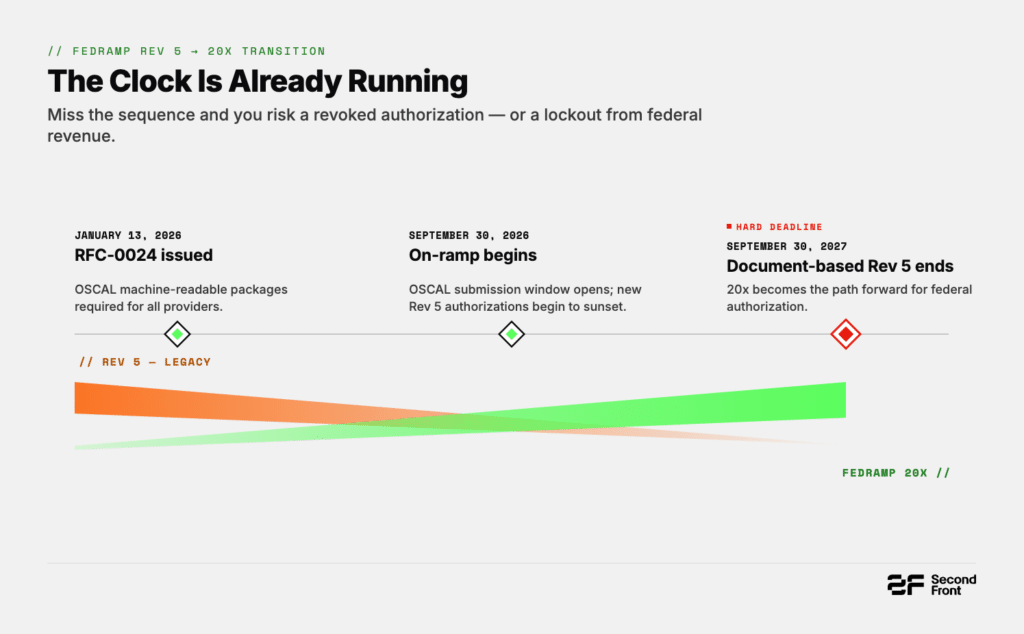
Surviving the shift from Rev 5 to 20x means meeting the deadlines, and they are not abstract; they decide whether engineering investment pays off or strands. RFC-0024 mandates machine-readable, OSCAL-based packages for all FedRAMP providers rather than 20x pilots alone. Miss the sequence below and you risk a revoked authorization or a lockout from federal revenue entirely.
| Date | Milestone | What it means |
| January 13, 2026 | RFC-0024 issued | OSCAL, machine-readable packages required for all providers |
| September 30, 2026 | On-ramp begins | OSCAL submission window opens; new Rev 5 authorizations begin to sunset |
| September 30, 2027 | Document-based Rev 5 ends | 20x becomes the path forward for federal authorization |
Three non-negotiables before you commit
A capable 20x partner already embodies three capabilities, each mapping to a point where DIY programs break down.
- Automated evidence reuse. Most providers reach the federal market with real security investment behind them, usually SOC 2 or ISO 27001 attestations. The right platform maps them directly to NIST 800-53 Rev 5 controls, crediting prior work instead of rebuilding it, which often decides whether onboarding takes weeks or quarters.
- A genuine shared responsibility model. The platform has to absorb the hard, forward-looking work, the infrastructure hardening and continuous monitoring never stopping once authorization lands. The test is not whether a vendor claims shared responsibility but how much substrate it actually takes off your plate. Second Front states the test plainly: “If you don’t control it, you aren’t responsible for it.”
- Built-in automated gating. Continuous authorization has minimal room for manual sign-off; a human approving each release is both a bottleneck against persistent, machine-validated KSIs. Require a native CI/CD pipeline where security and vulnerability scans gate production programmatically, blocking non-compliant changes and clearing compliant ones at the speed of software.
The bottom line
FedRAMP 20x is the framework; SaaS, PaaS, and IaaS are the service models. The framework sets a continuous, machine-validated bar that keeps rising. The service model decides how much of the bar you clear alone. Build the substrate yourself on raw IaaS, or stitch it together under a DIY SaaS, and you absorb heavy ongoing capital expenditure, pull engineering talent off your product, and expose yourself to a missed deadline or a revoked certification.
Choose a purpose-built, pre-accredited PaaS and you inherit the substrate the moment you deploy. Platforms like Game Warden do more than host applications; they act as managed compliance engines, absorbing the majority of foundational controls and automating the continuous-monitoring pipelines 20x KSIs demand.
Ready to inherit your compliance substrate? See how Second Front’s Game Warden compresses FedRAMP 20x timelines from years to weeks, so your team can focus on the mission, not the paperwork.