With 2F Game Warden for FedRAMP, deliver your cloud service to federal civilian agencies faster—accelerating authorization and opening federal market access.
Whether delivering software to the public sector for the first time or needing a hand navigating the complex accreditation process, 2F is your one-stop shop.
See how Second Front helped Integrate fast-track IL6 accreditation and deploy to a classified environment in under 12 months—paving the way for a $25M Phase III SBIR award.
The multidomain domino effect: Why modern warfare demands continuous software delivery
2F Team
08.05.2026 / 2 months ago
6 minute read
Share
Listen to This Article
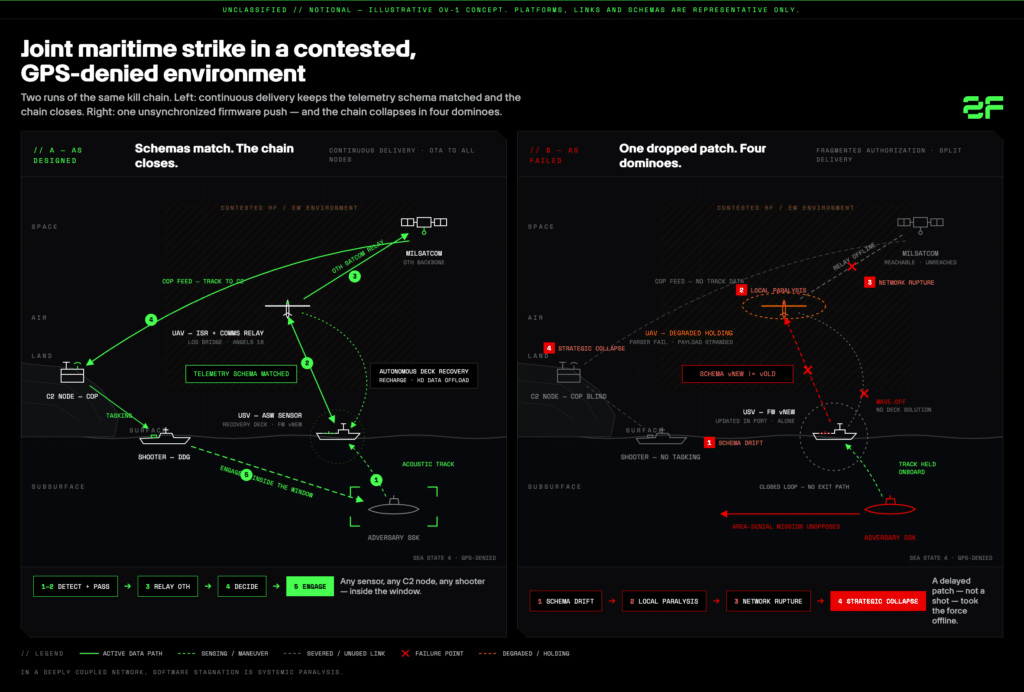
A delayed software update on an unmanned surface vessel can pull an unmanned aircraft out of the fight, sever a communications relay, and leave a shore-based fire battery with nothing to shoot at. None of those failures is kinetic, and none requires a shot to be fired. Each can be traced to a software delivery failure, and in a Combined Joint All-Domain Command and Control (CJADC2) architecture they fall in sequence, one domain disabling the next.
As the joint force wires sensors, command nodes, and effectors into a single self-healing network across land, sea, air, space, and cyberspace, warfighting stops being a contest of platform-versus-platform attrition and becomes a contest of data-centric decision dominance defined by software delivery speed, guaranteed data delivery, and API lifecycle management.
The shift buys enormous tempo. It also introduces a systemic dependency the old Force never had: the entire architecture now rests on persistent, synchronized software interoperability.
The interdependence is the point, and it is also the vulnerability. Software delivery through DevSecOps and continuous ATO (cATO) is the architecture that holds the network together, and the best illustration is to trace a single delayed update as it moves from one domain to the next.
The architecture that makes the cascade possible
CJADC2 requires dissolving proprietary communication architectures the military built over decades. In their place come federated data fabrics and self-forming mesh networks that stretch from the strategic cloud to the tactical edge, fusing inputs across the Internet of Military Things into a common operating picture.
The defining move is pushing computation to the edge. Legacy models route raw sensor data from forward platforms back to centralized command centers for processing, which fails in contested environments where adversaries degrade, deny, intercept, and limit communications. Sending 4K electro-optical video or raw sonar returns over vulnerable satellite links in a DDIL environment is both operationally prohibitive and tactically dangerous. So the processing burden shifts: AI-enabled sensor nodes run machine learning inference natively on the platform, correlating acoustic, seismic, radio-frequency, electro-optical, and infrared signatures into low-bandwidth, target-quality tracks without continuous human-in-the-loop oversight.
Hybrid fleets make that capability concrete: manned vessels coordinate with swarms of autonomous systems. The U.S. Navy’s Task Force 59 has demonstrated the value of integrating unmanned surface vessels (USVs) and unmanned aerial vehicles (UAVs) for persistent maritime domain awareness across the Arabian Gulf and the Red Sea. Inside such an architecture, the platforms are not independent. They are layered, and each depends on the others to function.
Mapping the domino effect, one domain at a time
The below is a hypothetical joint maritime strike in a contested, GPS-denied, communications-degraded environment. The high-level concept (i.e. OV-1) illustrates two outcomes of the exact same operation: one where software synchronization closes the loop, and another where fragmented delivery triggers a four-stage failure.
The Operational Precondition: High-density reconnaissance data collected by a UAV is too large to transmit over a jammed RF network. To offload data and recharge, the UAV must perform an autonomous deck landing on a moving Unmanned Surface Vessel (USV)—a robotic maneuver requiring real-time API synchronization between both platforms.
The Root Cause (Schema Drift): During a port maintenance cycle, the USV receives a firmware update (vNEW) that alters its telemetry schema fields. Because the UAV operates under a separate program office, its software update is delayed (vOLD), creating an unexpected data mismatch between the assets.
The Multidomain Cascade: When the platforms attempt to interact, this software misalignment propagates outward—progressing from localized asset failure to fleet-wide network loss, ultimately blinding command nodes and leaving the joint force unable to respond to an advancing threat.
The technical faults the cascade rides on
The cascade rides on real, persistent misalignments between complex data-driven systems, and drift is the first. It comes in three forms:
Schema drift is the structural kind from the scenario above: a new field, a changed data type, an altered relationship, and downstream parsers break, forcing routing systems to drop packets or handle malformed data, destroying situational awareness.
Data drift is subtler, because the schema holds but the statistical distribution shifts, so when jamming or weather moves a radar feed’s baseline noise off its historical norm, hardcoded thresholds start missing valid targets or flooding the picture with false positives.
Concept drift is subtler still and specific to AI: the relationship between inputs and predictions change. When an adversary alters a vessel’s camouflage, thermal signature, or emission profile, a UAV’s visual detection model becomes unreliable even while the data arriving stays structurally perfect.
Preventing all three requires enforceable, version-controlled data contracts defining structure, format, semantics, and quality, validated automatically inside the pipeline so incompatible data is rejected before it cascades.
The compliance bottleneck that manufactures the delay
Every failure above traces back to one root cause: Software that could not ship in time. The most common reason it cannot ship is the authorization process itself.
Under traditional cybersecurity frameworks, deploying any new capability to a military network requires an Authorization to Operate (ATO). The conventional ATO is a static, document-heavy review capturing a point-in-time snapshot of a system’s security posture through a rigorous six-step process, typically taking twelve months or more, with the resulting authorization valid for up to three years before full renewal. A cadence like that is incompatible with the speed of the fight.
This is where the policy environment is moving in the right direction. In September 2025, the Department of War announced the Cybersecurity Risk Management Construct (CSRMC) as the successor to the legacy Risk Management Framework (RMF). Implementation is still in progress and RMF remains operative for most efforts today, but the direction is set: CSRMC makes assessments threat-informed and mission-focused, bakes security into pipelines, requires continuous monitoring, and lets components revoke an ATO the instant risk thresholds are breached. The construct is what makes continuous ATO possible, and continuous authorization is what makes continuous delivery possible.
Continuous ATO: Authorizing the pipeline, not the snapshot
Continuous Authorization to Operate (cATO) shifts the unit of authorization from the artifact to the pipeline. Instead of reviewing each release against a point-in-time checklist, a cATO authorizes a software factory to develop, assess, and push updates into production continuously, without a fresh review for every patch. The authorization persists as long as the risk metrics hold, rather than expiring on a three-year clock. Where the traditional ATO requires the Force to fight with outdated software and lose decision advantage, a cATO supports secure updates at the speed of relevance the countermeasure cycle demands.
Earning a cATO means demonstrating three competencies to the Authorizing Official:
Continuous monitoring gives near real-time visibility into RMF controls through automated compliance tooling.
Active cyber defense supplies the capability to detect, analyze, and respond to threats autonomously using behavioral analytics, threat intelligence, and automated incident response aligned to frameworks like MITRE ATT&CK.
Secure software supply chain, built on an approved DevSecOps reference design, integrates static and dynamic code analysis, container scanning, and Software Bill of Materials (SBOM) generation at every phase so vulnerabilities are caught before deployment.
Standard interfaces: The precondition for pushing to anything
Rapid delivery is wasted if the hardware sits behind proprietary silos. Decades of optimizing individual systems over cross-platform interoperability produced exactly the fragmentation the domino effect exploits, so the DoW now enforces a Modular Open Systems Approach (MOSA) across new acquisitions.
At the core sit Open Mission Systems (OMS) and the Universal Command and Control Interface (UCI). OMS is a non-proprietary, government-owned reference architecture defining the interfaces between software services and hardware subsystems, replacing monolithic designs with a publish-subscribe framework whose modular components, the Units of Replaceability, swap or upgrade without re-engineering the whole platform.
Where Game Warden fits
The pattern running through every mitigation above is the same: authorize the pipeline once, then deliver continuously and securely to the edge. Removing that burden is precisely what 2F Game Warden is built for.
Game Warden is a pre-accredited DevSecOps platform as a service (PaaS). A software provider’s application deploys onto it and inherits its controls, rather than each program standing up its own accreditation boundary and repeating the six-to-twelve-month review manufacturing the delivery delays the domino effect exploits. The platform supplies the continuous monitoring, the active cyber defense posture, and the secure supply chain a cATO demands, and provides the DevSecOps pipeline and containerized delivery mechanism pushing updates to the tactical edge at the speed the countermeasure cycle requires. In the cascade traced above, the failure was never the schema change itself. It was the two platforms falling out of lockstep. A common accredited pipeline is what keeps a producer and a consumer speaking the same schema at the same time.
Continuous delivery, in other words, is not a support function bolted onto the weapon system. The character of modern warfare is defined by connectivity, and connectivity is defined by software. As assets become autonomous and functionally interdependent, physical lethality is being eclipsed by digital agility, and the multidomain domino effect is the proof of the stakes. A localized schema drift, an unmanaged API change, or a delayed update on a single unmanned vessel does not stay local. It severs data links, grounds aerial relays, blinds the maritime picture, and leaves long-range effectors with no target to engage. The Force that wins will be the one that learns, adapts, and ships its software at the speed of relevance.
Ready for an accredited DevSecOps pipeline and platform? Speak with our team to learn how Game Warden can compress your path from code to a continuously authorized, deploy-anywhere capability.
Whether delivering software to the public sector for the first time or needing a hand navigating the complex accreditation process, 2F is your one-stop shop.