TLDR: From checkbox compliance to continuous, verifiable security
- The Shift: The DoD has announced its clear intent to transition from the legacy Risk Management Framework (RMF) to the Cybersecurity Risk Management Construct (CSRMC). While the official implementation is still in progress, the long-term direction is undeniable: the era of static, paper-based compliance is coming to an end.
- The CISO’s New Mandate: Defense CISOs are no longer just technical overseers. They are strategic risk executives who must translate compliance mandates into verifiable, continuous security operations that operate at the speed of modern warfare.
- The Core Tension: Compliance and security are not the same thing. Passing a point-in-time audit does not mean a system is resilient against an adaptive adversary. CISOs must treat compliance as the floor, not the ceiling. Compliance should be the by-product of security, not the other way around.
- The Path Forward: Automated evidence collection, control inheritance through pre-accredited platforms like Game Warden, and continuous monitoring allow CISOs to collapse timelines and deliver verifiable security without stalling innovation.
Introduction: The CISO’s evolving role in defense cybersecurity
For any software company aiming to serve the Department of Defense, the Authority to Operate (ATO) remains the single most consequential gate between your capability and the warfighter. But the rules governing that gate have fundamentally changed, and the CISO is the executive responsible for navigating the transition.
The modern defense CISO is no longer operating solely as a technical SME. The role has expanded into that of a strategic risk executive, tasked with translating macroeconomic volatility, accelerated AI adoption, and an increasingly sophisticated threat landscape into actionable strategies to enable and extend mission and business objectives. Cybersecurity is now universally recognized as a core mission imperative, and executive leadership and oversight boards demand that the CISO serve as a strategic enabler, turning cybersecurity from a cost center into a driver of operational trust and mission innovation.
At the center of this mandate sits a persistent structural challenge: the bureaucratic friction of legacy accreditation processes. For over a decade, the Risk Management Framework (RMF) governed the path to an ATO. While the RMF established foundational baselines, it fundamentally conflated procedural compliance with actual security, resulting in massive financial inefficiencies, delayed mission readiness, and leaving critical systems vulnerable to dynamic adversaries.
This guide unpacks the strategic and operational implications of the DoD’s pivot away from that legacy model, provides a concrete playbook for translating compliance mandates into verifiable security architectures, and examines how pre-accredited platforms can serve as critical enablers for CISOs navigating this transition.
(If you need a refresher on the basics, start with our DoD ATO Explained guide.)
The existential debate: Security vs. compliance
Understanding the distinction between security and compliance is the foundational strategic clarity every CISO needs before engaging the ATO process. These are fundamentally distinct disciplines that are frequently, and dangerously, misunderstood at the executive level.
Compliance refers to adherence to specific regulations and standards set by governing bodies. For example, NIST 800-53, the DISA Cloud Computing Security Requirements Guide (CC SRG), and FedRAMP baselines are designed to ensure a minimum level of protection for sensitive data. Security is the practical, proactive implementation of measures to protect systems from active, evolving threats.
When compliance becomes the primary organizational objective, it invariably leads to a posture of “minimum viable security.” Organizations can develop a checklist mindset, thinking that verifying a control exists on paper is sufficient, without rigorously evaluating its contextual effectiveness in the real world. An auditor may check a box confirming that multi-factor authentication (MFA) is implemented, but fail to verify whether it is consistently enforced across non-human identities, legacy systems, or third-party access portals. Meeting compliance requirements may keep an organization legally covered, but it does not mean the organization is resilient against a targeted attack.
The divide between security and compliance manifests across every operational dimension. Compliance is reactive, rule-based, and tied to periodic assessment cycles. Security is proactive, dynamic, and continuous. Compliance measures audit readiness; security measures incident response times, time-to-patch, and threat detection rates. Compliance ensures approved operational status; security reduces operational risk and sustains mission continuity.
For the defense CISO, navigating this intersection requires a highly balanced approach. Compliance provides the necessary legal and regulatory framework, but it must be viewed as the absolute floor, not the standard for real security. The strategic imperative is to translate complex compliance mandates into dynamic security operations by mapping defenses to adversary behavioral models, validating controls through continuous testing, and utilizing automation to anticipate threats before they materialize.
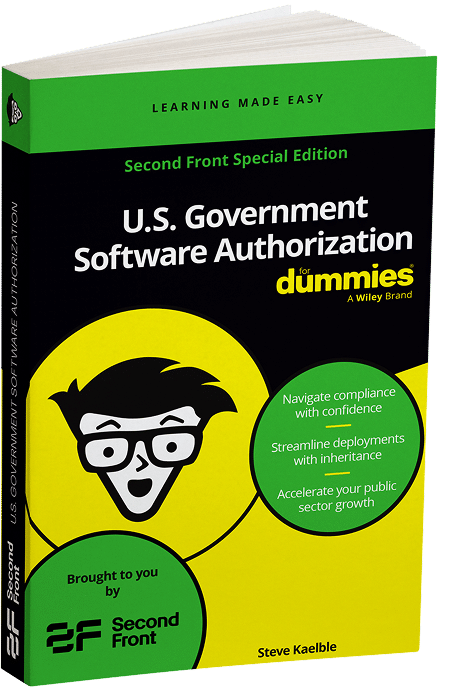
Dummies eBook
U.S. Government Software Authorization for Dummies
Government authorization doesn’t have to be a black box. Learn how it actually works.
Download now
The legacy ATO crisis: Why the old model fails CISOs
The traditional ATO process under the RMF is widely recognized as one of the most resource-intensive steps for any defense-focused software company. The average process can exceed $3 million and take 18 to 24 months, which is a timeline that stifles innovation and prevents critical capabilities from reaching the field when they are most needed. (For a deeper analysis of what goes wrong, read our guide on (Where DoD ATOs Go Wrong.)
The systemic friction is structural. The legacy process requires development teams to build their software, halt operational momentum, and then generate massive, static System Security Plans (SSPs) and Bodies of Evidence (BOEs) to prove they meet hundreds of NIST 800-53 controls. This methodology creates severe operational vulnerabilities that degrade rather than enhance national security.
Delayed innovation. The RMF process is inherently sequential. By the time commercial software receives a traditional ATO, it is often several versions behind the commercial market, depriving warfighters of the most advanced capabilities.
The snapshot fallacy. Traditional ATOs are generally granted for a three-year period, creating a static security snapshot. In an era where vulnerabilities are discovered, weaponized, and exploited in a matter of hours, a compliance artifact generated three years ago offers zero operational assurance.
Audit fatigue and duplication. The lack of standardized reciprocity means capability providers must often repeat the exhaustive ATO process for different DoD components, leading to massive duplication of effort and wasted resources.
The net result has been inadequate protection, delayed decisions, and a system that strongly incentivizes the generation of paperwork over the actual mitigation of cyber threats. An ineffective ATO process is no longer viewed as just an IT nuisance; it is a quantifiable loss of potential revenue, a delay in critical cost avoidance, and a strategic vulnerability that degrades both shareholder value and national security.
The strategic pivot: CSRMC and the future of authorization
Recognizing the risk posed by bureaucratic lag and static compliance, the Department of Defense has signaled a monumental overhaul of its risk management architecture. In September 2025, DoW leadership formally announced the Cybersecurity Risk Management Construct (CSRMC) as the intended successor to the legacy RMF.
It is important to be precise about where things stand. As of this writing, the announcement has been made, but detailed implementation guidance has not yet been published. Many RMF practitioners in the trenches have not yet encountered CSRMC in their day-to-day work. The legacy RMF process remains the operative framework for most authorization efforts today.
That said, the direction is a clear signal. The CSRMC is not a mere iterative update to a policy document. It represents a cultural and structural paradigm shift that will re-focus defense enterprises on mission effectiveness, active cyber survivability, and real-time data analytics. It envisions cybersecurity operating through a dynamic five-phase lifecycle: Design, Build, Test, Onboard, Operate, that closely mirrors the principles of agile DevSecOps and continuous delivery.
The construct is underpinned by ten foundational tenets, prominently featuring automation, a focus on critical controls, enterprise services and inheritance, reciprocity, and a definitive pivot toward continuous monitoring.
Within this future framework, Continuous Authorization to Operate (cATO) represents one of the DoW’s most ambitious objectives. It is important to understand that a cATO is not a tool or a platform, it is an organizational state of cybersecurity maturity. When a DoW component demonstrates sufficient maturity in maintaining a resilient, continuously monitored security posture, traditional periodic assessments become redundant. Achieving that state requires mastery across three competencies: continuous monitoring providing near real-time visibility into the authorization boundary; active cyber defense capable of responding to threats as they occur; and strict conformance to a DoD-approved DevSecOps Reference Design, ensuring pipelines are as secure as the software they produce.
For CISOs, the strategic takeaway is clear: the DoW is moving toward a world where security posture is measured in real-time telemetry, not three-year-old documentation. You do not need to wait for the final implementation memo to begin preparing. The infrastructure, automation, and continuous monitoring practices that the CSRMC will demand are the same practices that accelerate a traditional ATO today and dramatically reduce your operational risk right now. The organizations that invest in these capabilities before the guidance is finalized will be the ones positioned to move fastest when it is.
The CISO’s playbook: Translating mandates into verifiable security
Understanding the strategic intent behind the CSRMC is only half the battle. The true executive challenge lies in operational execution. Here are the practices CISOs must implement to make this transition real.
Enforce identity-first Zero Trust architectures. The concept of a secure network perimeter is dead. Aligning with DoD and White House mandates, CISOs must implement comprehensive Zero Trust frameworks that assume every network, device, and user is hostile until continuously verified. This must extend aggressively to Non-Human Identities (NHIs), service accounts, API keys, and automated machine agents, which are increasingly targeted by adversaries seeking lateral movement within sensitive defense networks.
Transition to compliance-as-code. The sheer volume of controls mandated by NIST 800-53 and the CC SRG makes manual tracking impossible in a continuous delivery environment. CISOs must champion the adoption of machine-readable frameworks, such as NIST’s Open Security Controls Assessment Language (OSCAL), to codify security policies directly into infrastructure. By treating compliance artifacts as executable code, organizations can automate SSP generation, continuously validate runtime configurations against baselines, and eliminate the documentation “drift” that frequently leads to ATO rejection.
Orchestrate the three lines of defense. True cybersecurity effectiveness requires strategic orchestration across technical DevSecOps teams, governance and risk management, and internal and external auditors. CISOs must break DoDn organizational silos so that risk tolerances defined by the Authorizing Official (AO) are seamlessly understood and executed by developers through automated pipelines.
Deploy continuous behavioral analytics. A proactive security posture requires moving beyond signature-based detection. CISOs must utilize User and Entity Behavior Analytics (UEBA) and AI-driven threat detection to identify anomalous activities. Defenses should be mapped against frameworks like MITRE ATT&CK, validating controls against known adversary procedures rather than relying on theoretical compliance checklists.
Standardize risk acceptance protocols. True risk management acknowledges that some risks cannot be eliminated without degrading mission capability. When a risk is accepted, it must be an affirmative, documented choice by senior leadership. The CISO’s role is to provide accurate, continuous data to decision-makers, not to bear sole accountability for the business choices made by operational units accepting the risk.
The role of pre-accredited platforms in the CISO’s ATO strategy
Building an in-house software factory capable of meeting the demands of the CSRMC, FedRAMP High, and DoD Impact Levels is a monumental undertaking. For commercial vendors entering the defense market and for DoD program offices looking to rapidly onboard capabilities, the time and cost to build this infrastructure from scratch are prohibitive.
This is where the concept of control inheritance becomes the CISO’s most powerful strategic lever. It is important to remember that ATOs are not transferable between environments. However, the DoD’s Risk Management Framework allows formal control inheritance when a system is deployed on top of an already authorized environment. By building on a pre-accredited Platform-as-a-Service (PaaS) like Second Front’s Game Warden, the application inherits the authorization of the underlying platform for the vast majority of physical, environmental, and foundational technical security controls. If a system inherits 70% of its required controls, the assessment workload is effectively reduced by 70%. (For a complete technical walkthrough, read our guide on How to Maximize Control Inheritance.)
Game Warden operationalizes the CSRMC tenet of “Enterprise Services & Inheritance” by providing a fully managed DevSecOps environment authorized across FedRAMP High and DoD Impact Levels 2 through 6. The platform replaces manual screenshotting and document creation with automated evidence collection, translating real-time system states into the exact Body of Evidence required for an ATO. It integrates compliant security testing directly into the CI/CD pipeline, giving developers immediate feedback on vulnerabilities and misconfigurations so high-severity findings are fixed before submission. This support comes not only from automated tools but also from security experts who guide customers throughout the entire process, helping them identify and fix vulnerabilities before they become showstoppers.
Critically, the continuous monitoring infrastructure that Game Warden provides automated vulnerability scanning, centralized audit logging, and real-time incident response baked into the accredited environment from Day 1 which directly addresses the “Day 2” operational burden that causes so many ATOs to lapse. Failing to plan for continuous monitoring significantly increases the Total Cost of Ownership (TCO) due to the need for dedicated staff and complex systems. By abstracting this burden to the platform layer, CISOs free their engineering teams to focus on mission software rather than compliance maintenance.
It is also crucial to understand that reciprocity is not automatic. Rather, the intention is that one organization should accept another’s due diligence to significantly speed up its own approval. When a vendor’s ATO package leverages standardized controls and is hosted on a pre-accredited platform, they give the Authorizing Official an established baseline they can immediately trust.
While no platform can streamline the entire process overnight, the difficulty of adopting the new model is a failure of execution, not a failure of vision, due to the immense expertise and effort required to achieve it. By automating evidence collection, enabling massive control inheritance, and providing built-in continuous monitoring, platforms like Game Warden allow CISOs to collapse the ATO timeline and focus on what matters most: delivering secure, mission-critical capabilities to the warfighter at the speed of relevance.
Conclusion: The CISO as the bridge between compliance and security
The Department of Defense has formally signaled that the era of treating cybersecurity as a bureaucratic, paper-based compliance exercise is over. The introduction of the CSRMC and the broader push toward continuous monitoring and automation represent an irreversible shift toward dynamic, verifiable, and threat-led security operations.
For the defense CISO, success in this new paradigm requires abandoning legacy mental models. The focus must shift from securing episodic audit approvals to engineering continuous risk visibility and active cyber defense. To achieve this efficiently, organizations must eliminate duplicative efforts, embrace enterprise inheritance, and embed compliance directly into the code base.
The CISOs who make this transition will not only reduce operational risk, they will turn compliance from a blocker into a strategic accelerator, capturing market opportunities faster while delivering superior security outcomes to the mission.
Ready to accelerate your ATO strategy? Speak with our team to learn how Game Warden can help your organization achieve verifiable security at the speed of relevance.
Let’s get your software where it matters.
Your success is our mission.