The federal cloud market represents one of the largest commercial opportunities in technology today, with annual spend estimated at over $75 billion. But unlike the commercial sector, you cannot simply sell and deploy into a government agency.
For commercial software vendors seeking to support U.S. federal civilian agencies, securing a listing on the FedRAMP Marketplace is the mandatory entry ticket to the world’s largest IT buyer. The journey is notoriously difficult. The traditional path to authorization can take 12 to 36 months, cost $2 to $3 million, and fundamentally reshape how an engineering team thinks about infrastructure. And the rules just changed. Sweeping reforms taking effect starting this year have replaced familiar terminology, retired the old “FedRAMP Ready” designation, and introduced strict machine-readable documentation mandates that render legacy compliance approaches obsolete.
This guide breaks down what the FedRAMP Marketplace actually is, who runs it, how the authorization process works under the new rules, and how commercial vendors can realistically accelerate their path to a FedRAMP ATO.
What is the FedRAMP Marketplace?
The FedRAMP Marketplace is the centralized, government-operated directory of cloud products and services that have been independently assessed against federal security standards. Think of it as the official catalog every federal Authorizing Official must consult before introducing a commercial cloud service into their environment.
A listing on the Marketplace signals three things to a buying agency: that the product or service has been evaluated against a defined security baseline, that its risk posture has been documented in a standardized package, and that another federal entity has either sponsored or accepted the underlying authorization. Without that listing, federal procurement teams generally cannot legally purchase or deploy commercial cloud software for sensitive workloads.
For a commercial vendor, getting onto the Marketplace is not the end goal in itself. It is the credential that unlocks the next step: an agency-issued Authority to Operate (ATO) that allows your software to actually run on a government network.
Who runs the FedRAMP program?
A common source of confusion for new entrants is the assumption that FedRAMP is administered by a single agency that grants approvals. It is not. The program is a coordinated effort between several distinct bodies, each with a specific role.
The FedRAMP PMO. Housed within the U.S. General Services Administration (GSA), the FedRAMP PMO (Program Management Office) is the operational engine of the program. The PMO develops the technical templates vendors must complete, reviews authorization packages submitted by independent assessors, manages the secure repository of authorization data, and serves as the gatekeeper of the FedRAMP Marketplace. When the PMO confirms a cloud service offering meets the rigorous certification standards, it approves the offering for inclusion in the Marketplace directory. Under the modernized framework, the PMO has been restructured into a smaller, more efficient team focused on automation, clearing legacy backlogs, and enforcing continuous validation rather than reviewing static documentation.
The FedRAMP Board. The Board is composed of seven federal technology executives appointed by the U.S. Office of Management and Budget (OMB). It does not approve individual authorization packages. Instead, it sets strategic direction by updating control baselines using threat-based analysis in partnership with the U.S. Cybersecurity and Infrastructure Security Agency (CISA), and by forming cross-agency working groups. The Board has formally replaced the legacy Joint Authorization Board (JAB), which previously issued provisional authorizations on behalf of the government. That separate pathway has been sunset.
The Sponsoring Agency. This is where many beginners get tripped up (and where Game Warden’s flexible architecture shines — but more on our inherited, sponsorless path later). The PMO does not actually issue your final ATO. Under the Federal Information Security Modernization Act (FISMA), each federal agency is legally responsible for the security of its own information systems. The agency that brings your software in, your sponsoring agency, reviews your validated security package, weighs the residual risk against its mission needs, and issues the formal ATO for its specific use case.
The strategic value of the Marketplace lies in what comes next. Under OMB Memorandum M-24-15, once a sponsoring agency issues that initial Agency Authorization, every subsequent federal agency operates under a “presumption of adequacy.” They can reuse your existing security package to issue their own ATOs, avoiding the redundancy of starting from scratch. This is the “do once, use many” principle that makes the FedRAMP Marketplace economically viable for commercial vendors.
FedRAMP Insights
Ready to ignite your FedRAMP Journey?
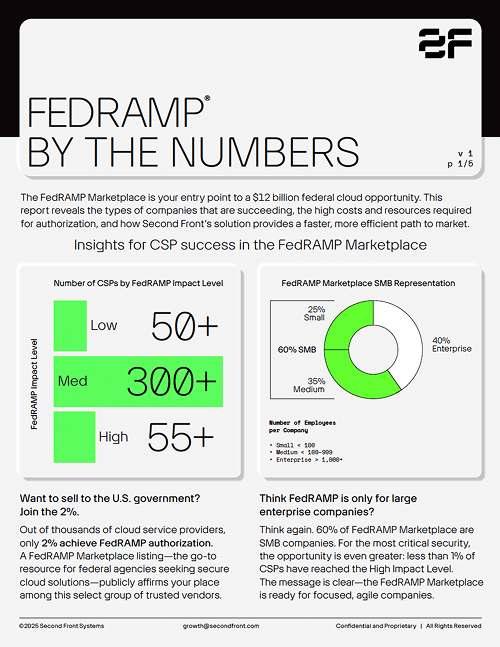
Unlock exclusive access to our FedRAMP By the Numbers Infographic—your front-row pass to a $12 billion federal cloud market opportunity!
Understanding FedRAMP: New 2026 terminology and baselines
To navigate the modern landscape, you must first unlearn the legacy vocabulary that dominated FedRAMP discussions before 2026.
Historically, cloud offerings were categorized by FIPS 199 impact levels (Low, Moderate, and High), and vendors aspired to a status called “FedRAMP Ready,” which signaled they had completed a Readiness Assessment Report and were prepared for full sponsorship. Vendors that completed the gauntlet became “FedRAMP Authorized.”
Under the Consolidated Rules for 2026 (CR26), which take effect in January 2027, “FedRAMP Authorized” is being formally transitioned to “FedRAMP Certified” or “FedRAMP Certification” as the single official label for all approved authorizations.
| Legacy Designation | 2026 Certification Class | Approximate Control Count | Primary Use Case |
| Pilot / FedRAMP Ready | Class A* | Scoped per offering | Initial preparation phase; replaces the old readiness designation |
| LI-SaaS / Low | Class B | 125–156 controls | Public or non-sensitive data; limited adverse impact if compromised |
| Moderate | Class C | 323–325 controls | Controlled Unclassified Information (CUI); serious damage if compromised |
| High | Class D | 410–421 controls | Most sensitive unclassified data; catastrophic impact if compromised |
*Under the new rules, providers can list on the Marketplace during preparation, but they must demonstrate continuous progress through quarterly Ongoing Certification Reports and schedule a full Class B, C, or D assessment within two years. Miss those milestones and you are removed from the Marketplace.
The path to FedRAMP ATO: A five-phase how-to
Moving to a Marketplace-listed entity is a multi-phase process. Here is what each phase actually demands.
Phase 1: Define your authorization boundary
Before a single line of compliance documentation is drafted, you must define your authorization boundary, architecture, inherited services, data flows, and shared-responsibility model. An ambiguous boundary inevitably triggers scope creep, cost overruns, and failed audits.
The rules are straightforward but unforgiving. Every component that processes, stores, or transmits federal data, including any Controlled Unclassified Information (CUI), must reside within the boundary. Every external connection must be disclosed and assessed for risk. Corporate services like internal HR or billing can remain outside the boundary only if they do not affect the confidentiality, integrity, or availability of the offering itself.
Under FedRAMP 20x, an alternative authorization pathway, preparation should focus less on producing new narrative documentation and more on reusing existing security program evidence, automating validation, and demonstrating measurable security outcomes through machine-readable evidence and Key Security Indicators (KSIs).
Phase 2: Harden the architecture
Once the boundary is set, the engineering work begins. Two requirements dominate this phase.
FIPS 140-3 cryptography. Federal encryption is not satisfied by modern TLS or commercial-grade libraries. Data in transit and at rest must use cryptographic modules validated under the Cryptographic Module Validation Program. The ecosystem is rapidly transitioning from FIPS 140-2 to FIPS 140-3, with all legacy 140-2 validations sunset by September 2026. FIPS 140-3 introduces stricter validation, enhanced physical security mandates, and rigorous requirements for the zeroization of sensitive security parameters. Maintaining compliance across distributed, containerized microservices is genuinely difficult. Custom OS builds or non-validated OpenSSL libraries can invalidate the entire cryptographic posture overnight.
Privileged access controls. Multi-factor authentication is mandatory across the board, but the program differentiates sharply between privileged and non-privileged users. System administrators, SREs, and anyone with elevated access must authenticate using phishing-resistant MFA aligned with NIST SP 800-63B’s highest Authenticator Assurance Levels (AALs). In practice, this means hardware tokens, strict session monitoring, least-privilege Role-Based Access Control (RBAC) documented in a formal Access Control List matrix, and Mobile Device Management for administrative endpoints.
Phase 3: Generate machine-readable documentation (OSCAL)
This is the most disruptive change in the modern program. Historically, the System Security Plan (SSP) and supporting evidence were delivered as massive static Word documents, often exceeding hundreds of pages, prone to human error, and almost impossible to keep accurate during continuous monitoring.
Under RFC-0024, those documents are being systematically replaced by the Open Security Controls Assessment Language (OSCAL), a NIST-developed standard that expresses security controls, implementation statements, and assessment results in structured, machine-readable JSON or XML.
The deadline is firm. By September 30, 2026, all new authorizations must be submitted in machine-readable format. Existing authorized services must transition during their next annual reassessment after that date. Following a brief grace period, any service that fails to adopt the schema by September 2027 will lose its FedRAMP Certification entirely.
This shift fundamentally moves the compliance burden from technical writers to DevSecOps engineers. Generating valid OSCAL packages requires deep integration with infrastructure-as-code, CI/CD pipelines, and cloud security posture tooling. Running parallel to this is FedRAMP 20x, which replaces narrative descriptions with Key Security Indicators (KSIs) and mandates dedicated digital Trust Centers that share security posture data via API in real time.
Phase 4: Independent assessment and ATO issuance
Once the architecture is hardened and OSCAL documentation is generated, you engage a Third-Party Assessment Organization (3PAO), increasingly referred to as an Independent Assessment Services (IAS) provider under CR26. Under the modernized FedRAMP 20x model, the assessor’s focus shifts away from manual validation of static paperwork and heavily toward validating your automated control enforcement and operational telemetry. The assessor tests your control implementation, reviews vulnerability scans, conducts annual penetration testing, and compiles their findings into a formal Security Assessment Report (SAR) detailing every finding.
Very few systems pass without findings. You will also develop a Plan of Action and Milestones (POA&M) documenting remediation timelines for each vulnerability. Finally, your complete package (machine-readable SSP, SAR, and POA&M) is submitted to your sponsoring agency’s Authorizing Official (AO). The AO reviews the package to weigh the residual risk against their specific mission needs. If the AO accepts the residual risk, they issue the formal authorization, triggering the FedRAMP PMO to update the Marketplace to reflect your new “FedRAMP Certified” status.
Phase 5: Continuous Monitoring
Authorization is not a finish line; it is the start of a permanent operational obligation. Evidence collection must run as an automated background process. Container and host vulnerability scans must occur at least every 30 days, with results pulled programmatically from cloud providers via API.
Vulnerability remediation SLAs are strict: Critical and High findings within 30 days, Moderate within 90 days, Low within 180 days. Every release requires a signed Software Bill of Materials (SBOM) to track third-party library risk. And unlike the rescinded JAB model, you must now share continuous monitoring data directly with every agency customer holding an ATO for your service. Miss a deadline, and you risk immediate suspension and removal from the Marketplace.
Why “Build It Yourself” rarely works
The traditional path (building a dedicated, compliant cloud infrastructure from scratch) routinely consumes 12 to 24 months and millions in pre-revenue engineering investment. For most commercial software companies, this is where the difficulty jumps an entire tier: the regulatory friction stalls or bankrupts emerging technology companies before they ever deliver value to the government.
The smarter approach is to inherit. ATOs themselves are not transferable, but FedRAMP and the broader Risk Management Framework explicitly allow formal control inheritance when your system is deployed on top of an already authorized environment. Instead of rebuilding 400+ controls from scratch, you inherit the foundational physical, environmental, and technical controls from a pre-accredited platform, and focus your effort only on the controls specific to your application.
Stop building from scratch: Fast-track your ATO with Game Warden
The federal government’s pivot to CR26, the 20x framework, and machine-readable OSCAL evidence represents a profound maturation of the federal cloud security ecosystem. However, for commercial software providers, attempting to engineer this independently is a high-risk, low-velocity strategy.
You don’t have to build it all from scratch. Second Front Systems’ Game Warden is a fully managed, multi-cloud DevSecOps environment that is itself FedRAMP Class D Classified (aka tier representing fewer than 1% of cloud providers in the United States) and additionally holds a DISA Provisional Authorization at DoD Impact Level 5 (IL5), with deployment pathways spanning IL4 through IL6+ for defense workloads. By deploying onto Game Warden, commercial vendors inherit the platform’s compliance posture for the vast majority of controls, including FIPS-validated cryptographic boundaries, secure-by-default infrastructure, automated vulnerability scanning, and continuous monitoring baked in from Day 1.
Game Warden offers flexible pathways built around your specific go-to-market needs:
- Inherit lets vendors deploy directly under the platform’s existing authorization for the fastest route to market. No sponsor required, either.
- Own lets vendors secure their own Marketplace listing while leveraging Game Warden’s compliance automation and infrastructure stack, preventing vendor lock-in while still drastically compressing the timeline.
- Prove is a specialized pathway for demonstrating FedRAMP security equivalency for specific procurements or defense requirements without pursuing full civilian authorization.
While no platform can streamline the entire authorization process overnight, Second Front has built Game Warden to speed up the process and remove costly touch labor, turning the compliance burden into a strategic accelerator and giving commercial vendors a credible path from code to mission deployment in months rather than years.
Ready to accelerate your authorization? Speak with our team to learn how Game Warden can compress your path to FedRAMP Certification.