With 2F Game Warden for FedRAMP, deliver your cloud service to federal civilian agencies faster—accelerating authorization and opening federal market access.
Whether delivering software to the public sector for the first time or needing a hand navigating the complex accreditation process, 2F is your one-stop shop.
See how Second Front helped Integrate fast-track IL6 accreditation and deploy to a classified environment in under 12 months—paving the way for a $25M Phase III SBIR award.
DoD DevSecOps fundamentals: Core concepts, principles, and practices explained
2F Team
07.31.2026 / 2 months ago
8 minute read
Share
Listen to This Article
DoD DevSecOps is a software engineering culture and a set of integrated practices unifying development, cybersecurity, and operations into a single automated, continuous lifecycle. The Department of War adopted it because the alternative stopped working. Acquisition frameworks engineered to field aircraft carriers decades ago cannot iterate code in minutes to close a zero-day. In an era of autonomous systems, AI, and nation-state cyber operations, the speed at which a military force can develop, secure, deploy, and update software correlates directly with survivability and lethality. As SECWAR Hegseth wrote in his March 2025 memo, Directing Modern Software Acquisition to Maximize Lethality, “Software is at the core of every weapon and supporting system we field to remain the strongest, most lethal fighting force in the world”. Software is now the primary vector for military advantage.
The policy vehicle is the DoD Enterprise DevSecOps Initiative, covered in depth in The DoD Enterprise DevSecOps Initiative (DSOP) and What You Need to Know. The DoD DevSecOps fundamentals beneath it are four interlocking pillars, a deliberately engineered culture, a ten-phase lifecycle, and the practices making continuous authorization possible.
Why the legacy model failed
Legacy defense software acquisition treated security as a terminal gate rather than a continuous state. Under the traditional Risk Management Framework (RMF), the Authorization to Operate (ATO) process required a manual review of static documentation packages, a bottleneck routinely delaying deployments by 18 to 24 months. Worse, the compliance model was point-in-time: a system deemed secure at authorization could sit unpatched for years while the threat landscape evolved around it. By the time software reached the warfighter, the codebase was frequently obsolete and exposed.
DoD DevSecOps inverts that paradigm on a simple premise: velocity is a prerequisite for security, not a trade against it. A static system is a vulnerable system. By embedding automated security checks, vulnerability scanning, and compliance validation directly into the delivery pipeline, an organization can identify, patch, and deploy countermeasures faster than adversaries can weaponize exploits.
The shift also demands new architecture: loosely coupled microservices on cloud-agnostic, open foundations, so software deploys anywhere from enterprise clouds to disconnected edge nodes, with over-the-air updates flowing to weapon systems and command-and-control networks securely and simultaneously.
Dummies eBook
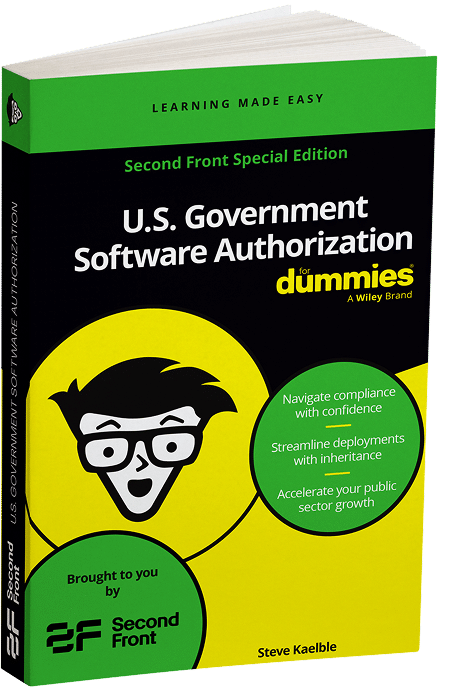
U.S. Government Software Authorization for Dummies
Government authorization doesn’t have to be a black box. Learn how it actually works.
The DoD Enterprise DevSecOps Reference Design builds the ecosystem on four interlocking pillars: organization, process, technology, and governance. The doctrine is explicit: a program must advance across all four synchronously. Failed synchronization results in technological speed bottlenecked by archaic governance, or agile processes stalled by organizational resistance.
Organization addresses the human element, widely considered by defense leadership to be the most challenging and intractable aspect of the digital transformation. It requires senior leadership buy-in to dismantle hierarchical, siloed structures in favor of decentralized, collaborative teams where calculated risk is encouraged and failure functions as a learning mechanism rather than a punishable offense.
Process mandates agile methodologies and the shift-left philosophy: moving security, performance, and functional testing to the earliest possible stage of the lifecycle. Code is scrutinized from the moment a developer commits it, so defects surface when they are cheapest to fix, not during pre-deployment audits or in an operational theater.
Technology covers the automated toolchain that executes the pipeline: Infrastructure as Code (IaC) and Configuration as Code (CaC) to eliminate manual provisioning, Open Container Initiative (OCI) compliant containers, and Cloud Native Computing Foundation (CNCF) certified Kubernetes distributions so software behaves identically on a developer laptop, a staging server, or a ruggedized edge node in a tactical vehicle.
Governance operationalizes compliance as code. In an environment deploying multiple times per day, manual policy enforcement is near impossible, so security policies and NIST controls are translated into machine-readable checks executing inside the pipeline. Governance stops being an external auditing function and becomes an automated byproduct of daily engineering, the groundwork for continuous authorization.
DoD DevSecOps culture: the mirroring effect
Buying a CI/CD orchestrator is a budgetary exercise. Building the culture to use it is the actual challenge. The DoD Enterprise DevSecOps Fundamentals warn leaders: success is not measured by the presence of an automated pipeline but by the commitment of every stakeholder to change how they work and how they interact with one another.
A defining tenet of DoD DevSecOps culture is the deliberate reversal of Conway’s Law, the adage that organizations design systems mirroring their own communication structures. Rigid hierarchies and compartmentalized departments produced exactly the software you would expect: monolithic, fragile, and hard to update. To build decoupled microservices, defense organizations must restructure into small, autonomous teams mirroring the architecture they are building.
That restructuring produces cross-functional defense software teams, the fundamental unit of capability delivery. Where a traditional program passes a product sequentially from requirements to development to testing to operations, a cross-functional team holds all the competencies, permissions, and tools to build, secure, and run the capability independently. Security is no longer the burden of a detached cyber unit, and uptime is no longer the sole problem of an operations center. Both become the shared, daily responsibility of everyone on the product.
These teams also need psychological safety. The doctrine encourages a mindset of “fail fast, but don’t fail the same way twice,” a sharp departure from traditional military risk aversion. Immutable infrastructure makes this practical: teams can ship experimental features, catch failures through automated telemetry, and roll back to a known secure state instantly, without compromising the broader system.
Inside cross-functional defense software teams
Team composition is designed so deep expertise is present at every phase of the lifecycle, and individuals frequently cover multiple roles to hit sprint objectives.
Role
Responsibility in a DoD DevSecOps team
Product manager
Owns vision and roadmap; prioritizes warfighter capability over technical debt; liaises between the tactical end-user and the engineering team.
Software developer
Designs, writes, and peer-reviews code; also writes the initial unit and security tests, applying shift-left security inside daily workflows.
DevSecOps specialist / SRE
Selects and maintains the CI/CD orchestrator, automates the toolchain, and ensures observability and security logging across the deployed lifecycle.
Software/cloud architect
Designs container orchestration and cloud pathways aligned to DoD reference designs, integrates Zero Trust, and avoids vendor lock-in.
Systems security analyst
Embeds threat intelligence and compliance into the pipeline; works with developers daily to configure analysis tools and define control-gate parameters.
Test and evaluation specialist
Replaces manual click-testing with scripted behavioral, integration, and functional tests validating every commit without human delay.
Authorizing Official (AO)
Accepts risk on behalf of the government; in a mature environment, monitors live compliance dashboards instead of static paperwork.
The DoD DevSecOps lifecycle: ten phases, one loop
The operational core of the methodology is the continuous lifecycle, visualized as an infinite loop: development activities on the left, operations on the right, and automated control gates at every intersection. These gates are software-defined checkpoints validating security, quality, and compliance thresholds before an artifact advances. The DoD Enterprise DevSecOps Fundamentals delineate ten phases.
Plan. Threat intelligence, security architecture, and Zero Trust principles are aligned before functional code exists, and teams work with the AO to define exactly what the control gates will validate downstream. Security is built in, not bolted on.
Develop. Developers work in Integrated Development Environments (IDEs) equipped with real-time linting, static analysis, and secrets scanning, catching hardcoded credentials and architectural flaws before they ever reach the repository.
Build. A commit to a secured repository such as Repo One triggers the orchestrator to compile the source, gather dependencies, and package the application into a standardized OCI-compliant container image, eliminating “it works on my machine” issues.
Test. The pipeline subjects the artifact to concurrent functional and security testing: Static Application Security Testing (SAST) against the source, Dynamic Application Security Testing (DAST) against the running application, and container scanning for compromised base images, malware, and unapproved licenses. Artifacts advance only with zero high or critical findings in accordance with the organization’s risk appetite.
Release and deliver. The vetted artifact is versioned and digitally signed, a Software Bill of Materials (SBOM) is generated, and the package moves to a trusted artifact repository before staging for transfer to production environments spanning unclassified clouds to disconnected classified networks.
Deploy. IaC playbooks replace old containers with new ones in their entirety. The doctrine mandates immutable deployment: components are never patched in place, preventing configuration drift and guaranteeing the live environment matches the source definition.
Operate and monitor. The warfighter uses the capability while telemetry, behavioral analytics, and active cyber defense tools continuously watch the application, service mesh, and infrastructure for anomalies, exploits, and degradation, invisibly to the end-user.
Feedback. Escaped defects, user telemetry, and operational data route back to the product team and feed the next plan phase, closing the loop and starting the next iteration immediately.
DoD DevSecOps practices: securing the software supply chain
Adversaries no longer attack only the finished application. They poison upstream open-source libraries and developer tools long before the code is compiled, making Secure Software Supply Chain (SSSC) practices a non-negotiable focus of DoD DevSecOps engineering.
The cornerstone is the SBOM: a machine-readable inventory of every component, library, transitive dependency, and license in an application, generated automatically during the build phase. For global zero-days, an organization with centralized SBOM management does not launch a weeks-long manual audit. It queries the database, identifies exactly which images contain the compromised library, and patches with precision. Paired with automated vulnerability scanners and policy engines in the pipeline, the orchestrator acts as a gatekeeper, blocking any artifact carrying unauthorized licenses, exposed secrets, or known high-severity vulnerabilities from the developer workstation to the tactical edge.
From point-in-time ATOs to continuous authorization
Everything above culminates in Continuous Authorization to Operate (cATO), a foundational shift in how the Department accepts cyber risk. Historically, an AO accepted risk based on static paperwork, a snapshot outdated the moment it was signed. Under cATO, the AO consumes live telemetry: dashboards aggregating machine-generated evidence from the pipeline, the runtime environment, and active cyber defense tooling. If the system holds its secure baseline, authorization to deploy remains continuous and updates flow to production instantly. If the baseline is violated, deployments halt or authorization is revoked until remediation.
Attaining cATO requires demonstrated competency across what the doctrine calls the 3 (+1) pillars. Continuous monitoring (CONMON) generates near-real-time machine evidence of RMF compliance across the lifecycle. Active cyber defense (ACD) means the environment responds to attacks dynamically, integrating a Cybersecurity Service Provider with the service mesh’s ability to isolate or terminate compromised containers in runtime. The DevSecOps platform (DSOP) is the approved pipeline itself, whose control gates no human error or fatigue can bypass. The (+1) is the secure software supply chain, extending verification to every third-party and open-source dependency.
The economics change accordingly. Upfront investment in automation and cultural retraining eliminates the multi-million dollar compliance costs and year-long delays of legacy ATO cycles, turning compliance from a downstream bureaucratic hurdle into an upstream engineering byproduct.
What the fundamentals mean for commercial vendors
Every fundamental above doubles as an entry requirement. The four pillars, the lifecycle’s control gates, the SBOM mandate, and continuous monitoring define what an AO expects any software running on defense networks to demonstrate, and building that capability bespoke is a time tax for a company whose business is its product, not federal infrastructure.
Control inheritance resolves it. Second Front’s Game Warden is a fully managed DevSecOps PaaS operating at FedRAMP Class D (High) with DISA Provisional Authorizations at Impact Levels 2, 4 and 5: your application deploys onto it and inherits the platform’s compliance posture for the large majority of required NIST controls, from Zero Trust networking to the Sidecar Container Security Stack. A FedRAMP Certification is not itself a DoD ATO; it is the strategic bridge, an assessed civilian baseline DoD Authorizing Officials can accept by reciprocity on the way to an Impact Level authorization. In practice, inheritance compresses the path to obtain a DoW ATO from an average of two years to months, and in optimized cases as little as 90 days.
The fundamentals are the strategy
The transition to DoD DevSecOps is not an IT modernization project. It is a recognition: in software-defined warfare, lethality is inseparable from digital agility, and building software like battleships will lose the race against the adversary. The direction of travel is one way: cross-functional teams over silos, immutable pipelines over manual gates, continuous authorization over static paperwork, and a supply chain verified at every node. Internalize the fundamentals now, whether as a military software factory or a commercial vendor, and you set the pace; wait, and you will be integrating against them later.
Ready to bring your software to the defense mission? Speak with our team to learn how Game Warden can compress your route to a DoW ATO.
Whether delivering software to the public sector for the first time or needing a hand navigating the complex accreditation process, 2F is your one-stop shop.