With 2F Game Warden for FedRAMP, deliver your cloud service to federal civilian agencies faster—accelerating authorization and opening federal market access.
Whether delivering software to the public sector for the first time or needing a hand navigating the complex accreditation process, 2F is your one-stop shop.
See how Second Front helped Integrate fast-track IL6 accreditation and deploy to a classified environment in under 12 months—paving the way for a $25M Phase III SBIR award.
An ISV’s FedRAMP playbook: Navigating certification pathways, baselines, and boundaries
2F Team
07.27.2026 / 2 months ago
6 minute read
Share
Listen to This Article
The traditional build-it-yourself approach to FedRAMP can take 18-24 months and cost up to millions in pre-revenue engineering. However, you can compress that timeline to a matter of months by mastering the three foundational pillars of compliance: the certification path you pursue, the baseline you build toward, and the boundary you draw around your system. Handle them badly and they compound. Handle them well and they accelerate. The work usually falls to individuals, not a team: the compliance officer answering to an Authorizing Official (AO), and the engineering lead shipping the architecture under them.
Pillar one: The certification pathway
Three pathways exist, and the right one depends almost entirely on where your federal demand originates.
Agency certification is the traditional and most common route. A federal agency sponsors your system, reviews your security package alongside an independent assessor, and its AO issues an ATO for its specific use case. The payoff arrives afterward: once one agency authorizes you, subsequent agencies operate under a “presumption of adequacy” and reuse your package to issue their own ATOs without restarting the assessment. The do-once-use-many principle, made concrete. For Class D (High) systems, the agency path is the only option, because the risk profile demands a named federal sponsor formally accept it.
Program certification replaces the older Joint Authorization Board model. The FedRAMP Program Management Office and the FedRAMP Board can certify cloud services showing broad federal demand even without a single initiating sponsor. While it targets widely adopted tools, no 20x availability at Class D steers new entrants to the agency route near-term.
FedRAMP Insights
Ready to ignite your FedRAMP Journey?
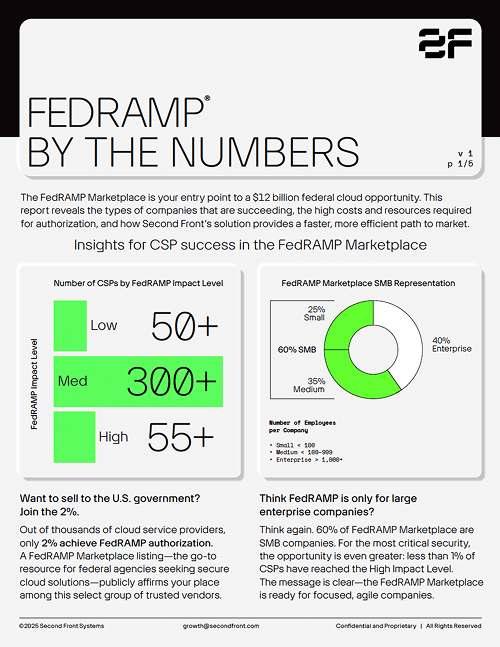
Unlock exclusive access to our FedRAMP By the Numbers Infographic—your front-row pass to a $12 billion federal cloud market opportunity!
Your baseline follows the sensitivity of the data your system touches, categorized under FIPS 199 across confidentiality, integrity, and availability. A system is rated by its highest requirement across the three, the “high-water mark,” so low confidentiality and availability but high integrity still produces a High system. Pinning your FedRAMP impact level early prevents the most expensive mistake in the process: building for the wrong tier and retrofitting later. As we will explore later, relying on a pre-accredited platform allows you to bypass this ‘retrofit trap’ entirely, ensuring you don’t have to tear down a commercial multi-tenant environment just to migrate to an isolated, higher-assurance one.
Li-SaaS baseline (Class B): The accelerator
The FedRAMP Tailored Low Impact SaaS baseline, Li-SaaS, applies to fully operational cloud services holding no personally identifiable information (PII) beyond the basics required to log a user in: username, password, corporate email.
The ingenuity is not a smaller control count. Li-SaaS draws from the same pool of roughly 156 Low-baseline controls; what changes is handling. A targeted subset requires full narrative documentation in the System Security Plan (SSP) and independent third-party assessment, while the rest can be satisfied through a formal attestation, bypassing exhaustive evidence collection and independent verification. The compression turns a four-to-six-month exercise into one closer to weeks. Li-SaaS also drops several recurring obligations, including annual penetration testing, contingency plan testing, and incident response plan testing, while still mandating monthly vulnerability scans and ongoing Plan of Action and Milestones (POA&M) updates.
If it’s your high-water mark, you can treat Li-SaaS as a launchpad. It builds compliance credibility, validates real federal demand, and establishes a secure foundation before you commit to a heavier baseline.
Moderate (Class C): The commercial center of gravity
Moderate is where most of the federal cloud market lives and accounts for the bulk of successful authorizations. It is mandatory for any system handling Controlled Unclassified Information (CUI), sensitive personnel records, or data where a breach causes serious adverse effects short of catastrophic harm. Under NIST 800-53 Rev 5, Moderate enforces well over three hundred controls, and unlike Li-SaaS there are no attestation shortcuts: every control documented, evidenced, and independently assessed. If your buyers handle CUI, this is your floor.
High (Class D): The most sensitive unclassified tier
High protects the government’s most sensitive unclassified data, such as critical infrastructure, law enforcement systems, and large-scale health data, where compromise could be severe or catastrophic. It mandates north of four hundred controls, frequently requires dedicated and logically isolated hosting, and cannot use the program shortcut; a federal sponsor must be directly involved in accepting the risk.
FedRAMP vs. DoW Impact Levels
For vendors targeting the defense market, the relationship between civilian and military compliance comes up constantly. While FedRAMP serves as the foundational civilian baseline; the U.S. Department of War layers additional requirements on top through the DISA Cloud Computing Security Requirements Guide, which are expressed as Impact Levels (IL2 through IL6).
IL2: Maps cleanly to the FedRAMP Class C (Moderate) baseline.
IL4 and IL5: Require FedRAMP Class C (Moderate) or Class D (High) as a foundation plus substantial defense-specific overlays, physical separation, and U.S.-person or U.S.-citizen personnel restrictions.
If you have a defense-bound roadmap, these requirements should shape your architecture now, rather than attempting to retrofit your system after a lucrative contract hinges on it.
Pillar three: The FedRAMP boundary
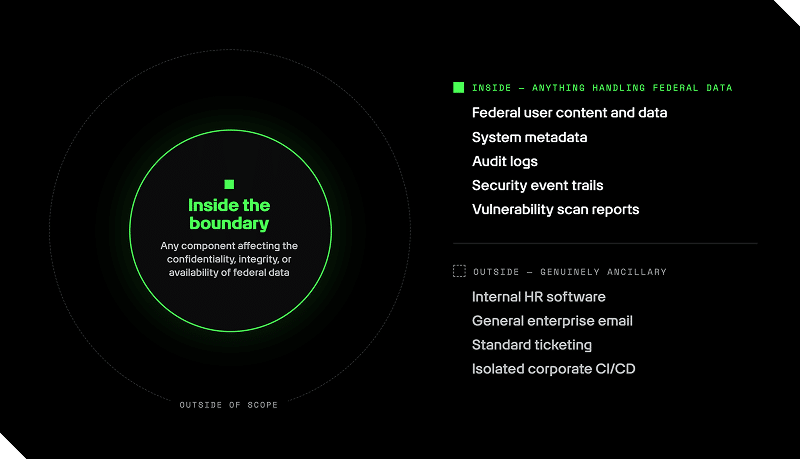
The authorization boundary defines what gets assessed, and on average is the single most error-prone element of the package. The FedRAMP boundary is the perimeter of your cloud service offering: which components, data flows, personnel, and external integrations fall inside the scope of assessment and continuous monitoring. Draw it too narrowly and you omit real risk, inviting audit failure. Draw it too broadly and you pull tangential corporate systems into scope, ballooning cost and timeline. Boundary ambiguity is one of the most common reasons AOs reject packages.
The governing principle: Anything handling federal data belongs inside. Handling means creating, processing, storing, or transmitting it. The definition reaches past user content to system metadata, audit logs, security event trails, and vulnerability scan reports, because each reveals sensitive operational information about how the agency uses your platform. Any component affecting the confidentiality, integrity, or availability of federal data is in scope, full stop.
The counterpart offers relief: Genuinely ancillary corporate systems stay outside. Internal HR software, general enterprise email, standard ticketing, and isolated corporate CI/CD pipelines posing negligible risk to production no longer get dragged in. The assessment narrows to the systems actually protecting federal interests rather than your entire IT footprint.
The inheritance model
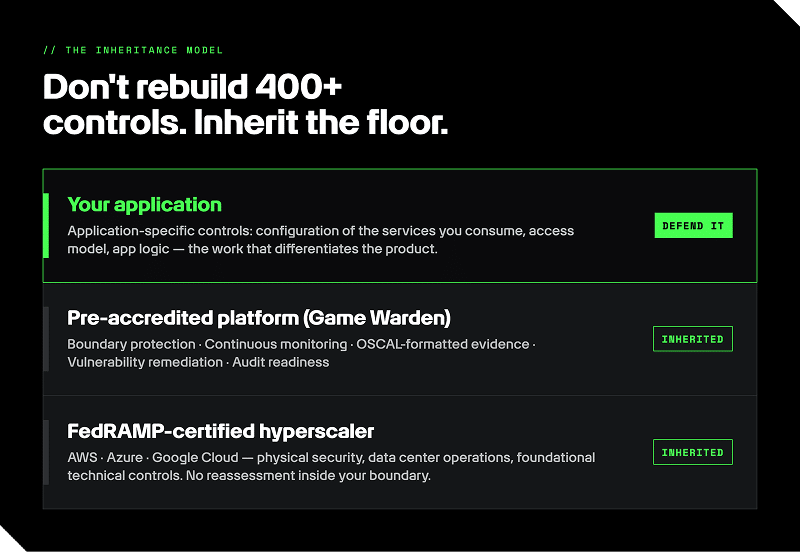
Nearly every ISV platform runs atop a hyperscaler such as AWS, Azure, or Google Cloud. FedRAMP enforces a hard rule: To certify, your application must reside on infrastructure already FedRAMP certified, because certifying the bare-metal stack yourself is functionally impossible for a software vendor. Building on an already-certified environment establishes a control inheritance relationship. The underlying physical security, data center operations, and foundational technical controls need no reassessment within your boundary; your work narrows to how you configure the services you consume, guided by the provider’s Customer Responsibility Matrix (CRM).
This is the lever that makes FedRAMP tractable. ATOs themselves never transfer, and context always counts, but controls satisfied by a pre-accredited environment can be formally inherited within your boundary, subject to AO approval. Rather than rebuilding four hundred controls, you inherit the foundational layers and spend your engineering effort on the controls specific to your application. The deeper and more credible the environment you inherit from, the less of the boundary you have to defend yourself, which is precisely why the platform decision in the final section carries so much weight.
Where a pre-accredited platform fits
The traditional build-it-yourself approach is slow and capital-intensive, routinely running 18 to 24 months and millions in pre-revenue engineering before any production traffic flows. Pre-accredited DevSecOps platforms have become the dominant accelerator for that reason, and the problem is the one Second Front Systems built Game Warden to solve.
Game Warden is a fully managed, multi-cloud environment, itself FedRAMP High (Class D) Certified, including a DISA Provisional Authorization across DoW Impact Levels. Game Warden addresses the retrofit trap: migrating from a multi-tenant commercial environment to a physically isolated, higher-assurance one. Containerizing an application and deploying onto it lets a vendor inherit the underlying controls, boundary protection, continuous monitoring, physical access, and the foundational technical layers, and concentrate on the application-specific controls that differentiate the product. The platform also absorbs the Day 2 burden the sections above flagged as the real cost: continuous logging, OSCAL-formatted evidence generation, vulnerability remediation, and audit readiness. Flexible pathways match it to a go-to-market plan, whether inheriting the platform’s certification/authorization for the fastest route to deployment, leveraging its automation to pursue an independent listing, or proving security equivalency for a specific procurement. The reported effect compresses timelines from years to months.
No platform makes the underlying requirements disappear, and none should claim to. Building for FedRAMP is a genuine engineering discipline. But the difference between vendors who reach the market and vendors who stall is rarely the quality of the software; it is whether certification was planned as a strategy or paid as a tax, late.
The regulatory perimeter is not softening. Impact Levels are becoming Certification Classes, narrative documents are becoming machine-readable evidence, annual reviews are becoming continuous validation. Vendors who treat certification, baselines, and boundaries as one connected system, and design backward from the tier their roadmap demands, consistently outpace the ones who do not. The right first move is not to pick the lowest tier and sprint. It is to classify your data, map your buyers, and choose your path with the full picture in view.
Ready to map your authorization path? Speak with our team to learn how Game Warden can compress your route to FedRAMP.
Whether delivering software to the public sector for the first time or needing a hand navigating the complex accreditation process, 2F is your one-stop shop.