With 2F Game Warden for FedRAMP, deliver your cloud service to federal civilian agencies faster—accelerating authorization and opening federal market access.
Whether delivering software to the public sector for the first time or needing a hand navigating the complex accreditation process, 2F is your one-stop shop.
See how Second Front helped Integrate fast-track IL6 accreditation and deploy to a classified environment in under 12 months—paving the way for a $25M Phase III SBIR award.
The accreditation dilemma: a TCO comparison of DIY vs PaaS FedRAMP Certification
2F Team
08.03.2026 / 2 months ago
6 minute read
Share
Listen to This Article
Reaching the federal market is not just a sales motion, it is an engineering and compliance decision that defines whether a commercial software company can deliver capability to Mission Owners. The U.S. government commits roughly $75 billion annually to technology, with approximately $20+ billion of that flowing into the rapidly expanding federal cloud market. Yet the path to capturing a slice of that opportunity runs through one of the most demanding regulatory frameworks in the world: a layered architecture of FedRAMP baselines, the Department of Defense (DoD) Cloud Computing Security Requirements Guide (CC SRG), and hundreds of NIST 800-53 controls.
This is the modern accreditation dilemma. Mission Owners urgently need commercial-first modern software. Yet, commercial vendors, accustomed to rapid DevSecOps cycles, are routinely paralyzed by static, documentation-heavy compliance work that was never designed for cloud-native architectures. The result is compliance paralysis, stalled public sector innovation, and inflated Total Cost of Ownership (TCO) for any cloud capability attempting to cross the government perimeter.
The traditional “build vs buy” Authority To Operate (ATO) decision, whether to construct a standalone compliance architecture independently or deploy onto a pre-accredited Platform-as-a-Service (PaaS), has become a consequential strategic choice in federal market entry.
The true financial burden of DIY FedRAMP
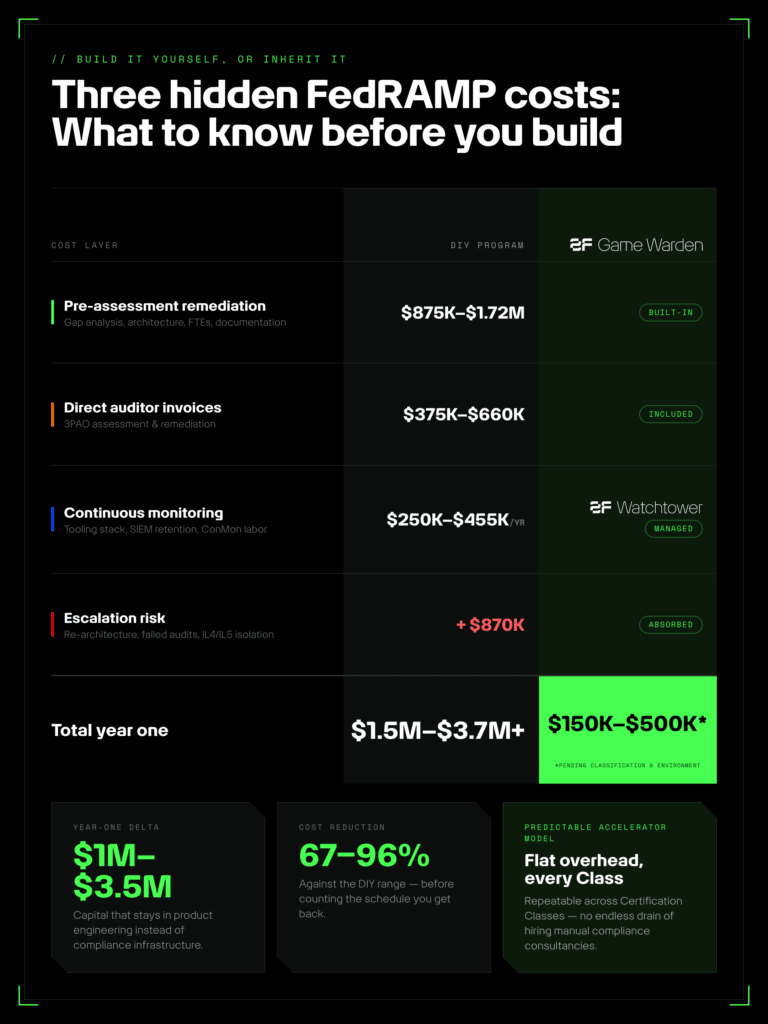
Most software vendors radically underestimate the cost of independent federal authorization, including investing in a higher Certification Class after initial entry. The headline numbers found in standalone Third-Party Assessment Organization (3PAO) audit quotes rarely capture the full operational picture. The true financial burden compounds across three hidden layers: intensive pre-assessment engineering/infrastructure remediation, direct auditor invoices, and the perpetual cost of continuous monitoring (ConMon).
A typical DIY FedRAMP program breaks down across five phases:
Pre-assessment and gap analysis: $125K to $235K
Architecture and engineering: $550K to $1.15M, including dedicated FedRAMP FTEs
Documentation and legal: $200K to $330K
Security tooling stack: $250K to $455K annually
Assessment and remediation: $375K to $660K
For a typical DIY build, FedRAMP totals approximately $1.5 million in first-year cost. A complex FedRAMP DIY build with escalation factors reaches $3.7 million or more.
Most organizations underestimate this all-in expenditure by 40% to 60% because they evaluate compliance as a static milestone rather than an ongoing operational tax.
What pushes DIY toward the $3.7M ceiling
Complex builds carry roughly $870K in escalation variables driven by four factors:
Application re-architecture to separate data boundaries or implement FIPS-validated cryptography
Failed first 3PAO assessments requiring expensive remediation and re-testing
FedRAMP Class D (High) or DoW Impact Level 4 (IL4)/IL5 targets that mandate physical isolation, strict container hardening, and personnel clearance requirements
Security Information and Event Management (SIEM) data ingestion under OMB M-21-31’s 30-month logging retention mandate, which vendors dramatically underestimate at build time
All-in cost breakdown by FedRAMP baseline
The financial outlay for initial DIY Certification and ongoing maintenance scales aggressively with the target certification class:
Certification Class
Approximate NIST Controls
Initial Authorization(USD, in ‘000)
Annual Maintenance(USD, in ‘000)
FedRAMP Class B (Low)
~125
250-500
100-200
FedRAMP Class C (Moderate)
~325
500-1,500
200-500
FedRAMP Class D (High)
~421
1,000-3,000
500-1,000
3PAO assessment fees inject another layer of extreme budget volatility. The initial assessment window alone typically runs $100,000 to $300,000, with mandatory recurring annual assessments adding $50,000 to $150,000. Because 3PAOs do not publish standardized transparent rate cards, financial predictability for vendors pursuing the DIY path is structurally nonexistent.
FedRAMP Insights
Ready to ignite your FedRAMP Journey?
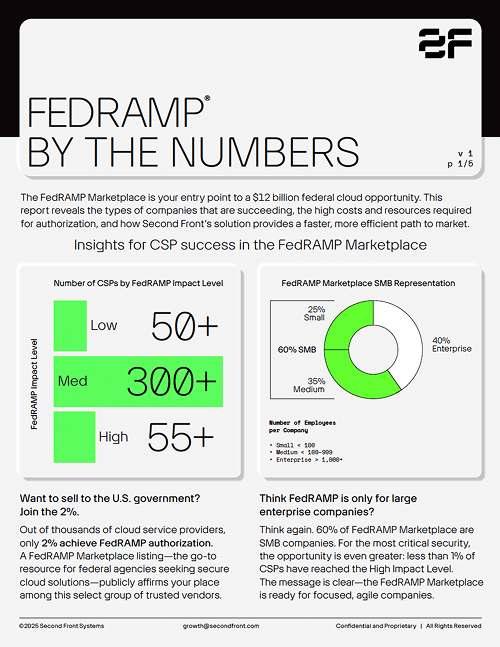
Unlock exclusive access to our FedRAMP By the Numbers Infographic—your front-row pass to a $12 billion federal cloud market opportunity!
Beyond direct engineering and audit expenditures, the timeline cost is just as punishing. Without modern acceleration platforms, manual, spreadsheet-driven Certification efforts routinely require 18 to 24 months and frequently stretch past 36 months for complex architectures.
In a market where FedRAMP functions as a binary gate, every quarter spent in accreditation limbo is a potential quarter of lost pipeline. SBIR Phase III awards, Program-of-Record transitions, and competitive public sector procurements are tied to strict delivery timelines that a legacy, slow-rolled DIY ATO process simply cannot survive.
Where DIY vs platform approaches diverge technically
The financial burden of DIY compliance is merely a symptom of deeper technical failure modes. Three distinct pitfalls show up consistently in stalled or rejected authorization packages.
The “Frankenstein” System Security Plan
A 1000-plus-page Word document stitched together from generic templates, fragmented spreadsheets, and outdated screenshots. Because the legacy DIY compliance treats the SSP as a static milestone artifact rather than a living machine-readable representation of the active environment, the document becomes obsolete the moment a new line of code is committed to production.
When an Authorizing Official (AO) or a 3PAO auditor identifies a structural disconnect between written documentation and runtime reality, such as an SSP claiming FIPS-validated encryption while real-world cloud configurations have drifted to non-compliant cipher suites, the package is instantly rejected. This phenomenon is compliance drift, and it remains a main reason why standalone ATO packages fail late in the formal assessment cycle.
The DIY vs platform debate is being settled at the policy level. Under FedRAMP 20x, static SSPs are being phased out entirely in favor of continuous, machine-readable validation through OSCAL (Open Security Controls Assessment Language). Vendors relying on manual documentation now face a compounding cost curve: retrofitting a legacy SSP into a compliant Word document for a 2026 audit, then rebuilding the same evidence pipeline as OSCAL-native data before their next assessment.
In parallel, the Department of Defense’s Cybersecurity Risk Management Construct (CSRMC) mandates “Always-On Compliance” and continuous Authority-to-Operate (cATO) postures, explicitly championing reciprocity and platform inheritance as its core foundational tenets. Both directions of federal modernization point to the exact same commercial outcome: vendors who can deliver continuous, automated, machine-readable security data will move at the speed of mission..
The collapse of continuous monitoring
NIST SP 800-53 control CA-7 demands a perpetual state of secure operations, not a point-in-time snapshot approval. Vendors attempting a DIY compliance route routinely underestimate the heavy infrastructure and specialized personnel required to sustain 24/7 logging, real-time alerting, and continuous vulnerability scanning.
Without automation compliance pipelines deeply integrated into your deployment workflow, security vulnerabilities rapidly accumulate in the Plan of Action and Milestones (POA&M). When an AO reviews a package and finds high-severity Common Vulnerabilities and Exposures (CVEs) that have languished unmitigated for 90-plus days, structural trust is broken and the ATO application is dead on arrival.
The ambiguous boundary protection
NIST controls AC-2 and SC-7 strictly mandate a clearly defined, defensible Certification boundary. Engineering teams building from scratch frequently present porous or ambiguous boundaries that inadvertently pull in third-party APIs, shared corporate software systems, or undefined data flows.
When structural boundary gaps surface late in an assessment, such as missing IPv6 support, absent DNSSec implementation, gaps in the MFA architecture, or undocumented external dependencies, it can lead to extensive re-architecting, turning a 12-month timeline projection into a multi-year ordeal.
The build vs buy ATO framework: why inheritance changes the math
Faced with these realities, federal technology leaders are re-evaluating the build vs. buy ATO question through the lens of control inheritance. Under the federal Risk Management Framework (RMF), software deployed on a fully accredited Platform-as-a-Service (PaaS) can inherit the vast majority of the underlying physical, network, and operating-system-level controls.
A vendor pursuing FedRAMP Class C (Moderate) certification independently must satisfy over 325 controls. Deployed on a properly accredited platform layer, that same vendor can inherit upwards of 80% controls on day one. The platform provider assumes responsibility for infrastructure hardening, boundary defense, physical data center security, and baseline continuous monitoring. The vendor’s engineering team focuses only on the application and data-layer controls that they are uniquely positioned to own, all without rebuilding hundreds of controls that have already been assessed elsewhere.
What differentiates Game Warden in the comparison
Within a fully managed DevSecOps PaaS, Game Warden’s structural advantages compound across upfront cost, ongoing operational cost, and speed to revenue.
For federal systems, the platform is FedRAMP Class D (High) Certified with built-in security controls and immediate 3PAO audit readiness. CSPs can secure their own FedRAMP Marketplace listing in as little as 180 days, or shorten the certification timeline to 60 to 90 days by inheriting Second Front’s existing ATO. Against DIY FedRAMP Class D (High) timelines that routinely stretch 18 to 36 months, that compression translates to 12 to 30 additional months of federal revenue capture.
For defense workloads, Game Warden supports the full DoW IL spectrum: IL2 through IL6, JWICS, and Top Secret environments. The platform holds a DISA Provisional Authorization at IL5 and is available on the AWS Joint Warfighting Cloud Capability (JWCC) contract, giving defense organizations a pre-authorized procurement pathway. The platform operates in strict alignment with the DoD DevSecOps Reference Design and maintains a zero Critical/High CVE posture through partnerships with vendors like Chainguard for hardened container images.
Game Warden natively integrates modern DevSecOps tooling. GitLab-based CI/CD, Grafana observability, automated Software Bill of Materials (SBOM) generation, and policy-as-code guardrails are built in, so vendors push updates without triggering full re-accreditation cycles. Continuous monitoring, database operations, logging, and incident response are managed by the platform, not the vendor, which eliminates the $500,000 to $1,000,000 annual burden of running an in-house federal-grade SOC that DIY teams carry indefinitely.
DIY vs. Platform: increasingly a one-sided choice
The accreditation dilemma is generally not solved by hiring more consultants, generating more documentation, or treating compliance as a quarterly milestone project. The data is unambiguous: Independent FedRAMP Certification and DoW Authorization efforts demand millions, multi-year timelines, and heavy operational commitments that most commercial software companies cannot sustain while also trying to scale a core product. When evaluated honestly against real-world TCO data, the DIY vs. platform decision is increasingly one-sided.
Adopting a modern, inheritance-based compliance model does demand engineering rigor and deep federal expertise. But this is the exact challenge Second Front built Game Warden to solve. By providing a fully accredited PaaS, automating evidence collection, and completely absorbing Day 2 continuous monitoring, Game Warden allows commercial vendors to inherit security controls that would otherwise consume years of capital and engineering effort.
If your commercial innovation is ready to be delivered at the speed of relevance, our team can help.
Whether delivering software to the public sector for the first time or needing a hand navigating the complex accreditation process, 2F is your one-stop shop.