With 2F Game Warden for FedRAMP, deliver your cloud service to federal civilian agencies faster—accelerating authorization and opening federal market access.
Whether delivering software to the public sector for the first time or needing a hand navigating the complex accreditation process, 2F is your one-stop shop.
See how Second Front helped Integrate fast-track IL6 accreditation and deploy to a classified environment in under 12 months—paving the way for a $25M Phase III SBIR award.
Choosing the right FedRAMP compliance tools for accelerating authorization
2F Team
06.15.2026 / 3 months ago
8 minute read
Share
For Compliance Officers tasked with steering commercial software through federal authorization, the toolchain has become as consequential as the regulatory framework itself. The era of managing System Security Plans (SSPs) in Word documents and tracking control implementation in shared spreadsheets is coming to an end. In its place, a new generation of FedRAMP compliance tools is emerging: platforms designed for continuous, machine-readable evidence and real-time validation against the National Institute of Standards and Technology (NIST) catalogs.
This shift is not theoretical. The transition to FedRAMP 20x, the impending OSCAL mandate, and the Department of War’s intention to move from the Risk Management Framework (RMF) toward the Cybersecurity Risk Management Construct (CSRMC) all converge on the same conclusion: the tools used to manage federal compliance must operate at the cadence of modern software delivery while providing continuous validation rather than static approval that quickly becomes out of date.
Historically, Compliance Officers felt forced to choose between a standalone GRC tool for tracking policies and an infrastructure platform for hosting their code. Today, the cutting edge of federal compliance has shifted toward a unified architecture: a pre-accredited, Platform-as-a-Service (PaaS) featuring a native, built-in GRC application layer. This combined approach allows teams to seamlessly pursue their own independent authorizations without managing disparate, disconnected systems.
This guide breaks down the evolving compliance toolchain, distinguishes the major categories of solutions on the market, and offers a practical evaluation framework for selecting tools that will accelerate, not impede, your path to authorization.
The regulatory landscape driving tool selection
Before evaluating any vendor, Compliance Officers must understand the forces reshaping the requirements tools must satisfy.
From impact levels to certification classes
FedRAMP is shedding its legacy terminology. The program is retiring “FedRAMP Authorization” in favor of “FedRAMP Certification,” and the familiar FIPS 199 categorizations of Low, Moderate, and High are being phased out in favor of an alphabetical Class A through Class D structure.
The change is not cosmetic. Class A serves as a pilot entry point requiring six core federal mandates. Class B (replacing Low and Li-SaaS) requires validation of 56 Key Security Indicators (KSIs). Class C, aligned with the legacy Moderate baseline, demands 61 KSIs. Class D, reserved for the government’s most sensitive unclassified data, retains the most rigorous requirements and still requires an active agency sponsor.
While FedRAMP 20x introduces sponsorless certification pathways intended to accelerate marketplace growth, it does not eliminate traditional agency-sponsored certification models. Agency-sponsored certifications remain part of the FedRAMP program, and many existing FedRAMP Class D and DoW Impact Level 5 (IL5) environments continue to rely on a sponsoring agency and Authorizing Official (AO) as the basis for their operational certification strategy. High-impact workloads, in particular, are still largely operating within certification models that involve significant agency participation.
The practical implication for Compliance Officers: select a platform built to operate across both schemas, so the multi-year transition is absorbed by the vendor rather than managed by your team.
The OSCAL mandate
The most consequential technical shift is the enforced adoption of the Open Security Controls Assessment Language (OSCAL), a NIST-developed framework for expressing security catalogs, baselines, and assessment results in structured, machine-readable formats (XML, JSON, YAML).
Tools that cannot natively produce OSCAL artifacts, or that depend on manual export from documents and spreadsheets, will become technical debt within months, not years.
FedRAMP Insights
Ready to ignite your FedRAMP Journey?
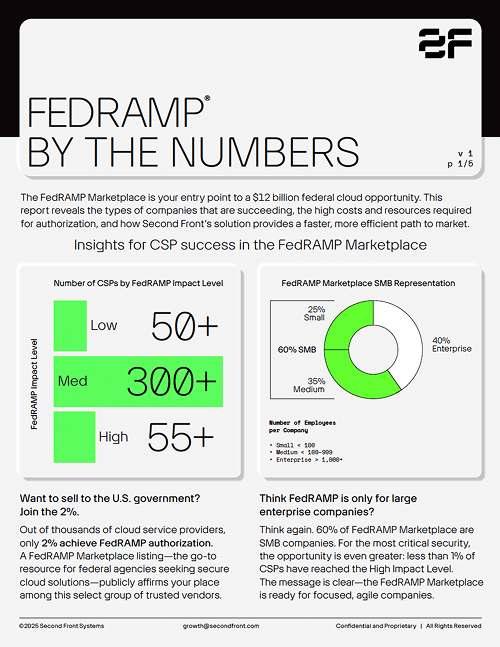
Unlock exclusive access to our FedRAMP By the Numbers Infographic—your front-row pass to a $12 billion federal cloud market opportunity!
Tool evaluation only makes sense in the context of what the underlying statutes actually require.
The Federal Information Security Modernization Act (FISMA) establishes the legal baseline for protecting federal information systems. Historically, FISMA assessments focused on discrete systems supporting a single agency, requiring vendors to secure separate Authority to Operate (ATO) decisions from each contracting agency. FedRAMP functions as “FISMA for the cloud,” establishing a do-once-use-many framework that allows cloud service providers to list their authorized package on the FedRAMP Marketplace for reuse across federal agencies.
NIST Special Publication 800-53 is the foundation of both frameworks, serving as the universal control catalog and organizing security and privacy controls into 20 control families. FedRAMP overlays additional cloud-specific parameters on top of NIST 800-53, including enhanced continuous monitoring obligations, mandatory third-party assessment by an accredited 3PAO, and strict data residency requirements for Class C and Class D systems.
Any FISMA compliance solution worth its license fee must map operational evidence directly to these control families and adjust dynamically as NIST issues revisions, including the transition to Revision 5 and 20x.
Tool category 1: Governance, risk, and compliance (GRC) platforms
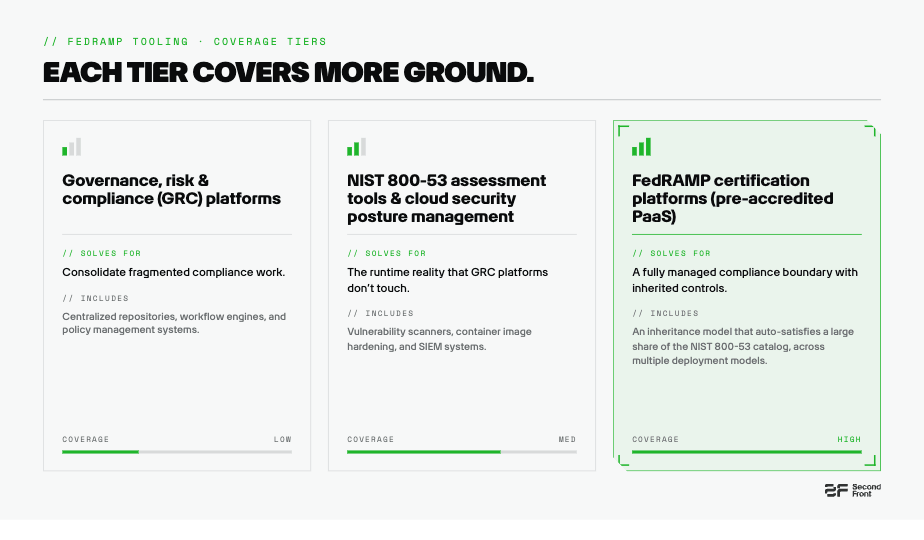
The first category of tools that Compliance Officers will encounter is the modern GRC platform. Solutions in this space function as centralized repositories, workflow engines, and policy management systems. They map controls across multiple parallel frameworks (FedRAMP, ISO 27001, SOC 2, CMMC) and (in the case of compliance-as-code tools) generate technically sound OSCAL evidence packages directly from structured inputs. But they do not enforce security at the runtime layer.
Best suited for:
Organizations seeking their own Certification: Software vendors who want full ownership of their own dedicated Certification (ATO) package.
Highly mature environments: Organizations that already possess highly mature cloud engineering teams capable of building, securing, and continuously monitoring their own complex infrastructure in-house.
A second category exists to address the runtime reality that GRC platforms do not touch. This category includes vulnerability scanners, container image hardening tools, and security information and event management (SIEM) systems. Most critical for federal workloads, it also includes Cloud Security Posture Management (CSPM) platforms.
CSPM platforms continuously monitor, assess, and remediate misconfigurations across dynamic cloud environments. In GovCloud and defense environments, they serve as the central nervous system for continuous compliance, detecting drift the moment code is committed, enforcing policy natively, and maintaining audit readiness across multi-cloud footprints.
The technical bar is significant. NIST SP 800-137 (Information Security Continuous Monitoring for Federal Information Systems and Organizations) requires real-time or near-real-time visibility into security-relevant events, with official guidance stating that monitoring gaps of more than 15 minutes provide sufficient time for an adversary to complete lateral movement before detection. Manual review of configuration changes across AWS, Azure, and Google Cloud at this cadence is impossible at scale.
FedRAMP’s Continuous Monitoring playbook adds specific scanning requirements that any tool in this category must support:
Scanning Requirement
Technical Mandate
Authenticated scanning
Required for all Class C and Class D systems; eliminates blind spots from restricted registry or file access
Signature updates
Vulnerability databases must update at least monthly, with machine-readable evidence before each scan. This accelerates to every three days under FedRAMP 20x
Asset identification
Unique identifiers mapped to inventory; ephemeral assets like containers must be tagged
Machine-readable output
All findings at low-risk threshold or higher must export in XML, JSON, or CSV
Image scanning
If the Cloud Service Provider (CSP) patches customer-leveraged images, source images must be scanned continuously
Best suited for: Teams that operate cloud infrastructure directly and need granular, real-time visibility into configuration drift, vulnerability posture, and runtime security signal across multi-cloud environments. CSPM and assessment tooling deliver maximum value when integrated with both DevSecOps pipelines and compliance documentation systems, forming the runtime telemetry layer that authorization platforms and GRC tooling depend on.
The third category collapses several of the above functions into a single, pre-accredited environment. FedRAMP certification platforms, provided as Platform-as-a-Service (PaaS), offer commercial software vendors a fully managed compliance boundary within which they deploy their applications and the ability to inherit the vast majority of NIST 800-53 controls.
This approach codifies a principle the DoW has formally endorsed through its Enterprise DevSecOps Initiative: define common security capabilities at the enterprise level so individual software systems do not duplicate them. Examples in this category include Second Front Systems’ Game Warden, which holds FedRAMP Class D Certification and accreditations across DoW Impact Levels 2 through 5, with deployment pathways into SECRET and TOP SECRET environments. True PaaS also includes a built-in GRC capability; a unified model that eliminates the friction of legacy setups by ensuring technical continuous monitoring, control inheritance, and operational policy documentation all live and sync natively within a single environment.
The inheritance principle: ATOs are not transferable, but the security controls satisfied by a pre-accredited platform can be formally inherited within an application’s authorization boundary, subject to AO approval. By deploying in a pre-defined boundary, a vendor automatically satisfies a large percentage of the NIST 800-53 catalog, including Access Control (AC-2), Boundary Protection (SC-7), physical and environmental controls, continuous monitoring infrastructure, and others.
Strategic pathways: Mature platforms in this category typically offer multiple deployment models: inheriting the platform’s existing ATO for the fastest path to revenue, leveraging the platform’s automated compliance architecture to pursue an independent ATO, or using the platform to prove FedRAMP-aligned equivalency without pursuing full Marketplace listing.
Best suited for: Commercial ISVs, defense technology companies, and software vendors that need to compress time-to-authorization, minimize internal compliance engineering investment, and inherit the heaviest portions of the NIST 800-53 catalog rather than building and defending them in-house. For these organizations, reported timelines compress from the traditional 18 to 24 months to as few as 90 days for DoW authorization and 180 days for FedRAMP Marketplace listing.
An evaluation framework for compliance officers
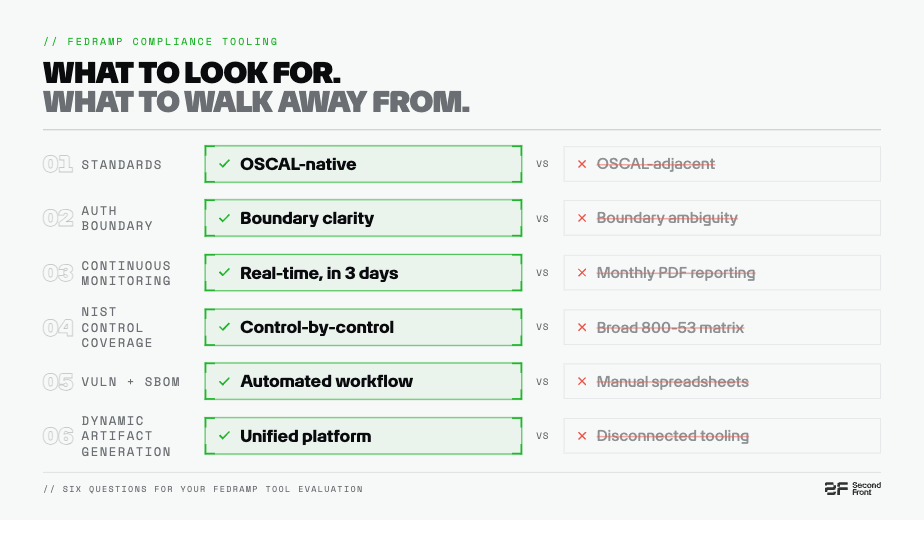
When assessing FedRAMP compliance tools and FedRAMP authorization platforms, Compliance Officers should pressure-test vendors against the following criteria:
1. OSCAL native or OSCAL adjacent? Ask the vendor to demonstrate machine-readable artifact generation. If they describe OSCAL support as “on the roadmap” or as an export option from a Word-based authoring tool, that is not native support. Confirm the tool generates structured OSCAL artifacts as a primary output, not as a translation step.
2. Authorization boundary clarity. For pre-accredited platforms, request the documented authorization boundary diagram and the list of inheritable controls. For GRC platforms, confirm how the tool documents the boundary and separately tracks customer-responsible, shared, and inherited controls. Boundary ambiguity is one of the most common reasons AOs reject packages.
3. Continuous monitoring depth. Probe the tool’s continuous monitoring software capabilities. Does it support authenticated scanning, container image scanning, real-time configuration drift detection, and automated Plan of Action and Milestones (POA&M) population? Does it produce machine-readable outputs that meet FedRAMP’s specific formatting requirements? Does it operate at the 3-day automated validation cadence required under FedRAMP 20x?
4. NIST 800-53 control coverage. Ask the vendor to map their tool’s automated evidence outputs to specific NIST 800-53 control families. Generic claims of “comprehensive coverage” should be replaced with a control-by-control matrix showing which evidence the tool generates automatically and which requires customer input.
5. Vulnerability management and SBOM workflow. Confirm how the tool handles Common Vulnerabilities and Exposures (CVE) remediation, software bill of materials (SBOM) generation, and Vulnerability Exploitability eXchange (VEX) documentation. AOs do not expect zero vulnerabilities; they expect a mature, automated remediation process.
6. Reciprocity readiness. If your federal go-to-market strategy spans civilian agencies and DoW environments, evaluate whether the tool’s outputs format cleanly against the DISA Cloud Computing Security Requirements Guide (CC SRG) standards. Reciprocity is never automatic, but standardized, machine-readable evidence dramatically accelerates an AO’s ability to accept a peer’s due diligence.
7. Unified platform or disconnected tooling. Evaluate whether the solution forces you to manually copy runtime infrastructure data into a separate, third-party GRC registry. The modern standard for accelerating an independent ATO is a unified environment in which the underlying cloud hosting infrastructure and the digital GRC compliance layer reside natively within the same boundary.
Bringing the toolchain together
No single category fully addresses federal compliance in isolation. Most Compliance Officers will operate a layered toolchain: a GRC platform for cross-framework coordination and stakeholder workflow, a CSPM and vulnerability management stack for runtime posture, and increasingly a FedRAMP certification platform that absorbs the heaviest engineering burden of maintaining the underlying compliant infrastructure.
What separates a strategically chosen toolchain from a reactive one is the question of where automation lives. Tools that simply track manual work being performed elsewhere generate documentation, not security. Tools that natively produce machine-readable evidence from live system state generate both. Under FedRAMP 20x, only the latter will withstand scrutiny.
The federal compliance landscape is not softening. FIPS 199 Impact Levels are giving way to Certification Classes. Narrative SSPs are being replaced by OSCAL artifacts and KSIs. Static annual reviews are being replaced by automated validation cycles measured in days, not months. For Compliance Officers, the practical implication is clear: paper compliance is closing as a viable operating model, and the tools selected today must already operate the way the program will operate by 2027.
While no platform can streamline the entire process overnight, Second Front has built Game Warden to solve this exact challenge. By providing a pre-accredited DevSecOps boundary with FedRAMP Class D Certification and DoW Impact Level accreditations through IL5, Game Warden allows commercial software vendors to inherit the heavy compliance burden through control inheritance, automated evidence collection, and native continuous monitoring. The result is straightforward: less time defending documentation, and more time delivering mission software to government users.
If you are evaluating FedRAMP compliance tools and want to compress your path to authorization, our team can help.
Whether delivering software to the public sector for the first time or needing a hand navigating the complex accreditation process, 2F is your one-stop shop.