The problem: A vendor can provide a force multiplier capability and garner warfighter interest and still be unable to deploy, because the software has no purchase path and no accredited environment to land in.
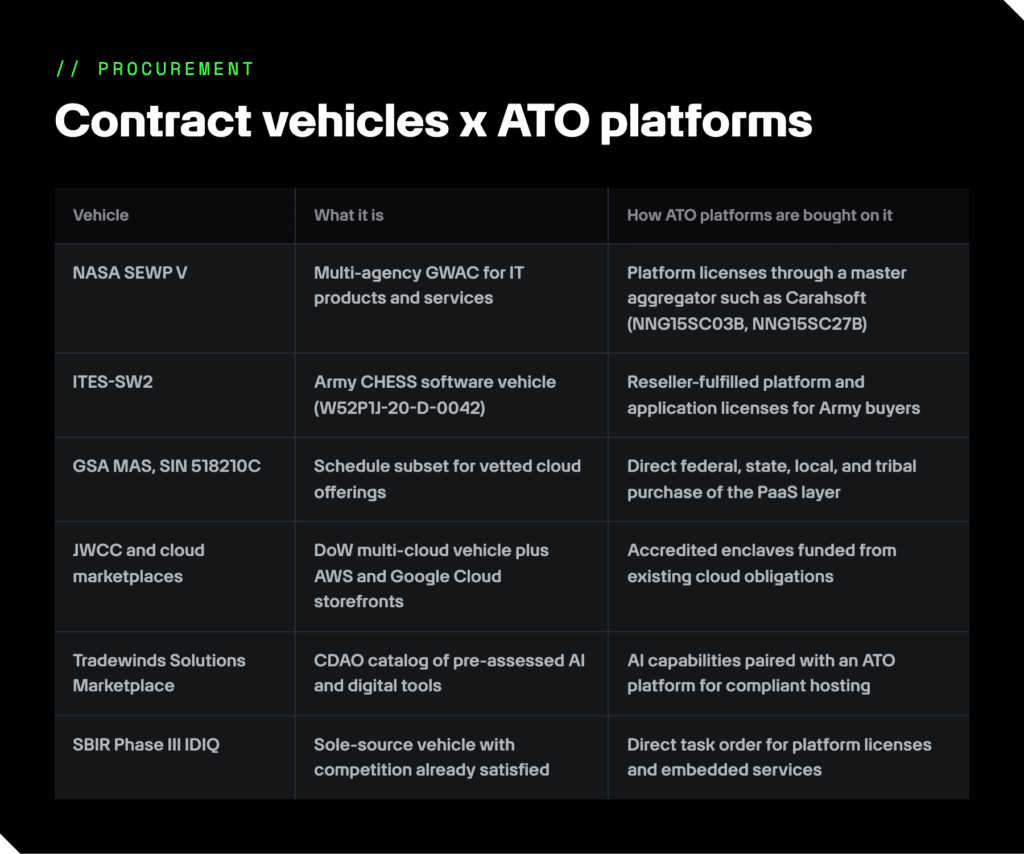
The vehicles: Government-Wide Acquisition Contracts (GWACs) like NASA SEWP V and ITES-SW2; GSA Multiple Award Schedule under cloud SIN 518210C; cloud marketplace listings that ride enterprise agreements such as JWCC; and SBIR Phase III IDIQs that require no new competition.
The mechanism: Master aggregators hold the underlying contracts and resell platform licenses, so a contracting officer buys an Authority to Operate (ATO) platform the same way they buy any other commercial cloud product or service.
The result: Procurement and accreditation stop being sequential. An agency issues a task order against a vehicle it already uses, and the application inherits the platform’s controls on arrival.
Which ATO platforms can be procured on existing government contract vehicles
The platforms an agency can buy without starting a new solicitation are the ones that have done the work twice: once to obtain accreditation, and once to get carried on the vehicles contracting officers already hold. Both halves are load-bearing. A platform with a Provisional Authorization but no reseller path forces an open-market competition that can outlast the requirement. A platform with a Multiple Award Schedule listing but shallow accreditation coverage gets bought quickly and then stalls at the Authorizing Official’s desk.
Second Front’s Game Warden serves as the worked example throughout, because its procurement footprint spans several mechanisms below.
Why the contract vehicle matters as much as the authorization
Under the Federal Acquisition Regulation (FAR) 12.212 and the Defense Federal Acquisition Regulation Supplement (DFARS) 227.7202, the government acquires commercial software under the license customarily offered to the public, so a standard commercial End User License Agreement governs use as long as its terms do not conflict with federal law. That sounds simple until the Anti-Deficiency Act enters the picture. Consumption-based cloud pricing is open-ended by design, and an agency cannot obligate funds it does not hold. Agencies solve this with fixed-price awards and Indefinite Delivery, Indefinite Quantity (IDIQ) structures that set a maximum consumption ceiling, usually placed through a broker or master aggregator rather than bought directly. The aggregator layer is not an intermediary tax, then. It is the mechanism that converts an elastic cloud service into a bounded, FAR-compliant line item.
The modular logic behind it predates the cloud. FAR Part 39, which codifies the Clinger-Cohen Act of 1996, directs agencies to break technology acquisitions into useful increments to compartmentalize risk. An ATO platform is that principle expressed as architecture: compute from a cloud service provider, the accredited platform layer from a reseller, the application on a third instrument, and none of the three welded to the others.
Dummies eBook
U.S. Government Software Authorization for Dummies
Government authorization doesn’t have to be a black box. Learn how it actually works.
GWACs and master aggregators: NASA SEWP V and ITES-SW2
GWACs are pre-competed, multi-agency vehicles that can carry federal ATO platform sales. NASA Solutions for Enterprise-Wide Procurement (SEWP) V (V1 anticipated go live November 1, 2026) is the workhorse, covering cloud hosting, Platform-as-a-Service (PaaS), and Developer Security Operations (DevSecOps) capability across the federal enterprise.
Access runs through master government aggregators. Carahsoft, for example, holds the underlying contracts and manages the reseller and integrator network beneath them, moving more than $10.3 billion in public-sector revenue in 2024 and representing close to two-thirds of all GovRAMP-authorized vendors. An agency buying an ATO platform license through Carahsoft’s SEWP V contracts (NNG15SC03B and NNG15SC27B) gets FAR compliance and fulfillment without generating a standalone contract.
The Army’s equivalent is Information Technology Enterprise Solutions Software 2 (ITES-SW2), managed by the Computer Hardware, Enterprise Software and Solutions program under contract W52P1J-20-D-0042. State and local buyers reach the same platforms through NASPO ValuePoint and OMNIA Partners.
GSA MAS and the cloud SIN 518210C
The GSA Multiple Award Schedule remains the default federal instrument, and within it, Special Item Number 518210C specifically covers cloud computing offerings. A platform listed under SIN 518210C has been vetted against the federal definition of cloud computing, including elasticity, broad network access, and resource pooling, which spares the contracting officer that determination. Once a platform is on Schedule, federal, state, local, and tribal buyers can all procure it with minimal administrative overhead. Aggregator-held MAS contracts such as 47QSWA18D008F extend the same reach to GovRAMP Authorized and FedRAMP Certified solutions.
Cloud marketplaces and enterprise agreements
The Joint Warfighting Cloud Capability (JWCC) is the Department of War multi-cloud vehicle, awarded in 2022 to AWS, Google Cloud, Microsoft Azure, and Oracle, which succeeded the single-vendor JEDI approach. It covers unclassified, Secret, and Top Secret workloads.
An ATO platform listed on AWS Marketplace or Google Cloud Marketplace becomes a line item accessible under that umbrella, allowing a program office to spin up an accredited enclave against cloud funds it has already obligated. The infrastructure and compliance layer arrive on the same invoice. Game Warden runs on AWS Marketplace for DoW JWCC, AWS Marketplace for the U.S. Intelligence Community (ICMP), Microsoft Marketplace via Carahsoft, and Google Cloud, which is also what makes an application inside its boundary portable between them without a fresh accreditation.
The DoW’s Chief Digital and Artificial Intelligence Office’s Tradewinds Solutions Marketplace works differently: a catalog of pre-assessed artificial intelligence and digital capabilities rather than a cloud storefront. AI vendors commonly pair a Tradewinds listing with an ATO platform so the capability is both discoverable and deployable. Find Second Front under ‘Streamlining Business Processes’ listings.
SBIR Phase III, the fastest path from requirement to task order
Every vehicle above still asks the agency to define requirements, request quotes, and evaluate responses. SBIR Phase III removes that step. Under 15 U.S.C. 638, the competition conducted during Phase I and Phase II satisfies the statutory competition requirement, so an agency can issue a sole-source Phase III award without a new solicitation, fresh market research, or a FAR Part 6 Justification and Approval. The contracting officer documents the derivation in a Memorandum for the Record instead.
Two features make it well suited to sustaining an accredited platform. Phase III accepts any color of money, so Operations and Maintenance and Procurement funds work as well as Research, Development, Test and Evaluation dollars, which matters for a subscription that runs for years. And it carries no ceiling on size, scope, or duration, so agencies can stand up large IDIQs or Blanket Purchase Agreements against it.
Second Front customer, Integrate, used a $25 million SBIR Phase III grant with Space Systems Command for funding and Game Warden for deployment, reaching IL5 on NIPR, IL6 on SIPR, and becoming the first real-time project management platform running on JWICS.
Read our SBIR cheat sheet to learn more.
Game Warden as the worked example
Game Warden is a fully managed DevSecOps PaaS for commercial applications, with CI/CD, observability, automated Software Bill of Materials (SBOM) generation, and policy-as-code guardrails. The stack relationship is worth stating plainly because it is routinely confused: your application is the cloud service offering, and Game Warden is the platform beneath it carrying the inherited controls. Continuous monitoring, database operations, logging, and incident response are the responsibility of the platform, not the software publisher.
Its accreditation coverage is what makes the vehicles above worth using. On the civilian side, it holds FedRAMP Class D (High) Certification. For defense workloads, Game Warden supports the full DoW IL spectrum, from IL2 through IL6, as well as Top Secret environments. The platform holds a DISA Provisional Authorization at IL5. Deploying within that boundary allows a commercial vendor to inherit the platform’s physical, environmental, and infrastructure controls rather than replicate them. That control inheritance is the difference between an accreditation timeline measured in months and one measured in years, and the cost mechanics are laid out in The accreditation dilemma: a TCO comparison of DIY vs PaaS FedRAMP Certification.
Sustainment Technologies is the cleanest demonstration that a vehicle alone is not enough. The company was awarded an SBIR Phase III contract in 2023 to bring its Enhanced Market Research product into production for the Air Force’s 448th Supply Chain Management Wing. Funding and contract vehicles were both in hand, but the software still could not be deployed because it lacked an IL2 ATO. Sustainment put ten people on a do-it-yourself accreditation and made no measurable progress for nine and a half months, which put the Phase III transition itself at risk. Moving to Game Warden reduced the compliance team from 10 to 3 and achieved IL2 accreditation in 58 days, ahead of a projected 12-month timeline. The full breakdown is in Mission Ready in 58 Days: Accelerating DoD Compliance for Defense Manufacturing.
The pattern repeats across vehicle types:
- Cohere paired inherited certification with Carahsoft listings on SEWP V, ITES-SW2, and NASPO ValuePoint.
- Unstructured combined IL5 readiness with SEWP V and ITES-SW2 availability, Phase III eligibility, and a Tradewinds listing.
- GovSignals added a GSA MAS listing and a Defense Innovation Unit Other Transaction agreement to its IL5 authorization.
In each case the platform answered the deployment question and the vehicle answered the purchase question, separately.
What to check before you shortlist a platform
- Which vehicles carry the platform, and confirm it by contract number rather than by a partnership announcement.
- How far the accreditation ceiling reaches, since a platform that stops at IL4 caps your addressable mission set no matter how easy it is to buy.
- Whether the accredited boundary moves across clouds, because a boundary tied to one cloud service provider re-opens the accreditation question the first time an agency changes infrastructure.
- What evidence the platform generates for you, because automated Body of Evidence (BoE) generation from the live runtime is what keeps a continuous authorization continuous instead of turning every release into a reaccreditation event.
Buying the platform is no longer the obstacle
The acquisition bottleneck has moved. A decade ago, running a full source selection for a secure software environment took administrative capacity that most program offices did not have. Today, a wing commander or a mid-level civilian director can identify a capability, put it on a vehicle their contracting shop already holds, and issue a task order in the time it used to take to draft the RFP. What has not moved is the accreditation gate. The vendors clearing that gate quickly treat accreditation as inherited infrastructure rather than a project to run, and vehicle coverage as part of the product rather than a sales afterthought.
Ready to line up your accreditation and your purchase path at the same time? Speak with our team to learn how Game Warden can place your application within an accredited boundary that agencies can already purchase.